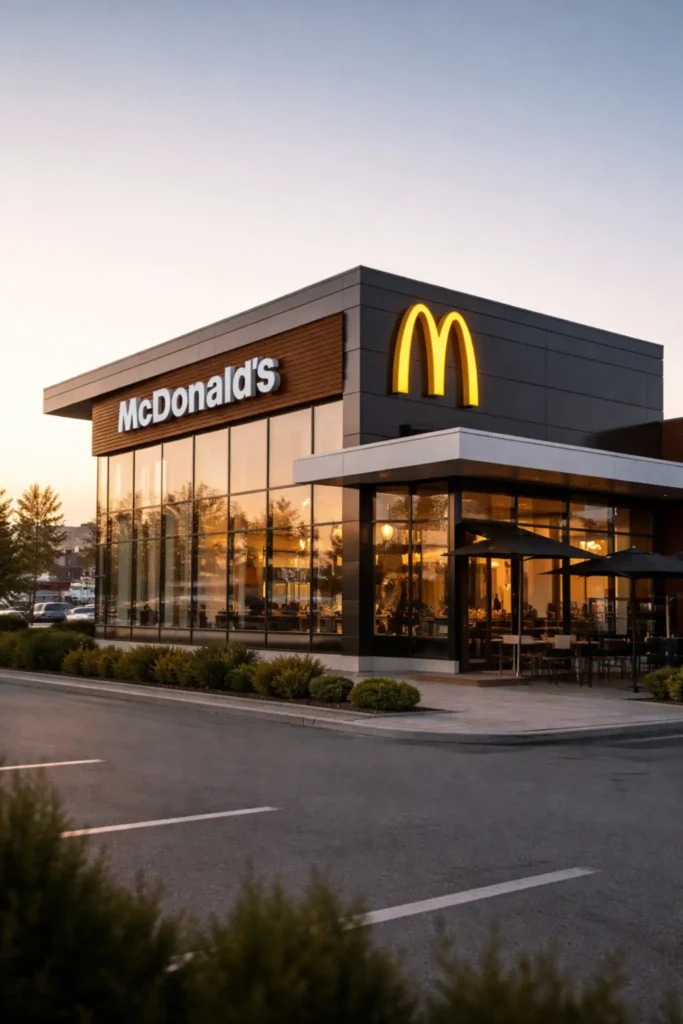

McDonald’s (MCD) is doubling down on affordability with a simplified $3 menu strategy, even as its stock has fallen 6.44% ahead of earnings and competition intensifies across the fast-food industry. The company’s new McValue platform, launching April 21, will feature 10 items priced under $3 — a move designed to win back budget-conscious customers after years of elevated food inflation.
The shift marks a clear reset. Instead of complex deals requiring additional purchases, McDonald’s is making pricing more transparent. Breakfast items like hash browns and Sausage McMuffins will headline the menu, while staples such as McDouble burgers and small fries will anchor daytime offerings. Notably, nearly half of the items are focused on breakfast, reflecting management’s push to rebuild morning traffic.
The strategy comes at a time when inflation has reshaped consumer behavior. Prices for food away from home surged 7% in 2023, followed by 4% in 2024 and 3.8% in 2025 — all above the historical average of around 3.5%. That sustained pressure has forced fast-food chains to rethink pricing as customers increasingly seek cheaper options.
McDonald’s is not alone. The fast-food price war is heating up rapidly. Taco Bell introduced a $3 Luxe Value Menu earlier this year with 10 items, while Panera launched its first value lineup at $4.99. Wendy’s revamped its offerings with $4, $6, and $8 bundled deals, and KFC added $5 bowls to attract cost-conscious diners. The result is a crowded battlefield where price, not just brand, is driving traffic.
Despite the competitive pressure, McDonald’s recent performance shows that value-focused strategies are gaining traction. The company reported global same-store sales growth of 5.7% in the fourth quarter, beating expectations of 3.9%. In the U.S., comparable sales rose 6.8%, supported by aggressive promotions, including $5 meal deals and discounted bundles offering up to 15% savings.
Still, cracks are emerging in industry demand. According to restaurant analytics data, U.S. fast-food traffic declined 2% during the last three months of 2025 and in January, before recovering slightly to under 1% growth in February. Rising fuel prices linked to geopolitical tensions have also begun weighing on discretionary spending, adding pressure on chains to maintain aggressive pricing.
For investors, the timing of McDonald’s new value push is critical. The stock recently closed around $307.29, down 1.13% in a single session and underperforming major indices like the S&P 500 and Nasdaq. Over a broader period, shares have declined 6.44%, reflecting cautious sentiment ahead of earnings.
Wall Street expectations remain moderately positive. Analysts are projecting quarterly earnings per share of $2.75, representing a 3% year-over-year increase, with revenue expected to reach $6.48 billion, up 8.84%. For the full year, consensus estimates call for EPS of $13.23 and revenue of $28.71 billion, implying growth of 8.44% and 6.78%, respectively.
However, valuation remains a concern. McDonald’s is currently trading at a forward P/E ratio of 23.49, significantly above the industry average of 18.82. Its PEG ratio of 2.77 also exceeds the sector average of 1.83, suggesting that growth expectations may already be priced in.
At the operational level, McDonald’s relies heavily on its franchise model, with approximately 95% of U.S. locations owned and operated by franchisees. While this structure provides flexibility in pricing, it also means that adoption of value initiatives depends on franchise-level execution. Early feedback suggests strong support, with operators expecting simpler menus to reduce customer confusion and speed up ordering.
Executives have emphasized that “value matters more than ever,” particularly for lower-income households earning under $45,000 — a segment McDonald’s has been actively trying to win back. Previous promotions, including the return of Snack Wraps at $2.99 and limited-time campaigns like themed meals, have helped improve brand perception and drive traffic.
Yet, analysts warn that relying too heavily on discounts carries long-term risks. As more chains position themselves around value, the concept itself may lose impact. Consumers may begin to expect permanent low pricing, making it harder for companies to maintain margins or upsell premium items.
That puts McDonald’s in a delicate balancing act: offering compelling value while continuing to push higher-margin products like specialty burgers and beverages. The company is also exploring new categories, including energy drinks and McCafe refreshers, as it looks to diversify revenue streams beyond traditional menu items.
For now, the $3 menu represents a clear and calculated move. It simplifies the message, aligns with consumer expectations, and positions McDonald’s competitively in an increasingly price-driven market. Whether it translates into sustained traffic growth — and ultimately supports the stock — will be closely watched in the coming quarters.
External reference: McDonald’s stock analysis and estimates