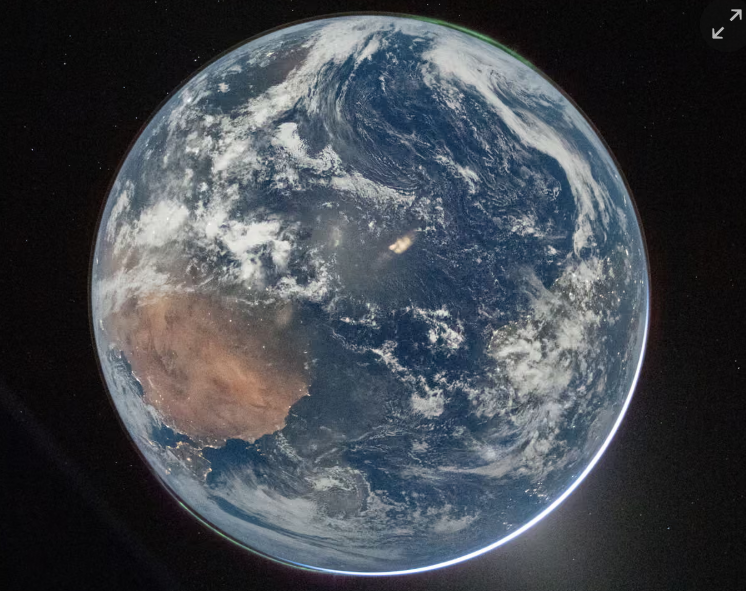

NASA’s Artemis II mission is rapidly becoming one of the most closely watched space events in decades, as astronauts traveling more than 150,000 miles from Earth have now released the first images of the planet from deep space. The visuals, transmitted from the Orion spacecraft on Day 3 of the mission, show Earth as a glowing blue sphere suspended in darkness — a view not captured by humans since the Apollo era.
The four-member crew — Reid Wiseman, Victor Glover, Christina Koch, and Canadian Space Agency astronaut Jeremy Hansen — launched earlier this week from Kennedy Space Center and are now en route to loop around the Moon. NASA confirmed the spacecraft has traveled over 150,000 miles (245,000 km), placing the astronauts closer to the Moon than to Earth, a critical milestone in the mission timeline.
The newly released images include a curved slice of Earth framed through Orion’s window and a full view of the planet, where swirling white clouds stretch across oceans and faint green auroras shimmer near the poles. For NASA, the moment represents not just a technical success, but a symbolic return to human deep-space exploration after more than 50 years.
Historic mission pushes beyond Apollo-era limits
Artemis II is the first crewed lunar mission since Apollo 17 in 1972, marking a generational shift in how humans approach space exploration. Unlike Apollo missions that aimed for lunar landings, this mission is designed as a high-stakes test flight, validating the Orion spacecraft and Space Launch System before astronauts attempt to land on the Moon later this decade.
The crew is following a “free-return trajectory,” a path that uses the Moon’s gravity to swing the spacecraft around its far side before returning to Earth. This approach ensures that even in the event of major system failures, the spacecraft would naturally loop back home without requiring complex maneuvers.
NASA has confirmed that Orion will travel approximately 4,000 miles beyond the Moon before turning back, potentially setting a new record for the farthest distance humans have ever traveled from Earth — surpassing the Apollo 13 crew.
As the spacecraft continues its journey, astronauts have begun witnessing the Moon from a perspective few humans have ever experienced. Christina Koch described the view as unfamiliar and striking, noting that the far side of the Moon appears dramatically different from the familiar face seen from Earth.
“Something about you senses that is not the Moon that I’m used to seeing,” she said during a mission update.
More than images: why this moment matters
The release of these images comes at a pivotal time for NASA’s Artemis program, which aims to establish a sustained human presence on the Moon and eventually use it as a staging ground for missions to Mars. The program has faced years of delays and cost overruns, but Artemis II is now seen as a crucial turning point.
The visuals themselves carry deeper significance. From more than 150,000 miles away, Earth appears borderless and fragile — a perspective that astronauts often describe as transformative. Victor Glover reflected on this during a live communication, saying the planet looks unified from space, reinforcing the idea that humanity shares a single home.
Beyond symbolism, the mission also demonstrates advancements in spacecraft systems, deep-space navigation, and life-support technologies. However, it has not been entirely without challenges.
NASA engineers have been working to resolve a malfunction in Orion’s onboard toilet system, which has struggled due to what is believed to be ice blocking part of the waste line. Until a fix is confirmed, astronauts have relied on backup urine collection systems, highlighting the practical realities of long-duration spaceflight.
Mission controllers have attempted to resolve the issue by reorienting the spacecraft toward the Sun, using heat to melt the blockage. While minor in the broader scope of the mission, the problem underscores the importance of reliable life-support systems for future missions that may last months or even years.
Inside the spacecraft, daily life continues with carefully planned routines. The crew follows a strict schedule that includes exercise using onboard equipment to counter muscle and bone loss in microgravity. Meals are also specially designed, consisting of shelf-stable foods such as tortillas, vegetable quiche, and barbecued beef brisket, as there is no refrigeration onboard.
The mission is also notable for its diverse crew, including the first woman, the first person of color, and the first non-American astronaut to participate in a lunar mission. This reflects NASA’s broader effort to reshape the narrative of space exploration for a new generation.
As Orion approaches the Moon, the crew is expected to swing behind it in the coming days, temporarily losing communication with Earth — a moment that will test both technology and nerves. When they re-emerge, they will begin their return journey, completing a mission that could redefine the future of human spaceflight.
More details about the Artemis program and its long-term goals can be found on NASA’s official Artemis page, which outlines plans for future lunar landings and deeper space exploration.
For now, the images arriving from Artemis II offer a rare reminder of humanity’s place in the universe — distant, unified, and once again reaching toward the Moon.

Make Swikblog your go-to source on Google for reliable updates, smart insights, and daily trends.