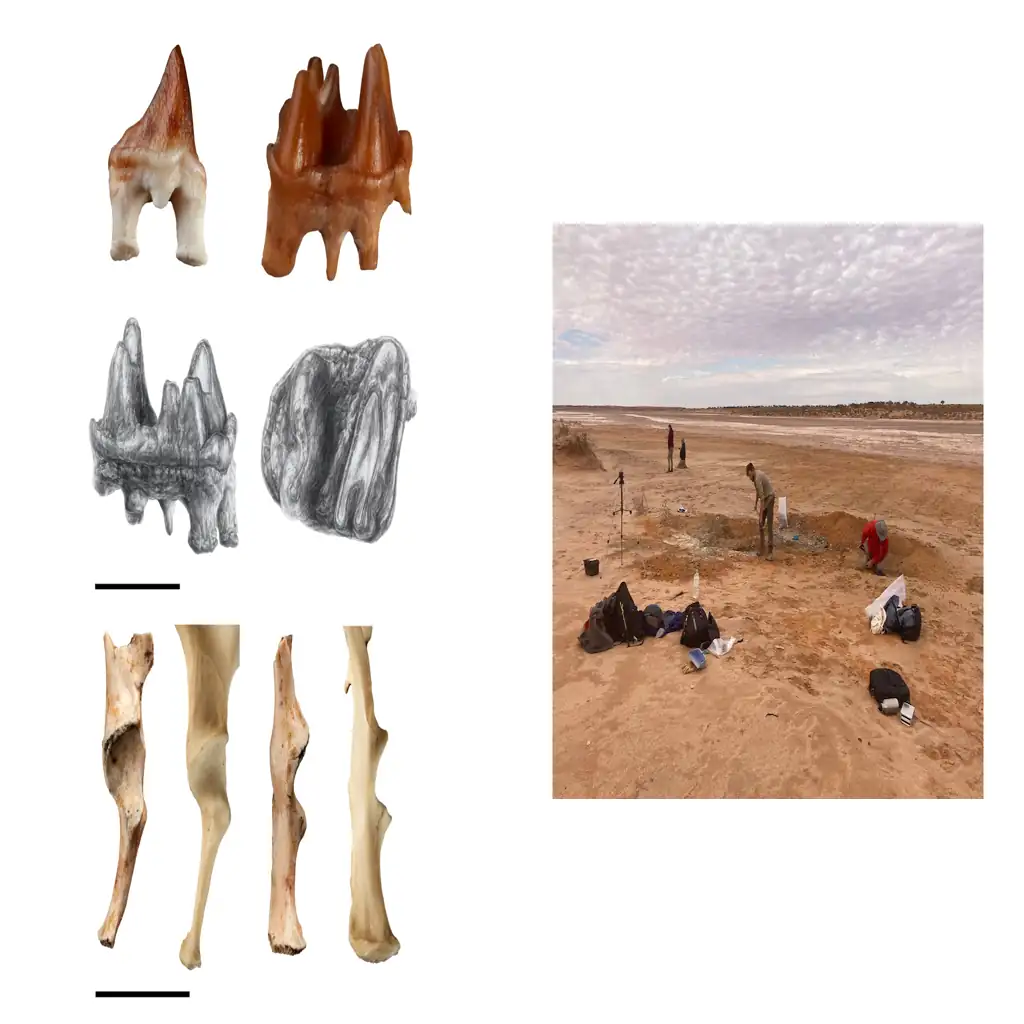

A few tiny fossils from the South Australian outback are giving scientists a bigger story about one of the world’s most unusual mammals. Newly studied remains of an ancient platypus show that its distant relatives once carried well-developed teeth, strong enough to crush hard-shelled prey in waterways that existed long before the region became dry and desert-like.
The discovery relates to Obdurodon insignis, an extinct platypus species that lived around 25 million years ago. Unlike the modern adult platypus, which loses its teeth early in life and uses rough pads to grind food, this prehistoric animal had molars and premolars that reveal a far more forceful feeding style.
Researchers have been studying fossil beds at Frome Downs Station, about 425 kilometres north of Adelaide, for many years. The site has produced huge numbers of ancient fish bones and more than 1,000 non-fish vertebrate fossils, but platypus remains are exceptionally rare. Only a small number of fossils from the toothed species have been found, making the latest evidence especially valuable.
Ancient platypus teeth reveal a harder diet
The most striking part of the discovery is the dental evidence. Earlier fossil finds had already shown that some ancient platypuses had teeth, but the newly described material pushes that evidence deeper into the past. It suggests toothed platypuses had developed complex chewing equipment at least 25 million years ago, around 8 million years earlier than some previous evidence had clearly shown.
The teeth tell a practical story. Large back molars would have helped the animal break down tough prey, while pointed premolars near the front of the jaw may have helped grip or pierce food. That means this ancient platypus was likely eating crunchy freshwater animals such as crayfish, clams and molluscs.
Modern platypuses feed differently. They hunt underwater for insect larvae, worms, shrimp and small crustaceans, storing prey in cheek pouches before grinding it with hard pads instead of teeth. The contrast shows how one evolutionary line can keep the same broad lifestyle while changing important details of how it feeds.
That is why the fossil teeth matter. They are not just small fragments of bone; they are evidence of behaviour. From them, scientists can infer what the animal ate, how it processed food and what kind of ecosystem supported it.
A lost wetland world beneath today’s outback
The landscape where these fossils were found is dry today, but 25 million years ago it was very different. Instead of open arid country, the region likely supported forests, rivers, lakes and wetlands. Ancient lungfish, water birds and even freshwater dolphins are believed to have lived in the same broader environment.
This setting changes how the platypus should be imagined. It was not an isolated oddity in a barren landscape. It was part of a rich freshwater ecosystem, using its body and teeth to survive among many other aquatic animals.
One of the fossils also includes part of a scapulocoracoid, a shoulder bone linked to the front limb. That detail gives researchers another clue: the ancient platypus appears to have had a forelimb structure very similar to the living species. In simple terms, it was probably already an efficient swimmer.
This makes the find even more interesting. The teeth show change, but the shoulder bone shows continuity. Across millions of years, the platypus lineage seems to have retained its strong swimming design while later losing adult teeth and shifting its feeding tools.
The research has been published in Australian Zoologist, adding new scientific detail to the fossil record of monotremes, the rare group of egg-laying mammals that includes the platypus and echidnas.
For readers who follow unusual science discoveries and natural history updates, Swikblog continues to track stories that show how new research can change what we know about ancient life on Earth.
The discovery also highlights why fossil sites in Australia remain so important. The continent has preserved evidence of animals that do not fit neatly into common ideas of mammal evolution. The platypus is a perfect example: it lays eggs, produces milk, senses electrical signals from prey and moves through water with remarkable efficiency.
Finding a toothed ancestor deepens that story. It shows that the modern platypus is not simply strange because it is unusual today. It is strange because it carries a long evolutionary history shaped by vanished rivers, changing climates and adaptations that stretch back tens of millions of years.
The rarity of the fossils adds to their importance. When only a few remains exist, each tooth or bone can shift scientific understanding. A single premolar can reveal diet. A shoulder bone can hint at swimming ability. Together, they build a clearer image of an animal that once thrived in a world that no longer exists.
In the end, the South Australian fossils offer more than a headline about a platypus with teeth. They show how evolution works in layers. Some features disappear, others remain, and the body of a living animal can still carry echoes of environments lost millions of years ago.
The modern platypus may be toothless as an adult, but its ancient relatives had a much stronger bite. Thanks to these rare fossils, scientists now have a better view of how one of nature’s most distinctive mammals survived, adapted and kept swimming through deep time.
You may like: Real Kraken? 19-Metre Giant Octopus Apex Predator

Make Swikblog your go-to source on Google for reliable updates, smart insights, and daily trends.