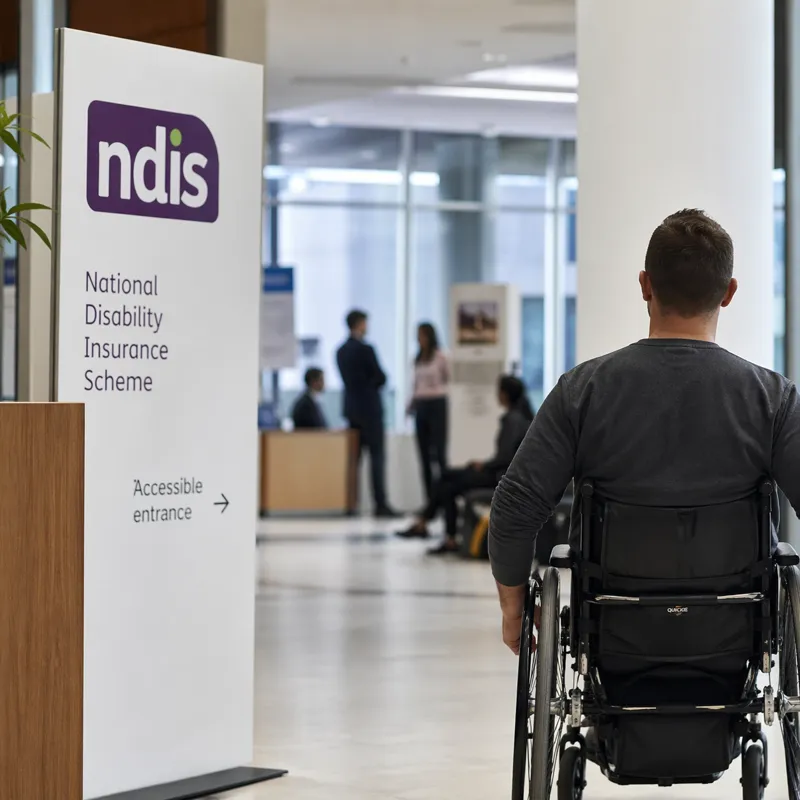

The National Disability Insurance Scheme is heading toward a major policy reset, with the federal government proposing a new access model that could substantially reduce the number of Australians eligible for support over the next several years. The reform package, outlined by Health and NDIS Minister Mark Butler, is being framed as an attempt to slow the cost growth of one of the country’s largest and most closely watched social programs. But for participants, carers and providers, the debate is about far more than budget discipline. It is about who qualifies for support, how need is measured, and what happens when a person falls outside the system.
At the centre of the proposed overhaul is a striking number: about 160,000 people could be moved out of the NDIS under the government’s initial modelling. That shift would not only reduce participation from the current level of roughly 760,000 people to around 600,000 by the end of the decade, but also leave the scheme with about 300,000 fewer participants than earlier forecasts had projected for the same period. It is, in effect, a redesign of the scheme’s future footprint.
The government says the reason is straightforward. The NDIS currently costs about $50 billion and, on its existing path, is forecast to reach around $70 billion by the end of the decade. Butler has argued that such a trajectory is unsustainable, and that the reform package would instead bring that figure closer to $55 billion. In political terms, the message is clear: the government wants to show it can preserve the NDIS without allowing spending to accelerate unchecked ahead of future budgets.
Why the eligibility test is changing
The most consequential change is the move away from a model where diagnosis plays the dominant role in determining access. Instead of relying on diagnosis alone, the government wants “standardised” assessments to focus on a person’s functional capacity. That means future decisions would turn more heavily on how much support someone needs in daily life, rather than whether they have a particular diagnosis on paper.
This is a significant philosophical shift. Under Butler’s approach, no single diagnosis category would automatically be treated more harshly or more generously than another. The real dividing line would be support need. People judged to have lower support needs or higher functional capacity would be more likely to miss out on the scheme or be moved out of it. Supporters of the change will argue that this creates a more uniform and targeted system. Critics will say it risks overlooking people whose conditions are real, long-term and disabling, but not always easily captured by a standardised test.
That tension is likely to define the public response. For many families, the NDIS is not simply a funding mechanism; it is the structure that makes therapy, mobility, community access and routine possible. A tighter access test may reduce costs, but it also raises questions about where people with genuine but lower-intensity needs are expected to go if they no longer qualify.
More than access rules are being tightened
The overhaul goes beyond eligibility. Butler has also flagged a clampdown on the cost of social and community participation supports, an area of spending he said reached $12 billion this year. The government wants to reset the total cost of those supports back to where they were last year and prevent further rapid growth. That is a meaningful intervention because this category has become one of the most visible and contested parts of NDIS spending.
Importantly, Butler has already acknowledged that this will have a “material impact” on participant plans. That wording matters. It signals that even people who remain in the scheme could see their plans reshaped under the new cost-control approach. For some participants, social and community participation supports are not optional extras. They are tied to independence, social engagement, confidence and day-to-day quality of life. Any tightening in this area will be felt well beyond administrative paperwork.
The government is also pushing to expand mandatory provider registration, with the expectation that 90 per cent of NDIS payments would flow through registered providers. That measure is likely aimed at improving oversight, lifting quality standards and reducing misuse of funds. Alongside that, there will be a stronger effort to limit unscheduled reassessments of plans, which have added cost and instability to the system over time. Taken together, these measures show the government is not just narrowing entry into the scheme; it is trying to exert greater control over how the entire system operates.
The larger political and social question
Butler’s argument is that the NDIS is at risk if growth is not brought under control. He has warned that the scheme costs too much, is expanding too quickly and needs to be returned to a more sustainable path, with spending growth averaging about 2 per cent each year over the forward estimates before moving back to 5 per cent growth from 2030. In that sense, Labor is presenting the reforms as an act of preservation rather than retreat.
Still, that case will face intense scrutiny. Disability policy is never just about total expenditure. It is also about the supports available outside the NDIS for those who do not qualify. If thousands of Australians are shifted out of the scheme, pressure will inevitably fall on mainstream health services, carers, community programs and state-based systems. Unless those alternatives are strengthened in parallel, the reform could simply move strain from one part of the support network to another.
That is why the details of the new test will matter far more than the headline alone. The government has made clear the broad direction of travel, but the exact eligibility rules are yet to be finalised. Until those details are known, uncertainty will remain high for current participants, future applicants and providers trying to plan for the years ahead.
Readers looking for the current framework can review the official NDIS eligibility criteria.
What happens next will shape not only the size of the NDIS, but also the public understanding of what the scheme is ultimately meant to do. The government says it is trying to protect the program from failing under its own weight. Opponents will argue that the real test is whether vulnerable Australians continue to receive the support they need when the rules become tougher. That is the question that will sit at the heart of this overhaul as the debate moves closer to budget season.

Make Swikblog your go-to source on Google for reliable updates, smart insights, and daily trends.