
KATHMANDU, Nepal — Rescue teams have found more survivors alive days after catastrophic flooding devastated parts of Nepal, renewing hopes for people still missing around flood-hit communities and hydropower projects.
A woman identified as Chandika Kumari Shrestha was rescued alive from the upper floor of her flood-damaged home in Betrawati, Nuwakot district. Rescue footage showed personnel giving her water before she was moved for medical treatment.
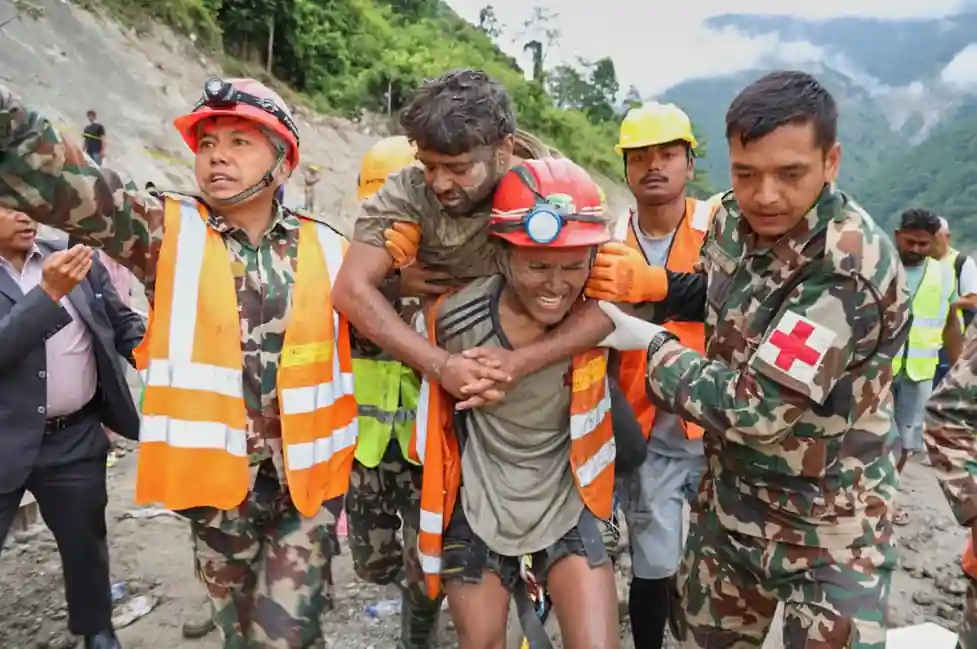
In a separate operation, Chinese national Lu Haitao was brought out alive from a tunnel at the Upper Trishuli-1 Hydropower Project. Rescuers reached him about 225 metres inside the tunnel. The discoveries came after two Nepali hydropower workers were rescued alive from Trishuli 3A on September 4.
Watch Video
In a major rescue, a survivor is taken out of Trishuli 3A project, after Nepal Floods by rescue teams: pic.twitter.com/SmkJyrOxLA
— Sidhant Sibal (@sidhant) September 4, 2026
BREAKING: Nine days after the devastating Bhote Koshi flash flood, one person has been rescued alive from inside the tunnel at the Upper Trishuli 3A Hydropower Project. Rescuers had earlier confirmed hearing voices of more than one person trapped inside. Rescue efforts remain… pic.twitter.com/ZYL0xBf7sN
— Everest Today (@EverestToday) September 4, 2026
Two Trishuli 3A workers rescued alive
On September 4, rescuers brought Sanjay Sah and Kabir Maharjan out alive after they had been trapped since the August 26 disaster. The men, described as a mechanical foreman and mechanical supervisor, were taken to hospital in Kathmandu.
Rescue teams reached the workers deep inside the Trishuli 3A underground complex after clearing blocked access routes. Footage showed one survivor covered in mud as personnel carried him from the site.
The breakthrough followed reports that rescuers had heard responses from people underground. The successful extraction strengthened hopes that pockets of survivable space could remain elsewhere in the tunnel network.
Radio Nepal, the country’s public broadcaster, has been providing updates on the continuing search and rescue operation.
How did workers survive underground?
The full accounts of the survivors are still emerging. Rescue teams had worked to maintain airflow into blocked sections while engineers studied underground layouts to identify possible safe spaces and alternative access points.
Air pockets inside sections that were not completely submerged may have helped some trapped workers survive. The latest rescues show why crews are continuing to search areas that initially appeared inaccessible.
Why has the rescue operation been difficult?
Floodwaters buried entrances beneath mud, rocks, damaged structures and twisted metal. Heavy equipment has been needed to clear debris, while damaged roads have complicated the movement of machinery and replacement parts.
Engineers have used hydropower plans and tunnel drawings to map routes hidden beneath the destruction. Nepali security personnel have worked alongside technicians and international specialists during the operation.
Flood disasters can make emergency access especially difficult when roads and infrastructure are damaged. Similar challenges emerged during the Grand Canyon flash flood that left people missing and forced evacuations.
Hundreds of hydropower workers remain missing
The emergency extends beyond a single tunnel. Authorities say around 900 workers from 12 hydropower projects remain missing, with roughly 500 feared trapped underground.
Rescue personnel are continuing to work through affected sites while trying to determine where workers were located when the flooding struck. The disaster has also severely damaged power and transport infrastructure.
Extreme weather has disrupted communities and infrastructure elsewhere in Asia this year, including Typhoon Dolphin’s flooding and evacuations in China.
What caused the Nepal floods?
The August 26 disaster is believed to have been triggered by a glacier collapse in the Himalayan region near the Nepal-Tibet border, sending a destructive surge of water, ice, rock and debris through valleys below. Investigations into the precise sequence of events are continuing.
More than 1,300 people have been reported dead, while thousands remain missing. The scale of the disaster has brought rescue teams from Nepal and international partners into some of the country’s hardest-hit areas.
El Niño 2027 Warning: Record Global Heat and Extreme Weather Risks Rise
Search teams continue looking for survivors
The September 5 rescues have given search teams new reason to continue working through blocked tunnels and collapsed structures. Operations remain focused on locating missing people while survivors receive medical care and engineers assess damaged hydropower facilities.
With people found alive long after the initial flooding, rescuers are continuing to treat accessible underground spaces and debris zones as potential survival locations rather than assuming everyone still missing has been lost.

Make Swikblog your go-to source on Google for reliable updates, smart insights, and daily trends.