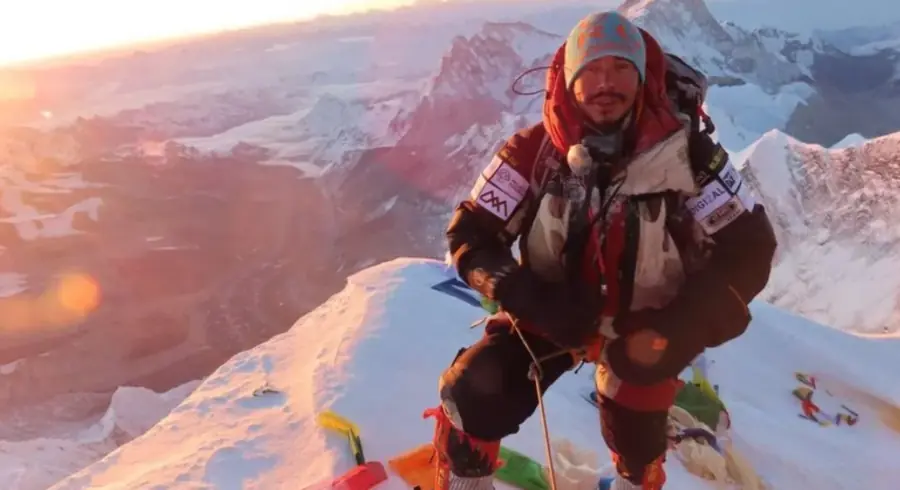

British-Nepali mountaineer Nirmal “Nims” Purja was among 10 climbers killed in an avalanche on Pakistan’s Broad Peak, according to his company and Nepal’s prime minister.
The avalanche struck the multinational expedition on Thursday, July 30, 2026, high on the 8,047-metre mountain in the Karakoram range. Purja, 43, was leading the group when communication with its members ended.
Elite Expeditions confirmed Purja’s death on Saturday, August 1. Nepalese Prime Minister Balendra Shah said the victims comprised six Nepalese and four foreign climbers.
Pakistani officials said the bodies of American climber Mallory Geis, Omani mountaineer Nadhira Ahmed Abdullah Al Harthy and Nepalese guide Pur Bahadur Gurung, known as Yukta, had been recovered.
How was Nirmal Purja’s death confirmed?
Elite Expeditions, the mountaineering company co-founded by Purja, announced that he had died following the avalanche. It also named Gurung and Nima Sherpa among the Nepalese climbing partners who lost their lives.
The confirmation replaced earlier reports that described Purja as missing. His GPS device recorded a sudden loss of altitude before later appearing to change position, briefly creating hope that he could be alive.
Trackers buried under snow can produce unreliable location readings. A device may also become separated from its owner during a large avalanche, meaning movement alone cannot confirm survival.
What happened on Broad Peak?
Available tracking information placed the expedition between Camp 2 and Camp 3 when the slide occurred at an altitude of about 6,600 metres. The team was climbing through the mountain’s main west-facing route.
Heavy snowfall had affected the area before the accident. Some other expeditions had reportedly left because recently accumulated snow needed time to settle or slide naturally.
Broad Peak is the world’s 12th-highest mountain and stands near K2 in northern Pakistan. Its exposed slopes, rapidly changing weather and extreme altitude make both climbing and rescue operations dangerous.
Who were the identified victims?
Al Harthy became the first Omani woman to summit Mount Everest in 2019. She later climbed K2 and Manaslu while pursuing the world’s 14 mountains above 8,000 metres.
Geis, a 39-year-old from San Antonio, Texas, had closed her Pilates studio to focus on mountaineering. Broad Peak was expected to be her first attempt on an 8,000-metre summit.
Gurung was an experienced high-altitude guide who worked closely with Purja. The expedition also included climbers from Pakistan and China, but a complete formally identified list had not been released when recovery work resumed.
Why do the recovery totals differ?
The confirmed death toll and the number of recovered bodies describe different stages of the operation. Authorities may establish that a climber has died before rescue teams can safely reach and retrieve the body.
Naila Kiani, a spokesperson for the Alpine Club of Pakistan, told the BBC that rescuers had seen bodies they had not yet reached. She said the organisation would formally announce individual deaths following recovery.
Pakistan Army helicopters, drones and specialist ground teams have taken part in the mission. Thin air reduces helicopter performance, while wind, cloud and unstable snow can prevent a safe approach.
Comparable hazards affected the Sierra Nevada avalanche operation near Lake Tahoe, where the threat of further snow movement placed search teams at risk.
What did Purja write before the climb?
In his final social media post, Purja said Broad Peak was not part of his original Pakistan itinerary. He had initially planned to climb Gasherbrum II, which he completed without supplementary oxygen before turning his attention to Broad Peak.
He wrote that completing another summit would move him closer to his latest high-altitude goal. Purja said he took no mountain for granted and asked Broad Peak for safe passage to the summit and back.
Who was Nirmal Purja?
Purja was born in Nepal and later became a British citizen. He served in the British military for 16 years, including 10 years in special forces, and received an MBE in 2018 for his achievements in extreme mountaineering.
He gained international recognition in 2019 after climbing all 14 mountains above 8,000 metres in 189 days. His journey became the subject of the 2021 Netflix documentary 14 Peaks: Nothing Is Impossible.
Purja later joined nine other Nepalese mountaineers in completing the first winter ascent of K2 in January 2021. His career followed a Himalayan climbing history shaped by milestones such as Tenzing Norgay and Edmund Hillary’s first confirmed Everest ascent in 1953.
Purja lived in Hampshire, England, with his wife and their three-year-old daughter. His death has prompted tributes from mountaineers and expedition organisations around the world.
Why is the recovery operation difficult?
Climbers above 8,000 metres enter an area commonly called the death zone, where the limited oxygen prevents the human body from functioning normally for long periods.
Ground teams on Broad Peak must contend with extreme cold, hidden crevasses and the possibility of another avalanche. Rescuers must assess the stability of the snow before approaching any bodies observed from the air.
A report carrying the Elite Expeditions statement confirms Purja’s death while detailing the continuing recovery effort.
Read More
Everest Crowding Fears After Record 274 Climbers Reach Summit in One Day
‘Spider-Man of Yemen’ Dies After 400-Foot Fall Into Volcanic Crater
What happens next?
Pakistani teams will attempt to recover the remaining victims when weather and snow conditions permit. Nepal’s embassy in Islamabad and mountaineering organisations are coordinating with Pakistani authorities.
The reported toll stands at 10: six Nepalese and four foreign climbers. A complete list should be treated as final only after every identity has been formally released by the relevant authorities or expedition operators.

Make Swikblog your go-to source on Google for reliable updates, smart insights, and daily trends.