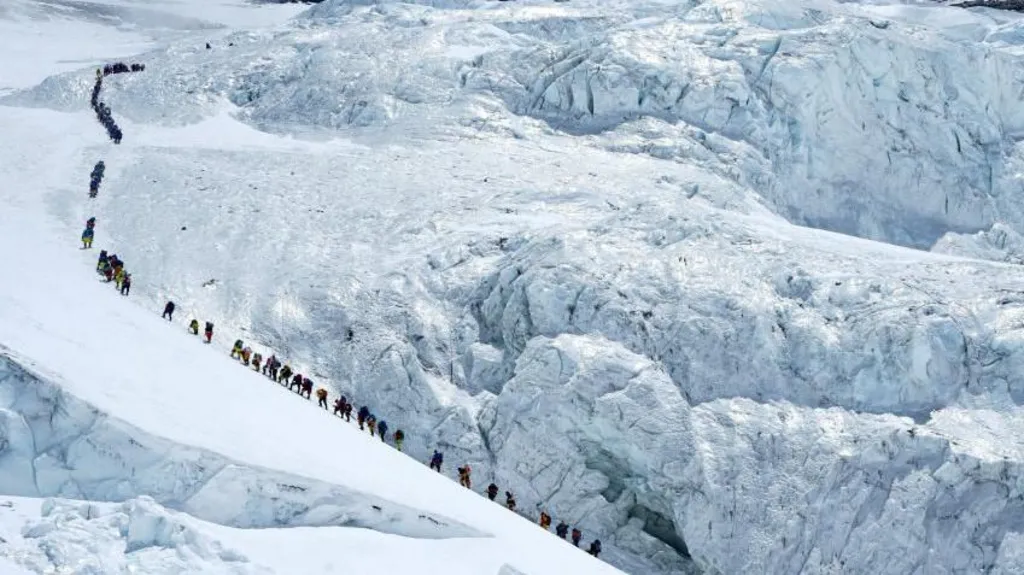

Mount Everest has produced another headline-grabbing record, but this one is less about glory and more about pressure. A record 274 climbers reached the summit from Nepal’s side in a single day, turning the world’s highest mountain into the centre of a fresh debate over crowding, commercial expeditions and safety in extreme altitude.
The summit rush came on Wednesday after teams finally got a favourable weather window following a delayed start to the spring climbing season. A large block of ice had earlier disrupted the route, forcing climbers and expedition operators to wait. Once conditions improved, hundreds moved upward almost at the same time.
Officials said the climbs began around 3 a.m. local time and continued for about 11 hours. The number surpassed the previous Nepal-side single-day record of 223 climbers, set on May 22, 2019. In that same 2019 season, 113 more climbers had also reached the summit from Tibet’s northern route, but China has not opened that side to foreign climbers this season, putting extra pressure on Nepal’s southern route.
Everest stands at 8,849 metres, or 29,032 feet, and the final stretch of the climb passes through the “death zone” above 8,000 metres. At that height, the human body begins to deteriorate quickly because natural oxygen is dangerously low. Most climbers depend on bottled oxygen, and even then, long waits near the summit can increase the risk of exhaustion, frostbite, altitude sickness and fatal delays.
The scale of demand is clear from this year’s permit numbers. Nepal has issued 494 Everest climbing permits for the season, according to AP News. Since most foreign climbers are accompanied by at least one Nepali guide, the real number of people moving through the route can be far higher than the permit count alone suggests.
The crowds have arrived despite a steep increase in climbing fees. Since September last year, foreign climbers have had to pay $15,000 for an Everest permit, up from the long-running $11,000 fee. The price rise has not slowed the appetite for Everest, showing how powerful the mountain remains for climbers, record seekers and commercial expedition companies.
Supporters of the expedition industry argue that traffic on Everest can be handled if teams are experienced, properly equipped and carry enough supplemental oxygen. Some operators also note that Nepal’s mountain tourism industry supports thousands of jobs, from guides and porters to hotels, transport workers and local businesses in the Khumbu region.
But the latest record also exposes the weakness of relying only on good weather and team discipline. When too many climbers chase the same short summit window, even a well-prepared expedition can be slowed by bottlenecks. On Everest, delay is not a small logistical problem; it can become a survival issue.
This season has also delivered major personal milestones. Kami Rita Sherpa, one of Nepal’s most respected high-altitude guides, reached the summit for the 32nd time, extending his own world record. Lhakpa Sherpa, known widely as the “Mountain Queen,” completed her 11th Everest summit, strengthening her record for the most ascents by a woman. Russian climber Rustam Nabiev, a double-leg amputee, also reached the top without using prosthetic legs.
Alongside those achievements, the season has carried a heavy human cost. Bijay Ghimere, reported as the first mountaineer from Nepal’s Dalit community to scale Everest, died after suffering altitude sickness. Phura Gyaljen Sherpa, a 21-year-old guide, died after slipping on snow and falling into a crevasse near Camp 3. Another guide, Lakpa Dendi Sherpa, died while heading toward Base Camp earlier in the season.
Read More
- Visit Swikblog Homepage
- Noosa Marathon road closures as 9,000 runners take part
- Ontario couple loses $90,000 in Scotiabank fraud case
- Olive Garden sister chain closes Capital Grille location
- Rob Base dies at 59: ‘It Takes Two’ legacy remembered
- Charlotte Truck Race postponed during Kyle Busch tribute weekend
The contrast is difficult to ignore. Everest continues to create historic records, but many of the risks are carried by Nepali guides and support workers who make commercial expeditions possible. Their role is often less visible than the summit photos, yet they are central to rope fixing, load carrying, route support and emergency response.
The debate now is not whether Everest should remain open. It is how Nepal can manage access without turning the mountain into a dangerous queue. Stricter experience requirements, better summit-day coordination, limits during narrow weather windows and stronger safety checks are likely to become louder demands after this record-breaking climb.
The pressure on Everest also fits into a wider mountain story. Glaciers, snow routes and high-altitude ecosystems are changing, while tourism demand keeps rising. Swikblog has covered this broader environmental concern in its report on International Mountain Day and the importance of glaciers.
For Nepal, Everest is both a national symbol and a major source of tourism income. For climbers, it remains one of the most powerful goals in adventure sport. But the record 274 summits in one day show that Everest’s biggest challenge may no longer be only the climb itself. It is whether the mountain can be managed safely as more people try to stand on top of the world at the same time.

Make Swikblog your go-to source on Google for reliable updates, smart insights, and daily trends.