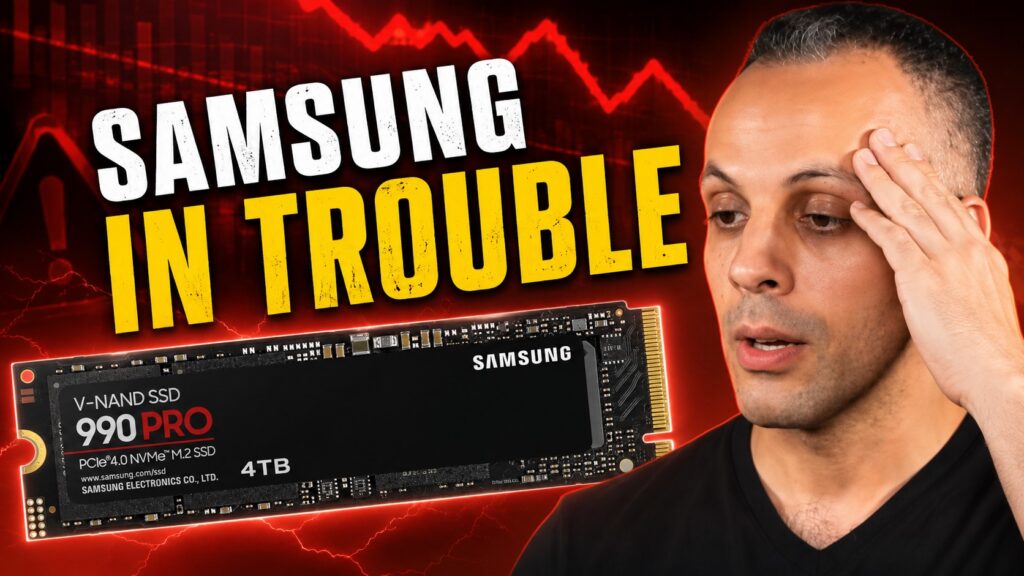

Louis Rossmann’s dispute with Samsung has turned a failed 4TB SSD into a wider test of warranty fairness, replacement inventory and what “current market value” really means when electronics prices surge.
The right-to-repair advocate says his Samsung 990 Pro 4TB SSD failed inside its five-year warranty period, yet Samsung returned the drive as “verified good” before later offering a $330 refund. Rossmann argues that offer falls short because the same model was reportedly selling for about $949 through Samsung’s own Amazon storefront.
The disagreement is now heading toward a legal fight in Texas, with Rossmann giving Samsung 60 days to resolve the claim before moving ahead in small claims court.
A Warranty Claim That Did Not End With a Replacement
Rossmann says the SSD was not pushed beyond normal limits. The 990 Pro 4TB was reportedly used in a RAID 1 setup, kept cool with a heatsink and active fans, and remained far below Samsung’s 2,400 TBW endurance rating.
After the drive began showing serious errors, Rossmann submitted diagnostic information to Samsung. According to his account, Samsung’s business support initially recognized signs pointing to a fatal controller or firmware-level failure.
That made the case appear straightforward: a premium SSD, still under warranty, showing failure symptoms that could justify replacement.
But once the drive reached Samsung’s service process, the result changed. Samsung returned the SSD with a repair statement saying it had passed testing and was “verified good.”
The Drive Still Failed in Rossmann’s Testing
Rossmann disputed Samsung’s finding after testing the returned SSD on professional data-recovery hardware. He claimed the drive continued to behave abnormally, with write speeds collapsing to roughly 40 MB/s to 60 MB/s before the SSD stopped responding properly.
For context, that level of performance is far below what buyers expect from a high-end PCIe 4.0 NVMe drive such as the Samsung 990 Pro. The issue, according to Rossmann, was not a minor benchmark dip but a pattern of instability that made the drive unreliable.
This detail is important because Samsung’s “verified good” result is now one of the most disputed parts of the story. If Rossmann’s testing is accurate, the case raises questions about how deeply warranty centers test intermittent SSD failures before closing a claim.
The $330 Refund Became the Flashpoint
After Rossmann challenged the service result, Samsung reportedly reopened the case but said it could not provide a replacement because of a broader shortage of memory products.
The company then offered a refund of about $330, matching the amount Rossmann originally paid at Best Buy.
Rossmann rejected that offer because the same Samsung 990 Pro 4TB was reportedly available at around $949. His argument is simple: a refund based on the old purchase price would not restore him to the position he was in before the failure, because buying the same replacement drive would cost nearly three times more.
That price gap is why the story has spread quickly across the PC hardware community. It is not just about one SSD. It is about whether a warranty refund should reflect what a customer paid years ago or what an equivalent replacement costs today.
Why the Warranty Wording Matters
The strongest part of Rossmann’s argument appears to be Samsung’s own warranty language. Samsung’s SSD warranty page says the company may repair, replace or refund the product depending on the circumstances. The disputed wording concerns a refund based on the product’s “then current market value” if Samsung cannot repair or replace it.
That phrase can work in a manufacturer’s favor when electronics lose value over time. But in a rising market, it can work the other way. If the current market value is higher than the original purchase price, a customer may argue that the refund should rise too.
Samsung’s official SSD warranty information is available through its Samsung Semiconductor warranty page.
The Bigger Question for Tech Buyers
This dispute could matter to anyone buying expensive computer hardware during a volatile market. SSDs, graphics cards, memory kits and AI-related components can move sharply in price when supply tightens.
If manufacturers can offer only the original purchase price during a warranty shortage, customers may be forced to spend significantly more to replace a product that failed while still covered. If courts side with a current-market-value interpretation, companies may face higher warranty costs when hardware prices spike.
There is also a retail-versus-warranty inventory question. Rossmann’s complaint is not only that Samsung cited shortage conditions, but that the same product appeared available for sale elsewhere at a much higher price. That creates a consumer-facing trust problem, even if companies internally separate sales stock from warranty replacement stock.
What Could Change After This Case
If the matter reaches court, the decision may turn on narrow warranty language rather than broad right-to-repair politics. A judge may need to examine whether Samsung’s offer satisfied the written warranty, whether the SSD was actually defective, and how market value should be measured.
Manufacturers may also be watching closely. If current-value refund language becomes costly during supply spikes, future warranties could be rewritten with clearer limits, depreciation schedules or replacement caps.
For consumers, the lesson is practical: keep purchase receipts, save diagnostic logs, document warranty communications and compare refund offers against the real cost of an equivalent replacement.
The case also fits into a broader technology-market pattern, where memory supply, semiconductor demand and premium hardware pricing are increasingly tied together. Swikblog has covered that wider pressure in the chip industry, including Samsung’s rise during the AI chip boom.
Read More
For now, Samsung has not publicly issued a detailed response addressing every claim Rossmann has made. No court has ruled on the dispute, and the final outcome remains uncertain.
Still, the controversy has already done one thing: it has turned a failed SSD into a sharp reminder that warranty fine print can become very expensive when the market moves against the customer.

Make Swikblog your go-to source on Google for reliable updates, smart insights, and daily trends.