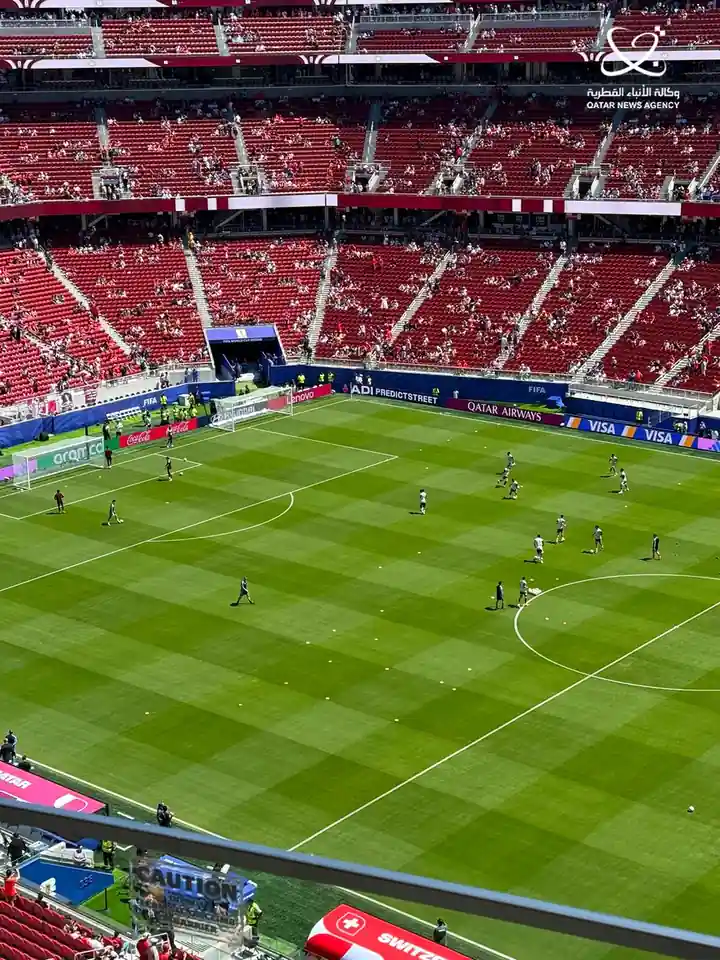

Switzerland’s penalty against Qatar became an early flashpoint after Breel Embolo converted from the spot to make it Qatar 0-1 Switzerland. The decision was not just about the final kick. The key moment came in the buildup, when Remo Freuler attacked a knock-down from Embolo and was brought down by Qatar goalkeeper Mahmoud Abunada inside the penalty area.
The referee awarded the penalty after the collision, but the decision still required a longer check because there was a possible offside question against Freuler before the contact. VAR reviewed the buildup, the offside check did not cancel the decision, and Embolo scored with a composed right-footed penalty into the bottom-left corner.
Poll question: Was Switzerland’s penalty against Qatar the correct decision after the Abunada-Freuler collision and VAR offside check?
Switzerland receive a penalty despite being clearly offside. 🚨🇨🇭 pic.twitter.com/aPbs4wtGBO
— World Cup HQ (@WorldCup26HQ) June 13, 2026
[yop_poll id=”9″]
Penalty decision: technical breakdown
The incident has two separate decision points. First, whether Abunada’s contact on Freuler was enough for a penalty. Second, whether Freuler was legally onside when he moved onto Embolo’s knock-down before the goalkeeper challenge.
Under the official IFAB penalty law, a penalty is awarded when a player commits a direct-free-kick offence inside their own penalty area. In this case, the technical question is whether the goalkeeper’s challenge stopped Freuler without cleanly playing the ball.
Decision check 1: Did Freuler receive Embolo’s knock-down from an onside position?
Decision check 2: Was Freuler active in play before the goalkeeper contact?
Decision check 3: Did Abunada make clear contact with Freuler inside the box?
Decision check 4: Did the goalkeeper play the ball before taking the player?
Decision check 5: Was the contact strong enough to stop a clear attacking action?
If Freuler was onside and Abunada made contact without winning the ball, the penalty decision is technically supportable. Goalkeepers are allowed to challenge for the ball, but they are still judged like any other player if they arrive late, miss the ball, or bring down an opponent inside the area.
The offside review is the part that made the decision more controversial. If Freuler had moved too early beyond the last defender before Embolo’s knock-down, the penalty should not have stood because the attacking phase would have been cancelled before the foul. VAR allowed play to stand, which means the review did not find enough evidence to overturn the on-field decision.
Why the call is still debatable
The argument for the penalty is straightforward: Freuler attacked the loose ball, Abunada came out, contact occurred inside the area, and the goalkeeper did not appear to prevent the collision cleanly. That makes the penalty a defensible decision if the offside line was cleared by VAR.
The argument against the penalty focuses on the buildup and the level of contact. Some viewers may see the goalkeeper’s challenge as a natural attempt to close the angle rather than a careless foul. Others may feel the offside phase needed a clearer public angle before accepting the decision.
The strongest technical reading is that this was a two-stage VAR decision: first the possible offside, then the goalkeeper contact. Once the offside check did not overturn the play, the foul threshold became the decisive issue.
Embolo’s finish was not in doubt. The wider debate is whether the referee and VAR team were right to let the penalty stand after the Abunada-Freuler collision.
Vote in the poll and decide whether the Qatar vs Switzerland penalty was correct, soft, or should have been overturned for offside in the buildup.

Make Swikblog your go-to source on Google for reliable updates, smart insights, and daily trends.