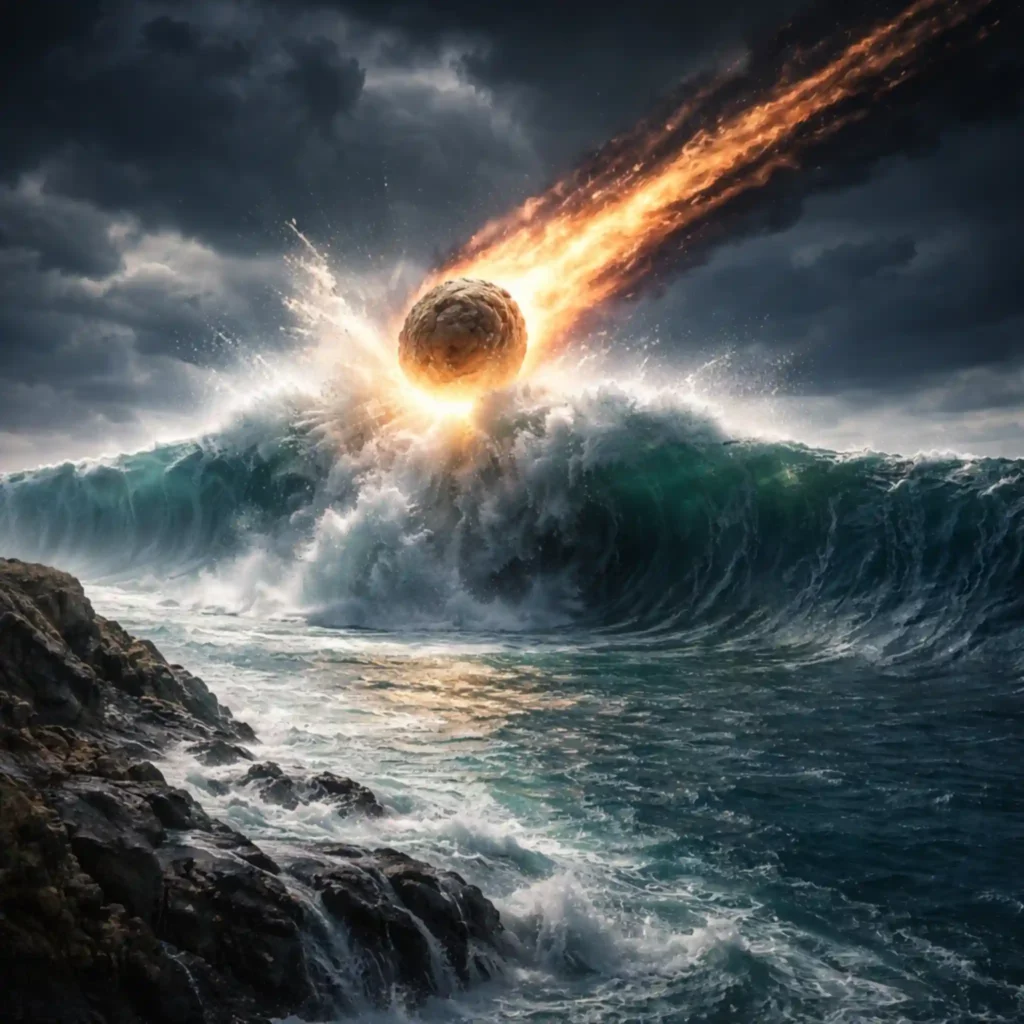

A buried scar beneath the North Sea has finally been identified as the mark of an ancient asteroid strike, ending one of the most stubborn geological arguments linked to British waters. Scientists now say the Silverpit structure was created when a 160-meter-wide asteroid smashed into the southern North Sea around 43 to 46 million years ago, unleashing a violent chain of events that included a towering tsunami estimated at more than 100 meters, or about 330 feet. That wave height would have been taller than Big Ben, giving the discovery an extraordinary scale even though the impact happened in a distant prehistoric world.
The new conclusion transforms Silverpit from a long-debated mystery into one of the clearest confirmed records of a marine asteroid impact on Earth. Hidden about 700 meters beneath the seabed and located roughly 80 miles off the Yorkshire coast, the structure had intrigued scientists ever since it was first identified in 2002. Its circular shape looked dramatic from the beginning, but shape alone was never enough to settle the argument. Over the years, geologists split into rival camps. Some believed Silverpit was the scar of a high-speed asteroid impact. Others argued it could have been caused by movement in underground salt deposits, while another idea pointed to volcanic collapse beneath the seabed.
That uncertainty lasted for more than two decades. In fact, during a scientific debate in 2009, many experts rejected the asteroid explanation. Silverpit remained one of those features that seemed suggestive but not proven. The latest research has now overturned that scepticism in decisive fashion, replacing speculation with a much firmer body of evidence.
The evidence that changed the Silverpit debate
The breakthrough came when researchers combined advanced seismic imaging, microscopic mineral analysis, and impact modelling to re-examine the buried structure in greater detail. The crater itself measures about 3 kilometers across, while the surrounding circular faults stretch out to nearly 20 kilometers. Those concentric rings had long hinted at an impact origin, but the strongest proof came from material recovered much closer to the crater floor.
Scientists studying samples from an offshore oil well found ultra-rare grains of shocked quartz and shocked feldspar at the same depth as the crater. These are not ordinary minerals. Under the microscope, they show internal deformation patterns created by extreme pressure, the kind generated in a violent hypervelocity collision. In simple terms, these minerals carry the physical fingerprint of an asteroid strike. Their discovery gave researchers the “smoking gun” that Silverpit had lacked for years.
The work was led by Dr. Uisdean Nicholson of Heriot-Watt University, whose team described the find as a needle-in-a-haystack success. That description fits. Shocked minerals are difficult to recover, especially from a buried offshore site, and their presence at Silverpit is the detail that finally pushes the structure beyond doubt into the category of a confirmed impact crater. The findings were published in Nature Communications, closing a scientific dispute that had remained open since Silverpit first entered public discussion.
A shallow-angle impact and a giant wall of water
The study does more than confirm that an asteroid hit the North Sea. It also reconstructs the violence of the impact itself. According to the researchers, the asteroid approached from the west and struck the seabed at a shallow angle. That geometry mattered, because it helped amplify the disruption at the seafloor. Within minutes of impact, the collision is believed to have blasted a 1.5-kilometer-high curtain of rock and water into the sky. As that plume collapsed back into the sea, it generated a massive tsunami that surged outward across the ancient North Sea basin.
The estimated wave height of more than 100 meters is the detail that has captured the public imagination, and for good reason. Even in today’s world, a wave of that scale would be almost impossible to picture calmly. In the prehistoric North Sea, it would have been a catastrophic regional event. The coastlines, seafloor sediments, and marine ecosystems of the time would all have been violently disturbed. The region we know now as a heavily trafficked offshore zone once experienced a disaster on a scale that is hard to overstate.
Why Silverpit matters beyond one dramatic headline
The importance of Silverpit is not only that it produced an ancient mega-tsunami. It is also a rare scientific archive. Earth constantly recycles and erases its own surface through erosion, plate tectonics, and sediment movement, which is why so few impact craters survive in recognizable form for millions of years.
Researchers note that only around 200 impact craters have been confirmed on land, while only about 33 have been identified beneath the oceans. That makes Silverpit especially valuable. It is both rare and remarkably well preserved, offering scientists a chance to study what happens when a fast-moving space rock strikes a marine environment rather than dry land. That kind of evidence is difficult to gather anywhere, and almost impossible to recreate in laboratory conditions.
The discovery also places Silverpit in a more recognizable family of impact sites. It is not on the extinction-level scale of the Chicxulub crater in Mexico, the famous impact linked to the end of the dinosaurs, but it belongs to the same broad class of planetary collision scars. Researchers have also drawn attention to the Nadir crater off West Africa as another major offshore impact site. Each confirmed example adds to a much larger effort to understand how these collisions shape planets, disrupt environments, and leave traces beneath the surface that can remain hidden for millions of years.
There is another reason the Silverpit result matters. It shows the scientific process at its best. This was not a story where the first explanation simply won because it sounded dramatic. The asteroid theory was challenged, doubted, and even voted down. It took better seismic data, careful work on well samples, and stronger modelling to reverse that view. The result is more persuasive precisely because the case had to survive years of scrutiny before being accepted.
Silverpit now stands as one of the most compelling confirmed impact craters beneath the ocean, a hidden reminder that the calm maps of modern seas cover a past shaped by astonishing violence. What once looked like an enigmatic geological pattern beneath the North Sea is now understood as the aftermath of a cosmic collision powerful enough to rip open the seabed, throw rock and water high into the sky, and send a colossal tsunami racing across an ancient marine world.

Make Swikblog your go-to source on Google for reliable updates, smart insights, and daily trends.