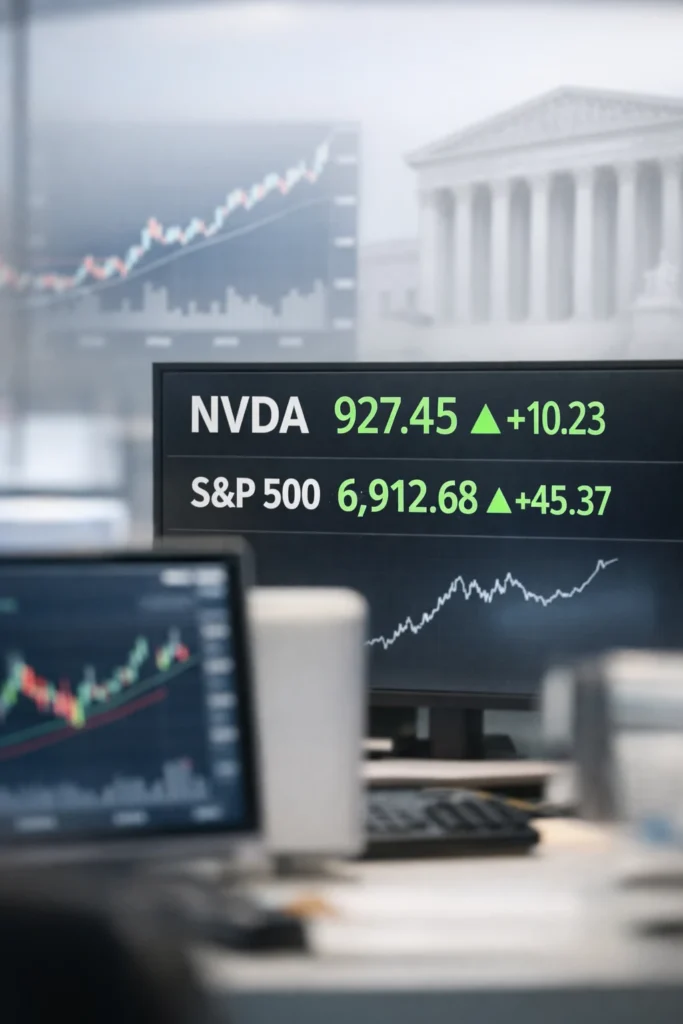

Wall Street heads into a catalyst-heavy week with policy shockwaves still rippling through markets, oil climbing on Middle East tensions, and Nvidia’s earnings poised to test the durability of the AI trade. After the Supreme Court struck down a major portion of President Trump’s tariff framework, investors are recalibrating expectations for inflation, corporate margins, and Federal Reserve rate cuts — all while bracing for one of the most closely watched earnings reports of the year.
The backdrop is complex. The S&P 500 and Dow Jones Industrial Average ended last week higher after the ruling, while tech outperformed. At the same time, crude has surged roughly 15% year-to-date, injecting a fresh geopolitical risk premium into energy markets. Add sticky inflation and a pivotal Producer Price Index reading due Friday, and the stage is set for elevated volatility.
Nvidia’s Moment: AI Leadership on Trial
All eyes turn to Nvidia after the close Wednesday. As the world’s most valuable semiconductor company, Nvidia has become shorthand for the artificial intelligence investment cycle. The numbers will matter, but the market reaction will hinge on forward guidance and management’s tone around AI infrastructure demand.
Investors are focused on three pressure points:
Data-center revenue trajectory: Has hyperscaler demand remained robust, or is growth normalizing after last year’s explosive expansion?
Supply and margin outlook: Any commentary on chip availability, next-generation platform rollouts, and pricing power could shift expectations for the entire semiconductor complex.
AI spending sustainability: Markets want confirmation that enterprise and sovereign AI adoption is broadening beyond early adopters.
Strong guidance could reinforce megacap leadership and reaccelerate growth momentum. A cautious tone, however, risks exposing crowded positioning across AI-linked equities and cloud infrastructure plays.
Supreme Court Tariff Fallout: Policy Uncertainty Returns
Friday’s 6–3 Supreme Court decision limited the administration’s authority under the International Emergency Economic Powers Act, invalidating a significant share of existing tariffs. Markets initially interpreted the ruling as modestly positive, reflecting expectations that tariff pressures may ease.
Yet uncertainty persists. The White House has already indicated it will pursue alternative legal mechanisms to implement a new 10% global tariff layer under separate trade provisions. The pivot raises questions about inflation pass-through effects and retaliatory trade dynamics.
The unresolved issue of potential tariff refunds — estimates suggest liabilities could reach into the hundreds of billions of dollars — adds another layer of fiscal ambiguity. For corporates reliant on imports, clarity on timing and repayment mechanisms could influence capital allocation decisions and forward guidance.
For broader coverage on global trade and macro shifts, investors can reference analysis from Bloomberg Markets.
Oil’s Risk Premium: Strait of Hormuz in Focus
Energy markets are increasingly dominated by geopolitics. Tensions between Washington and Tehran have escalated, with negotiations over Iran’s nuclear program appearing fragile. Market participants are not just monitoring production risks but the strategic chokepoint of the Strait of Hormuz, through which roughly 20 million barrels per day transit.
Analysts suggest a limited military event could produce a short-term $10 per barrel spike before retracement. A broader regional escalation could sustain a $15-per-barrel premium or more. Even absent direct confrontation, prolonged uncertainty supports elevated volatility in crude futures.
For equities, higher oil prices can bolster energy producers but complicate the inflation outlook, especially as consumer-facing sectors remain sensitive to input cost pressures.
Friday’s PPI: The Inflation Test
Macro attention shifts Friday to the Producer Price Index. After recent data showed both headline and core PCE climbing 0.4% month-over-month, investors are alert to signs that upstream cost pressures are persisting.
A hotter-than-expected PPI print could reignite concerns that inflation progress has stalled, potentially pushing Treasury yields higher and pressuring high-growth equities. Conversely, softer data could revive expectations for Federal Reserve rate cuts later this year, offering support to risk assets.
Official release details are available through the U.S. Bureau of Labor Statistics.
Sentiment, Jobs, and the Real Economy
Tuesday’s Conference Board consumer confidence report and weekly jobless claims later in the week will provide incremental data on household and labor market resilience. While often categorized as “secondary” releases, these indicators can materially shift rate expectations when policy uncertainty is elevated.
Any signs of weakening employment conditions could alter the Fed’s policy trajectory assumptions. Conversely, continued labor market strength may reinforce the narrative that the economy can absorb higher rates for longer.
Corporate Crosscurrents Beyond Tech
Beyond Nvidia, earnings from major retailers, software firms, utilities, and financial institutions will offer sector-specific insights. Home improvement retailers serve as proxies for housing activity, while power-market operators provide indirect confirmation of AI-driven electricity demand.
Management commentary across sectors will be closely scrutinized for references to tariff exposure, wage pressures, and capital expenditure adjustments. In a policy-fluid environment, forward guidance carries amplified significance.
Market Setup: Volatility with a Narrow Margin for Error
This week represents a convergence of catalysts: AI earnings momentum, tariff recalibration, geopolitical escalation risk, and critical inflation data. Markets have shown resilience, but leadership remains concentrated and macro crosscurrents are intensifying.
If Nvidia reinforces growth optimism and inflation data cools, equities could extend gains with renewed conviction. If oil remains elevated, tariffs re-emerge in new form, and PPI surprises to the upside, investors may pivot toward defensive positioning and cash-flow durability.
For now, traders are navigating a landscape where policy and geopolitics matter just as much as earnings — and where each data release has the potential to shift sentiment quickly.

Make Swikblog your go-to source on Google for reliable updates, smart insights, and daily trends.