
Ralf Schumacher has offered a rare and revealing look at the pressure that came with racing in Formula 1 while carrying one of the most famous surnames in motorsport. Long remembered as a multiple Grand Prix winner and the younger brother of seven-time world champion Michael Schumacher, Ralf has now spoken about the side of that fame that rarely appeared in race reports or podium photographs.
His message was direct: being part of the Schumacher story came with attention, comparison and a loss of privacy that became “unpleasant”.
Ralf competed in Formula 1 from 1997 to 2007, a decade in which his brother Michael was not just winning races but changing the scale of modern F1 fame. Michael’s championship run with Ferrari between 2000 and 2004 made him one of the most dominant drivers the sport had ever seen. The official Formula 1 Hall of Fame profile for Michael Schumacher records seven world titles and 91 Grand Prix victories, numbers that still define his legacy.
For Ralf, those achievements created a complicated reality. He was successful in his own right, but he was also judged against a brother who had become the benchmark for greatness.
Ralf Schumacher explains the pressure behind the famous name
In comments made to Abendzeitung München, Ralf said he did not believe anyone could have been fully prepared for the level of attention that followed him. He described how fame pushed him out of his comfort zone and changed the way ordinary life felt.
“You no longer have any privacy,” Ralf said, explaining that wherever he went and whatever he did, he felt watched and judged. He called that feeling “unpleasant”.
That admission gives a more human reading of a career often viewed only through results. Ralf was not an outsider in Formula 1. He won six races, raced for teams including Jordan, Williams and Toyota, and produced some of his strongest performances during the early 2000s. But the Schumacher name meant his career was never allowed to stand entirely alone.
He entered Formula 1 with Jordan in 1997, the same team that had given Michael his debut in 1991. He later became a central part of Williams’ push near the front of the grid. His breakout moment came in 2001, when he took his first Grand Prix victory at Imola. That same season, he beat Michael on more than one occasion and proved that he could win on merit in a highly competitive field.
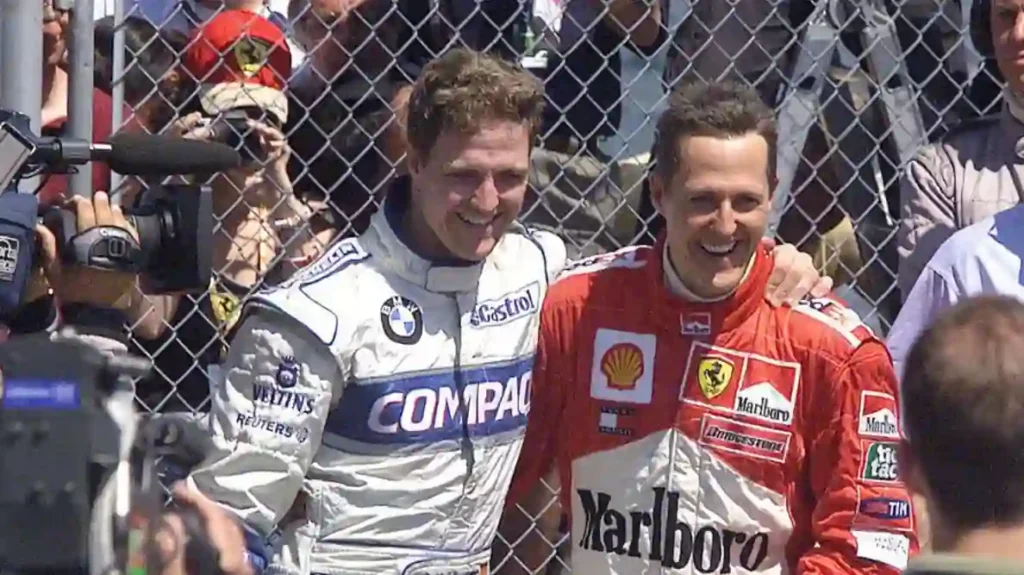
One of the most historic moments came at the 2001 Canadian Grand Prix, when Ralf won ahead of Michael. It was a rare brotherly one-two in Formula 1 and remains one of the defining images of the Schumacher family’s racing story. The pair would share more one-two finishes at races including the 2001 French Grand Prix, 2002 Brazilian Grand Prix, 2003 Canadian Grand Prix and 2004 Japanese Grand Prix, with Michael winning those later duels.
Those moments looked like sporting perfection from the outside. Two brothers, both in Formula 1, both on the podium, both part of the same family legacy. But Ralf’s latest comments show how much pressure sat behind that image.
He said his situation was more difficult because Michael was “extremely successful”. That success did not only raise expectations on track. It also followed Ralf into restaurants, public spaces and private moments. He said he always wanted peace and quiet, but public life made that difficult.
Ralf described the awkwardness of being recognised while simply spending time with friends. If he did not want to pose for a picture, he risked being seen as arrogant. That small example says a lot about the emotional trade-off of sporting fame. Fans often feel close to famous athletes, but drivers still have private lives, tired days and moments when they do not want to perform for the public.
His move to Toyota in 2005 brought a new chapter, but not the level of success he had enjoyed at Williams. By then, Michael’s Ferrari dominance was nearing its end, but the Schumacher comparison remained impossible to escape. Ralf left Formula 1 after the 2007 season, having recorded six wins and a career that many drivers would envy, even if it was always measured against something almost impossible to match.
Read More
Why Ralf’s admission matters beyond Formula 1
Ralf Schumacher’s comments arrive at a time when Formula 1 is more visible than ever. Modern drivers live under constant camera coverage, social media reaction and fan debate. Every race result is picked apart instantly, and every personal decision can become a headline. In that sense, Ralf’s experience from the 1990s and 2000s still feels relevant today.
Swikblog has covered similar pressure around the current F1 grid, including how intense attention can shape driver narratives in stories such as Max Verstappen’s comments on considering F1 retirement after the Japanese GP. While the eras are different, the central issue remains familiar: elite drivers are expected to deliver results while also carrying the weight of public judgement.
Ralf’s situation was unique because the comparison was not only professional, but personal. He was not being compared to a rival from another team or another generation. He was being compared to his own brother, a driver whose name became almost inseparable from Formula 1 dominance.
That made his career difficult to frame fairly. Six Grand Prix wins would be a major achievement for most drivers. A long F1 career with Williams and Toyota would be enough to secure respect across the paddock. But next to Michael’s seven titles, every Ralf achievement risked being treated as smaller than it really was.
His remarks also come as his personal life enters a new public chapter. Ralf is preparing to marry his partner Étienne Bousquet-Cassagne, with German broadcaster Sky Deutschland filming the event for a documentary titled Ralf & Étienne: Wir sagen Ja. The couple confirmed their engagement earlier this year and thanked supporters for their kind messages while asking for privacy around further personal details.
That request for privacy connects directly with Ralf’s wider point. Choosing to share a personal milestone is different from feeling that every public appearance is open to judgement. His comments are not a rejection of fans or the sport. They are a reminder that fame can become exhausting when there is no clear boundary between public interest and private life.
Ralf was previously married to Cora Schumacher from 2001 to 2015. They share a son, David Schumacher, who has also followed the family path into motorsport. The Schumacher racing line therefore continues, but Ralf’s latest reflections add a more grounded note to the family’s public image.
For many fans, the Schumacher name will always bring memories of Ferrari red, title celebrations, emotional podiums and Michael’s place among Formula 1’s greatest drivers. Ralf’s account does not take anything away from that legacy. Instead, it adds depth to it.
Behind the records and famous photographs was another Schumacher trying to build his own career while living beside a sporting giant. Ralf won races, made history with his brother and earned his place in Formula 1. But as he now makes clear, the cost of that visibility was real, personal and sometimes painful.

Make Swikblog your go-to source on Google for reliable updates, smart insights, and daily trends.