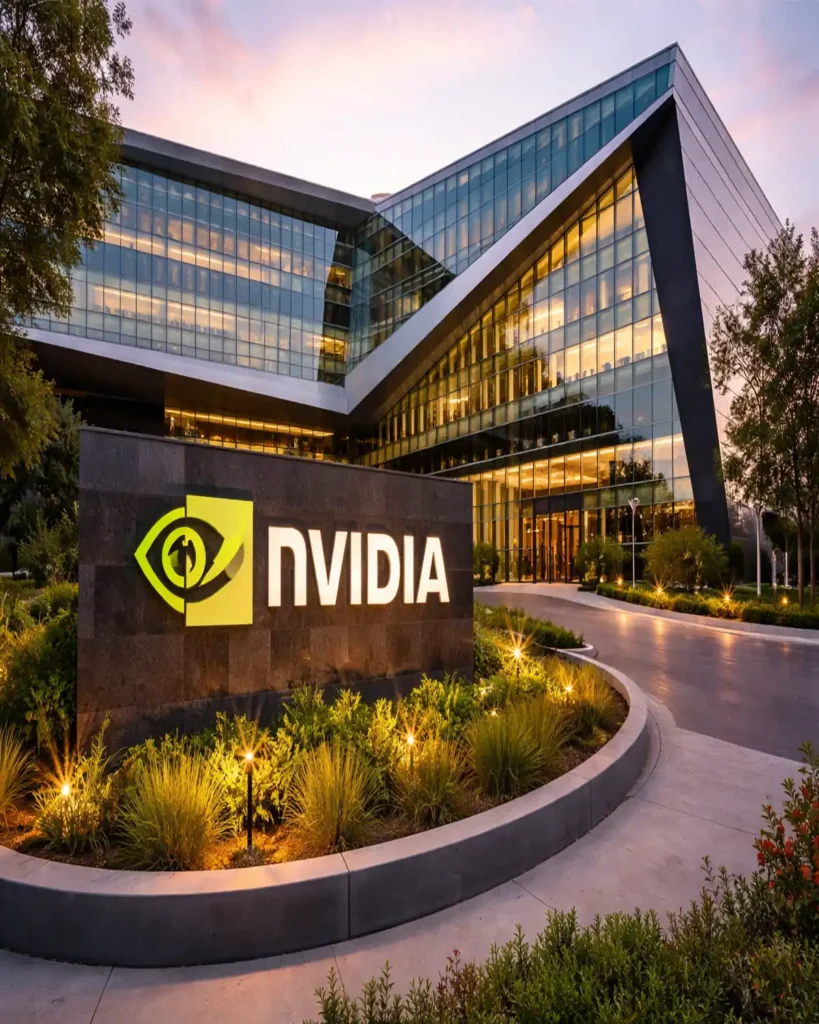

Nvidia stock tumbled 4.16% to $177.19 as investors digested a tempered forward outlook, even as the AI chip giant unveiled a strategic 6G telecom alliance that could define the next infrastructure spending cycle. The session erased $7.70 per share in value, with trading volume surging to 307.9 million shares, far above the 174.6 million average — a sign of institutional repositioning rather than light retail profit-taking.
Session data: Previous close $184.89; open $181.22; intraday range $176.38–$182.58. Nvidia’s market capitalization hovered near $4.3 trillion. The 52-week range stands at $86.62 to $212.19.
The immediate pressure stemmed from guidance that failed to materially exceed already elevated expectations. Nvidia’s valuation remains demanding, with a P/E ratio of 36.09 and trailing EPS of 4.91. Analysts’ consensus target near $263.39 implies confidence in sustained expansion, but at these levels, incremental growth must consistently outpace forecasts to support further upside.
6G becomes Nvidia’s next strategic frontier
While near-term traders focused on earnings dynamics, Nvidia made a longer-horizon move that could widen its total addressable market. The company announced an alliance with Nokia, SoftBank, and T-Mobile aimed at shaping the architecture of sixth-generation wireless networks around artificial intelligence.
Unlike 5G, which primarily accelerated mobile data and consumer connectivity, 6G is being framed as a foundational layer for machine-driven intelligence. Nvidia’s thesis is clear: future networks must move beyond transporting information and instead embed intelligence directly into the infrastructure. That shift would require significantly more computing power inside radio access networks and telecom data centers — precisely where Nvidia’s silicon and software ecosystems operate.
Industry officials note that wireless spectrum is finite. Simply expanding bandwidth will not accommodate billions of connected devices, autonomous vehicles, industrial robotics, and AI-powered edge applications. Nvidia argues that AI-driven optimization — dynamically routing traffic, predicting congestion, allocating spectrum in real time — could deliver the massive efficiency gains required to support these use cases.
A new capex cycle in the making
Every wireless generation resets infrastructure investment priorities. Standards formation precedes hardware refresh cycles that often stretch across a decade. By entering early discussions around 6G technical direction, Nvidia positions itself not just as a supplier, but as an architect influencing compute-heavy network designs.
If 6G networks become AI-native, telecom operators may require data-center-class acceleration embedded throughout the network core and edge. That scenario expands Nvidia’s footprint beyond hyperscale AI clusters into carrier-grade infrastructure — potentially unlocking a parallel spending cycle.
This matters because Nvidia’s current growth engine is heavily concentrated in AI data centers. To maintain momentum at a $4+ trillion valuation scale, demand must broaden. Physical AI — robotics, autonomous transport, connected industrial systems — depends on wireless reliability and ultra-low latency. An AI-optimized 6G backbone could accelerate that deployment curve.
Valuation pressure versus structural opportunity
Despite the pullback, Nvidia remains one of the market’s highest-conviction AI plays. Its beta of 2.31 underscores volatility, but also highlights how closely the stock tracks shifts in risk appetite. The forward dividend remains symbolic at $0.04 with a yield near 0.02%, reinforcing that capital returns are secondary to reinvestment and expansion.
The next earnings catalyst is expected around May 20, 2026. Investors will look for clarity on margin durability, AI demand diversification, and early monetization pathways tied to telecom partnerships.
Why 6G timing still matters today
Although 6G commercial deployment is years away, capital markets price future infrastructure waves well in advance. Companies that influence standards often secure ecosystem advantages that compound over time. Nvidia’s strategy suggests it intends to anchor AI compute not only in cloud data centers, but across the connective backbone of global communications.
For detailed reporting on the telecom alliance and strategic positioning, see coverage from Bloomberg.
You May Also Like
More stock market coverage and AI sector analysis on Swikblog

Make Swikblog your go-to source on Google for reliable updates, smart insights, and daily trends.