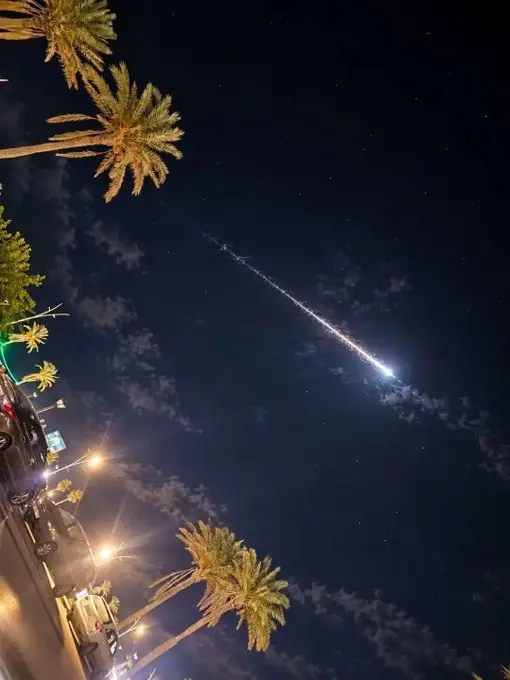
Space weather specialists are monitoring the Sun after an extremely powerful X8.1 solar flare erupted from Sunspot Region 4366 on February 2, 2026, raising questions about whether associated solar material could produce stronger auroras later in the week.
The flare was among the most intense recorded during the current solar cycle. However, the strength of a flare alone does not determine whether Earth will experience a geomagnetic storm. The direction, speed and magnetic structure of any accompanying coronal mass ejection will ultimately decide how much of an impact reaches the planet.
First look at the 8.1 X-class flare, still ongoing in x-class territory (most extreme category of solar flare) pic.twitter.com/9QuA1TZ7b4
— Stefan Burns (@StefanBurnsGeo) February 2, 2026
Read More
Why the X8.1 solar flare attracted attention
Solar flares are sudden bursts of electromagnetic energy released when stressed magnetic fields around sunspots reconnect. Scientists classify them as A, B, C, M or X events, with each category representing approximately ten times more energy than the one below it.
X-class flares occupy the strongest category. The number following the letter provides a more precise measurement, meaning an X8.1 flare is substantially more powerful than an X1 event.
What made the February 2 eruption particularly notable was the wider pattern of activity surrounding Region 4366. During an approximately 24-hour period, the sunspot produced 17 M-class flares and four X-class flares.
That repeated activity showed that the region remained magnetically unstable rather than producing one isolated eruption. Active regions can continue generating flares while they remain visible from Earth, although not every event sends material in this direction.
Interest in space science has also grown through the achievements of figures such as Mercury 13 aviation pioneer Wally Funk, whose long career helped connect early astronaut testing with a new era of commercial spaceflight.
Could the eruption produce northern lights?
The possibility of enhanced auroras depends largely on whether the eruption launched a coronal mass ejection, commonly known as a CME, toward Earth. A CME is a large cloud of electrically charged plasma and magnetic material expelled from the Sun.
Early analysis indicated that the main body of solar material could pass north and east of Earth. Forecasters were nevertheless examining whether the planet might receive a glancing impact from the edge of the cloud.
Even a partial encounter can disturb Earth’s magnetic field if the solar material arrives with sufficient speed and density. Its magnetic orientation is equally important because a southward-facing field can connect more effectively with Earth’s magnetosphere.
When those conditions align, northern lights may become brighter and visible farther south than normal. The exact viewing area cannot be confirmed from the flare measurement alone, and forecasts often become more reliable only as the solar cloud approaches monitoring spacecraft near Earth.
Possible effects beyond the aurora
Strong solar flares can affect technology before any slower-moving CME reaches Earth. The radiation from a flare travels at the speed of light and can briefly disrupt high-frequency radio communications across the sunlit side of the planet.
These radio blackouts are most relevant to aviation, maritime operators, emergency communications and other services that depend on long-distance high-frequency signals. Most households do not notice a direct effect.
A geomagnetic storm caused by arriving solar plasma can create a different set of concerns. Depending on its severity, it may introduce errors into satellite navigation, increase atmospheric drag on low-orbit spacecraft and require satellite operators to take protective measures.
The growing importance of satellites and human spaceflight is also reflected in developments such as Hong Kong’s first astronaut joining China’s lunar mission plans, highlighting how more countries and regions are becoming involved in long-term exploration programs.
Serious power-grid disruption is generally associated with stronger and more sustained geomagnetic storms. A powerful flare does not automatically mean those conditions will develop, particularly when the main CME trajectory appears to miss Earth.
An X8.1 Solar Flare Occurred from Region 4366. pic.twitter.com/q8PuvOsUL5
— NOAA Space Weather Prediction Center (@NWSSWPC) February 2, 2026
Why forecasts can change close to arrival
Solar eruptions travel across millions of kilometres of space, and conditions inside a CME cannot always be measured accurately while it remains near the Sun. Forecast models estimate its direction and arrival time using coronagraph images and observations from several spacecraft.
More precise information becomes available when the solar wind reaches instruments positioned upstream from Earth. Those measurements help forecasters determine the cloud’s density, speed and magnetic direction shortly before it interacts with the planet.
This is why an early aurora outlook can change during the final 12 to 24 hours. A predicted near miss may still deliver a weak edge impact, while an apparently favourable eruption may produce limited effects if its magnetic field is poorly aligned.
Official flare measurements, geomagnetic storm watches and aurora forecasts are published by the NOAA Space Weather Prediction Center.
Region 4366 remained the main area of interest following the X8.1 eruption. Further M- or X-class flares could extend the period of elevated space weather activity, but any meaningful effect on Earth will depend on whether future eruptions are directed toward the planet.

Make Swikblog your go-to source on Google for reliable updates, smart insights, and daily trends.