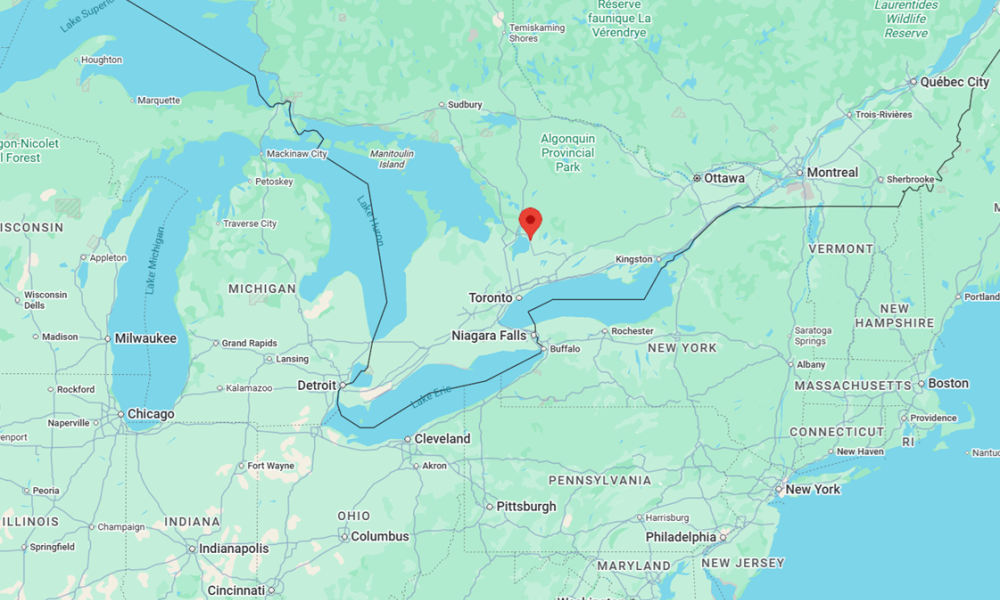

A magnitude 4.1 earthquake shook parts of southern Ontario late Tuesday night, startling residents across the Greater Toronto Area, Lake Simcoe communities and parts of western New York. The tremor lasted only a few seconds, but many people reported feeling homes sway, windows rattle and furniture vibrate.
According to preliminary information from the U.S. Geological Survey (USGS), the earthquake struck at approximately 10:59 p.m. local time on January 27, 2026. The event occurred at a shallow depth of about 11.5 kilometres, allowing the shaking to be felt across a wide area.
Epicentre Near Lake Simcoe
The earthquake’s epicentre was located near Brechin, Ontario, close to Lake Simcoe. The area lies around 45 kilometres east of Barrie and roughly 104 kilometres northeast of downtown Toronto.
Residents in Toronto, Oshawa, Lindsay, Millbrook and several neighbouring communities reported feeling the tremor. Similar reports also came from western New York, including Rochester, showing the quake was felt well beyond Ontario.
Why So Many People Felt the Earthquake
Although a magnitude 4.1 earthquake is considered moderate, shallow earthquakes often produce stronger surface shaking than deeper events. Combined with the quiet conditions late at night, the tremor was easier for people to notice.
Many described the movement as a rolling sensation lasting only a few moments before everything returned to normal.
Ontario Still Experiences Occasional Earthquakes
Southern Ontario is far less seismically active than British Columbia, but earthquakes do occur from time to time. Ancient geological faults beneath the province can produce occasional tremors, though most are too small to be widely noticed.
Events reaching the mid-4 magnitude range are uncommon and often generate reports from multiple cities because they can be felt across a broad region.
Aftershocks Could Follow
Smaller aftershocks remain possible following an earthquake of this size. Scientists will continue reviewing seismic data, which means the reported magnitude, depth or epicentre could be refined as additional monitoring stations submit information.
For official earthquake information, maps and updated seismic data, visit the USGS Latest Earthquakes map. If you’re interested in recent seismic activity elsewhere in Canada, see our report on the 4.5 magnitude Alberta earthquake near Edmonton.
Safety Steps After Feeling a Tremor
Even when damage appears unlikely, it is a good idea to check your surroundings after an earthquake.
- Check for gas leaks, damaged pipes or exposed electrical wiring.
- Inspect shelves and furniture for items that may have shifted.
- Move unstable objects away from areas where they could fall.
- Keep mobile devices charged for emergency notifications.
- If another earthquake occurs, drop, cover and hold on until the shaking ends.
Preliminary Data May Be Revised
Earthquake information released shortly after an event is based on initial seismic readings. As experts analyse additional data, the earthquake’s reported magnitude, depth and exact location can change slightly.
While the technical details may be updated, the event serves as a reminder that noticeable earthquakes can occur even in regions where they are relatively rare.

Make Swikblog your go-to source on Google for reliable updates, smart insights, and daily trends.