
Updated: August 18, 2026
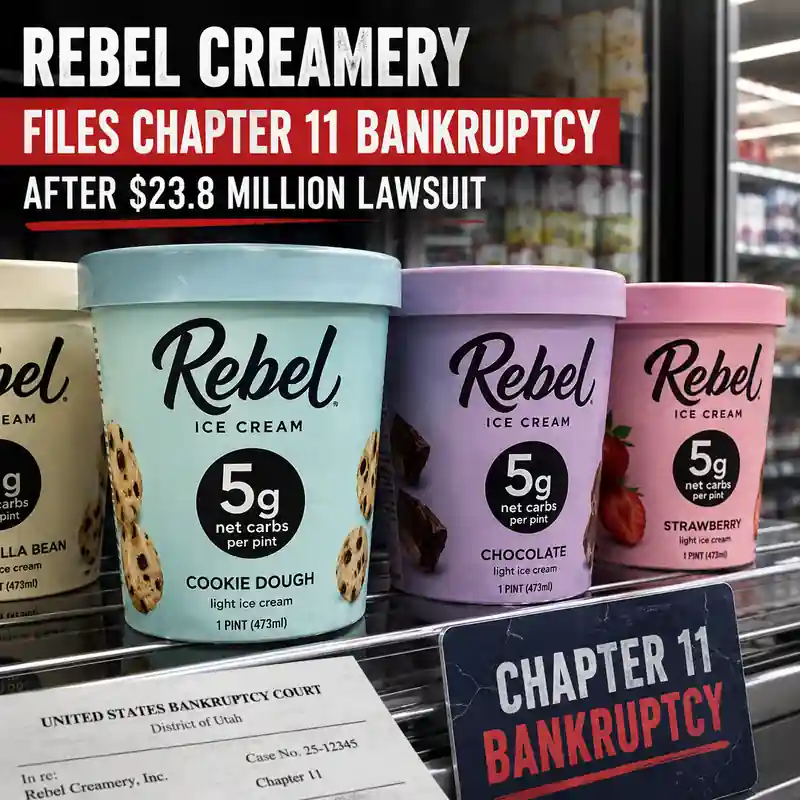
Rebel Creamery, the Utah-based maker of Rebel Ice Cream sold through major retailers including Walmart, Target and Kroger, has filed for Chapter 11 bankruptcy protection as it appeals a $23.785 million federal court judgment in a packaging dispute with Van Leeuwen Ice Cream.
The Midway, Utah-based company filed for Chapter 11 on August 14, 2026, in the U.S. Bankruptcy Court for the District of Utah. Updated bankruptcy disclosures show approximately $13.78 million in assets and $23.85 million in liabilities, giving a clearer picture of Rebel’s finances than the initial $10 million to $50 million ranges listed in its petition.
The bankruptcy came less than a month after U.S. District Judge Eric R. Komitee ordered Rebel to turn over $23.785 million in profits to Van Leeuwen after finding that Rebel infringed the rival ice cream company’s protected trade dress.
Rebel filed a notice of appeal on August 12, two days before entering Chapter 11. The company is therefore restructuring its finances while separately attempting to overturn or reduce the judgment.
Rebel reports $13.78 million in assets and $23.85 million in liabilities
The latest financial disclosures underline how significant the Van Leeuwen judgment is for Rebel. The $23.785 million award is about 1.7 times Rebel’s reported total assets and accounts for most of the company’s reported liabilities.
Rebel’s disclosed assets reportedly include about $5.22 million in cash and cash equivalents, $2.59 million in accounts receivable and $5.65 million in inventory. The company has listed Van Leeuwen’s claim as disputed because the judgment is being appealed.
The bankruptcy filing also indicates that Rebel expects funds to be available for distribution to unsecured creditors. Chapter 11 is primarily a reorganization process rather than an automatic liquidation, allowing businesses to continue operating while restructuring debts and developing a plan for creditors.
There is currently no confirmed announcement that Rebel Ice Cream is shutting down nationwide. Rebel’s website remains active, products continue to be offered online and its store locator continues to direct shoppers to retailers carrying the brand.
That distinction has mattered in other recent restructuring cases. The iRobot Chapter 11 bankruptcy involving the maker of Roomba similarly demonstrated that bankruptcy protection does not necessarily mean an immediate end to a recognizable consumer brand.
Why Rebel owes Van Leeuwen $23.785 million
The dispute did not center on Rebel copying the Van Leeuwen name or logo. Instead, Van Leeuwen accused Rebel of infringing its trade dress — the overall visual appearance of its ice cream packaging.
Van Leeuwen argued that its monochromatic cardboard containers, matching lids, pastel colors, black script lettering and minimalist design had developed a distinctive identity that consumers associated with the company.
Van Leeuwen was founded in Brooklyn in 2008 and later expanded from ice cream trucks into packaged products and retail stores. Rebel Creamery was founded in 2017 and built its business around low-carb and keto-focused frozen desserts, with its products reaching grocery stores in 2018.
Van Leeuwen filed its lawsuit in April 2021. After years of litigation and a bench trial, the federal court found Rebel liable for trade dress infringement, unfair competition and dilution.
The July 16, 2026 order required Rebel to stop using packaging likely to be confused with Van Leeuwen’s protected trade dress and redesign affected products. The court also awarded Van Leeuwen $23.785 million of Rebel’s profits from infringing pint sales.
The amount was not calculated from every dollar Rebel earned. The court applied a 33% equitable reduction after considering evidence that some Rebel customers previously purchased only products in the “better-for-you” ice cream category, reflecting Rebel’s low-carb positioning.
Rebel’s August 12 appeal means the company is now dealing with two connected legal proceedings: its Chapter 11 restructuring in Utah and its challenge to the New York federal judgment.
The appeal does not automatically eliminate the $23.785 million award. Unless the judgment is overturned, reduced, settled or otherwise modified, it remains the central financial issue surrounding Rebel’s bankruptcy.
Rebel entered Chapter 11 with liabilities roughly $10 million higher than its reported assets, making the outcome of the appeal particularly important. A reduction or reversal of the judgment could materially improve the company’s restructuring position, while an unsuccessful appeal would leave the company dealing with an award larger than its reported asset base.
For customers, the key point is that Chapter 11 should not currently be interpreted as proof that Rebel Ice Cream is disappearing from stores. As of August 18, 2026, no nationwide liquidation or shutdown has been announced. The confirmed story remains a major court judgment followed by a Chapter 11 restructuring and an active appeal.

Make Swikblog your go-to source on Google for reliable updates, smart insights, and daily trends.