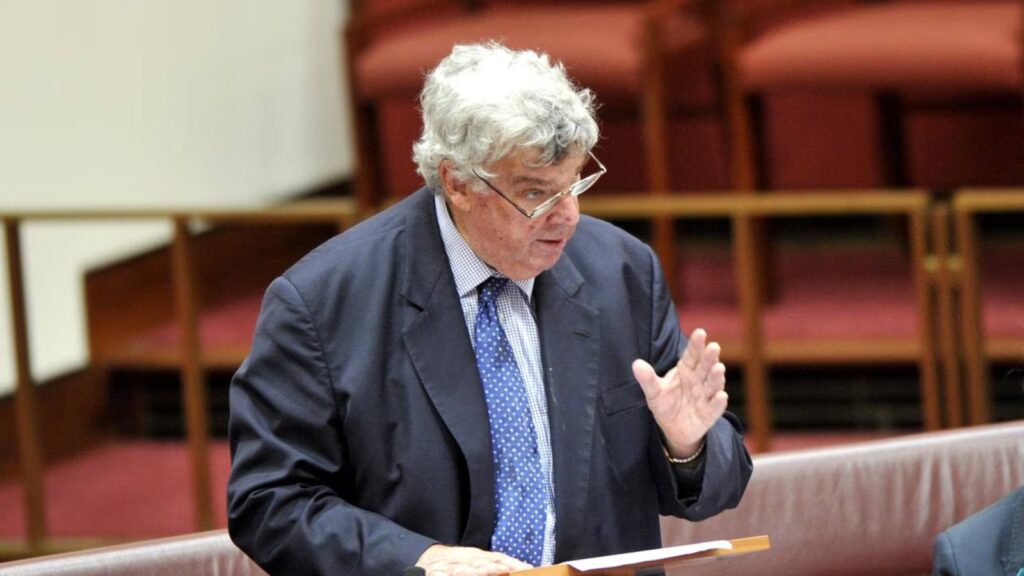

Ron “Bozzie” Boswell, a long-serving Queensland senator and one of the National Party’s most influential parliamentary operators, has died aged 85, prompting tributes from across Australia’s political spectrum.
Ron Boswell — remembered by friends and colleagues as “Bozzie” — has died overnight at the age of 85, according to reports carried by ABC News. Boswell served as a Senator for Queensland from 1983 until 2014, building a reputation as a tough, tireless advocate for regional Australia and a commanding figure inside Coalition politics.
For many Australians outside Canberra, Boswell was best known for his blunt speaking style and his long tenure in the upper house, where the Senate’s numbers often made it the true negotiating chamber of federal politics. Within the Nationals, he was viewed as both an enforcer and a deal-maker — someone who understood the machinery of parliament and used it to keep regional issues in the national conversation.
A Queensland senator with rare staying power
Boswell was first elected to the Senate in 1983 and re-elected multiple times, making him one of the longer-serving federal parliamentarians of his era. Official parliamentary records show he represented Queensland in the Senate for more than three decades and retired at the end of his term in 2014. :contentReference[oaicite:1]{index=1}
He also led the National Party in the Senate for 17 years — an unusually long stretch in a role that requires both internal party authority and constant negotiation with Coalition partners. That position placed him at the centre of strategy, messaging, and legislative bargaining during changing political cycles, particularly when governments relied on Senate support to pass key measures.
Parliamentary records also note Boswell served as a Parliamentary Secretary in the Howard government between 1999 and 2003, a period when the Coalition pursued major reforms while balancing competing regional and national priorities.
Why tributes are flowing
Tributes following Boswell’s death have been bipartisan, with leaders and colleagues describing him as a committed representative who took the Senate’s scrutiny role seriously. Several outlets reported that he died peacefully at his Brisbane home and that condolences came from senior figures across Australian politics.
Supporters frequently point to his focus on rural and regional issues — the everyday pressures on farming communities, small businesses, and families in areas that can feel distant from national decision-making. Even critics often acknowledged his effectiveness: Boswell had a reputation for being hard to shift once he committed to a cause, and for pushing colleagues to take regional concerns seriously rather than treating them as a footnote.
Part of Boswell’s legacy is also cultural: he belonged to a generation of retail politicians who built influence through branch meetings, local networks, and long hours on the road. That approach, while less visible online, helped anchor the Nationals’ identity in constituencies where personal relationships still matter.
Key moments people remember
Boswell’s long career meant he was present for major turning points in Australian politics — from shifting Coalition leadership eras to changing debates about immigration, regional development, and the balance of power in the Senate. One of the most frequently cited moments, reported in tributes today, was his 2001 Senate contest in Queensland in which he defeated Pauline Hanson for a seat — a result Boswell later described as one of his proudest political achievements.
In the Senate itself, Boswell’s longevity also carried symbolic weight. He was “Father of the Senate” from 2008 until his retirement — a title given to the longest continuously serving senator — reflecting how long he remained a fixture in the chamber.
Outside the parliamentary arena, Boswell also authored a memoir in recent years, offering a personal account of the pressures and compromises of political life. Supporters say that willingness to reflect — and to keep engaging publicly even after retirement — contributed to the sense, in tributes today, that an era has closed with his death.
For many who worked with him, the defining story is not one single vote or speech, but his persistence: the calls, the meetings, the behind-the-scenes negotiations, and the habit of returning to the same practical question — what does this mean for the communities we represent?
Written by Swikriti

Make Swikblog your go-to source on Google for reliable updates, smart insights, and daily trends.