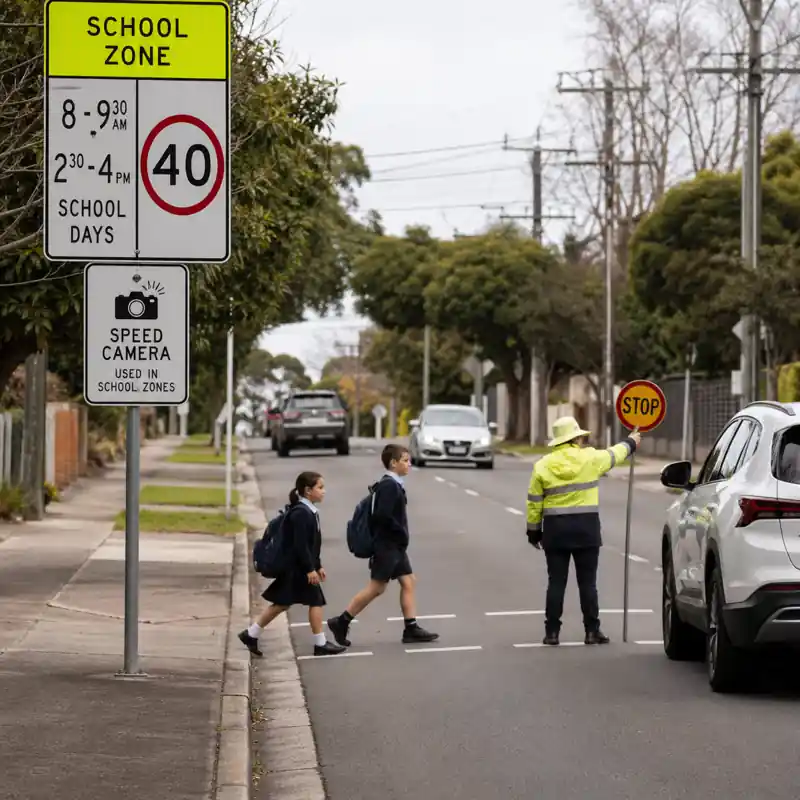

Drivers in Adelaide are being urged to pay closer attention around schools after nearly 1,200 motorists were fined under South Australia’s new 40km/h school zone speed limit rules, with penalties reaching almost $700,000 in only 11 weeks.
The figures have turned a local road safety rollout into a wider warning for motorists across the state. According to South Australia Police data, 1,194 drivers were caught speeding through two newly monitored school precincts from late 2025, generating $694,037 in fines.
The highest number of offences was recorded on Kensington Road near Marryatville High School, where 992 drivers were fined. Another 202 motorists were caught on Goodwood Road near Goodwood Primary School. That means about 24 drivers a day were penalised for failing to slow down during school zone hours.
The new 40km/h limit applies only on school days during peak student travel times: 8am to 9.30am and 2pm to 4pm. These are the morning drop-off and afternoon pick-up windows, when students are more likely to be walking, cycling, crossing roads or moving between parked cars and traffic.
Why the new school zone rule matters
The rule is aimed at busy main roads near schools where traffic usually moves at 50km/h or higher. South Australia has long used 25km/h school zones on many local streets, but the newer 40km/h zones are designed for larger roads where children and fast-moving vehicles often share the same area.
The South Australian Department for Infrastructure and Transport says the lower speed limit is being introduced near schools to improve safety for children travelling to and from class. The department says the project applies to roads near schools with existing speed limits of 50km/h or more and forms part of a wider road safety program. More information is available on the official 40km/h school speed limits project page.
For drivers, the change means familiar routes may no longer operate the same way at certain times of the day. A road that allows 50km/h or 60km/h outside school hours can drop to 40km/h during the morning and afternoon school peaks. Missing the sign, assuming the old limit still applies, or speeding up too early can all lead to a fine.
Authorities have also made clear that drivers must slow down before reaching the school zone and should not accelerate again until they pass the sign showing the higher speed limit has resumed. In areas with fixed safety cameras, that leaves little margin for motorists who are not watching the signs carefully.
More than 160 schools expected to be covered
The fine surge comes as South Australia expands the 40km/h school precinct program. More than 160 schools are expected to eventually be included, with around 60 already rolled out and about another 100 planned by the end of the year.
Marryatville High School was the first to receive the new limit in November 2025. Goodwood Primary School was also among the early sites, along with other schools such as Golden Grove High School and Mercedes College.
The rollout was announced in September 2025 by then-Education Minister Blair Boyer and is partly funded through the $168 million National Road Safety Program in partnership with the federal government. The project also follows growing concern about student safety on busy roads, including areas where traffic volume, speed and crash history have been considered in selecting locations.
Road safety advocates say the timing of the limits is important. RAA South Australia senior safety manager Charles Mountain has warned that drivers who ignore the 40km/h rule during drop-off and pick-up periods may be putting children and other road users at risk.
Crash data cited by the RAA shows about 40% of injury crashes involving pedestrians and cyclists under 16 happen during school peak hours. That statistic helps explain why authorities are focusing on relatively short but high-risk parts of the day rather than applying the lower limit around the clock.
How the 40km/h zones differ from 25km/h school zones
One reason some drivers may be confused is that South Australia now has different school zone rules operating in different road environments.
The existing 25km/h school zones on local roads still apply whenever children are present, including outside normal school times and even on non-school days. These zones are not being replaced by the new 40km/h rule.
The newer 40km/h limits apply to selected main roads near schools during set times on school days. They are time-based, meaning drivers need to check both the road signs and the clock. In some locations, electronic signs and fixed safety cameras have been installed to support the rollout.
That distinction is important. A driver who understands one type of school zone may still be caught out by the other. The safest approach is to treat every school precinct as a place where the speed limit can change quickly depending on the road, time and presence of children.
The penalties issued so far show how expensive a small mistake can become. A driver who travels the same road every weekday may not notice a new sign immediately, but enforcement begins once the zone is active. With cameras monitoring compliance, authorities do not need to stop drivers at the roadside for fines to be issued.
The warning for motorists is simple: school zone habits need to change. Slow down before entering the signed area, stay at 40km/h during the operating times, and wait until the next speed sign before increasing speed again.
For families, schools and road safety officials, the issue is bigger than the fine total. Lower speeds give drivers more time to react and can reduce the severity of crashes when pedestrians or cyclists are involved. Around schools, where children can be unpredictable and traffic is often congested, that extra reaction time can be critical.
As more 40km/h school zones appear across South Australia, the Adelaide fine spike is likely to serve as an early warning. Drivers who rely on memory instead of signs may find themselves caught, while those who adjust now will be better prepared as the rollout reaches more suburbs and school communities.
For related updates, read more on road rule changes affecting Australian drivers.

Make Swikblog your go-to source on Google for reliable updates, smart insights, and daily trends.