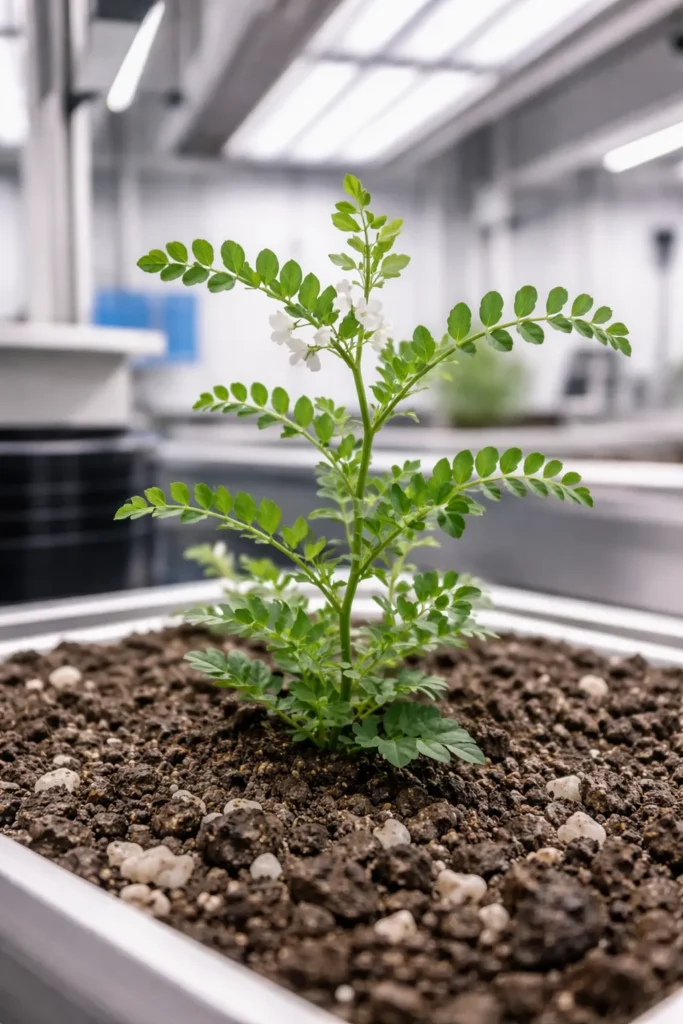

Moon hummus just moved a step closer to reality. In a new experiment designed for the era of long-duration lunar missions, scientists successfully grew chickpeas in “moon dirt” — soil mixtures made mostly from simulated lunar regolith — showing that future astronauts may be able to produce part of their own food on the Moon instead of relying entirely on shipments from Earth.
The work was carried out in a climate-controlled growth chamber at Texas A&M University, using chickpeas from a variety called Myles. Researchers planted the seeds into blends that combined a lunar soil simulant with a nutrient-rich material called vermicompost, which forms when earthworms break down organic waste. The simulated lunar soil was designed to mimic real lunar samples returned during NASA’s Apollo missions, giving the team a realistic stand-in for what crops might face in a moon base greenhouse.
Why chickpeas are on the shortlist for space crops
Chickpeas are appealing for extraterrestrial agriculture because they pack a lot of nutrition into a small footprint. They’re high in protein and provide essential nutrients that matter when resupply is limited. The bigger picture is survival logistics: if human crews are expected to live on the Moon for extended stretches — especially as the United States and China plan astronaut returns with an eye toward longer-term activity — local food production becomes a cornerstone of any realistic life-support system.
Shipping every meal from Earth is a fragile plan. Launch capacity is expensive, weight is constrained, and crews can’t be dependent on perfectly timed deliveries. A reliable lunar food loop reduces mission risk, and plants can contribute beyond calories by supporting life-support functions — including helping future habitats manage oxygen and overall system stability.
What the experiment actually did
The “moon dirt” in this study wasn’t a gimmick mix sprinkled on top of potting soil. Researchers tested soil blends where simulated lunar regolith made up a large share of the growing medium. They coated chickpea seeds with beneficial fungi before planting — organisms meant to form a cooperative partnership with the plant roots. The seeds then went into mixtures of lunar simulant and vermicompost, with the regolith percentage increasing across trials.
The headline result: the team produced harvestable chickpeas in blends containing up to 75% lunar simulant. That’s a meaningful milestone because it suggests a lunar greenhouse may not need to fully replace regolith with imported “Earth-like” soil to raise at least some crops. Instead, it points to a future where regolith is treated and conditioned into a workable growing medium.
The 75% ceiling and the 100% wall
As the proportion of simulated regolith increased, the experiment showed a clear tradeoff. The number of harvestable chickpeas declined as the “moon dirt” got more intense, but the size of the chickpeas stayed stable among the plants that did reach harvest. In other words, yields dropped, but the chickpeas that formed didn’t shrink into useless pellets.
Then came the hard limit: seeds planted in 100% lunar simulant failed to carry the full life cycle. Those plants did not produce flowers and seeds and experienced early death. For mission planners, that’s not discouraging so much as clarifying: pure regolith, on its own, behaves more like abrasive crushed rock than a living soil system, and it needs help to become a stable root environment.
Moon soil is not “soil” in the way plants mean it
Lunar regolith is essentially crushed rock and dust shaped over billions of years by meteorite impacts. Its particles can be sharp and glass-like. While it contains many minerals and nutrients plants can use, it is inorganic and deeply inhospitable compared with Earth soil, which is rich in organic matter and teeming with microbial life that supports roots.
That contrast is why earlier experiments often relied on adding compost or organic matter. This study leaned into biology in a different way, testing whether partnerships between plants and microbes could improve regolith conditions and reduce plant stress, rather than relying only on dumping in organics as the fix.
The microbial “assist” that made regolith behave more like Earth
The fungi coating the chickpea seeds played a symbiotic role, helping the plants absorb certain essential nutrients while also reducing uptake of heavy metals. That point matters because regolith and many simulants contain naturally high levels of metals such as iron and aluminum. Iron is useful for plant growth. Aluminum is not — and can become toxic if it accumulates in food that people eat.
One striking observation was that microorganisms successfully colonized chickpea roots even in 100% regolith simulant. Beyond nutrient dynamics, the microbes also helped bind loose particles, effectively improving structure so the regolith behaved a bit more like Earth soil — a small but important step in making a harsh, dusty substrate friendlier to roots.
Do moon-grown chickpeas taste normal
Not answered yet — and the researchers are treating that as a serious safety question, not a novelty. The harvested chickpeas are currently being tested for metal accumulation. Until those results are in, no one is eating them, and no one should assume “moon hummus” is ready for the menu. A follow-up paper is expected to report whether the chickpeas are safe and nutritious after assessing the risk of metals like aluminum building up in edible tissues.
If you want the full reporting details and the broader context behind the work, you can read the Reuters coverage of the chickpea “moon dirt” experiment.
What this means for lunar bases and beyond
This is not a claim that the Moon is about to become an agricultural world. It’s a demonstration that, with the right conditioning strategy, crops can be grown in a medium that is mostly regolith rather than mostly Earth-style soil. That distinction matters for long-duration lunar missions, because the whole point is to reduce dependence on supply chains from Earth.
It also connects to a broader wave of research into off-world growing systems. A second study published the same day examined growing conditions for microbes in simulated Martian soil, reflecting the shared logic that future exploration will hinge on biology — not just engineering — to build resilient habitats.
For now, the chickpeas are a proof of feasibility: up to 75% regolith blends can produce harvestable seeds, microbes can colonize roots even under extreme conditions, and biological partnerships may help turn hostile dust into something closer to soil. It’s not a moon farm yet, but it’s a practical step toward one.
You May Also Like

Make Swikblog your go-to source on Google for reliable updates, smart insights, and daily trends.