

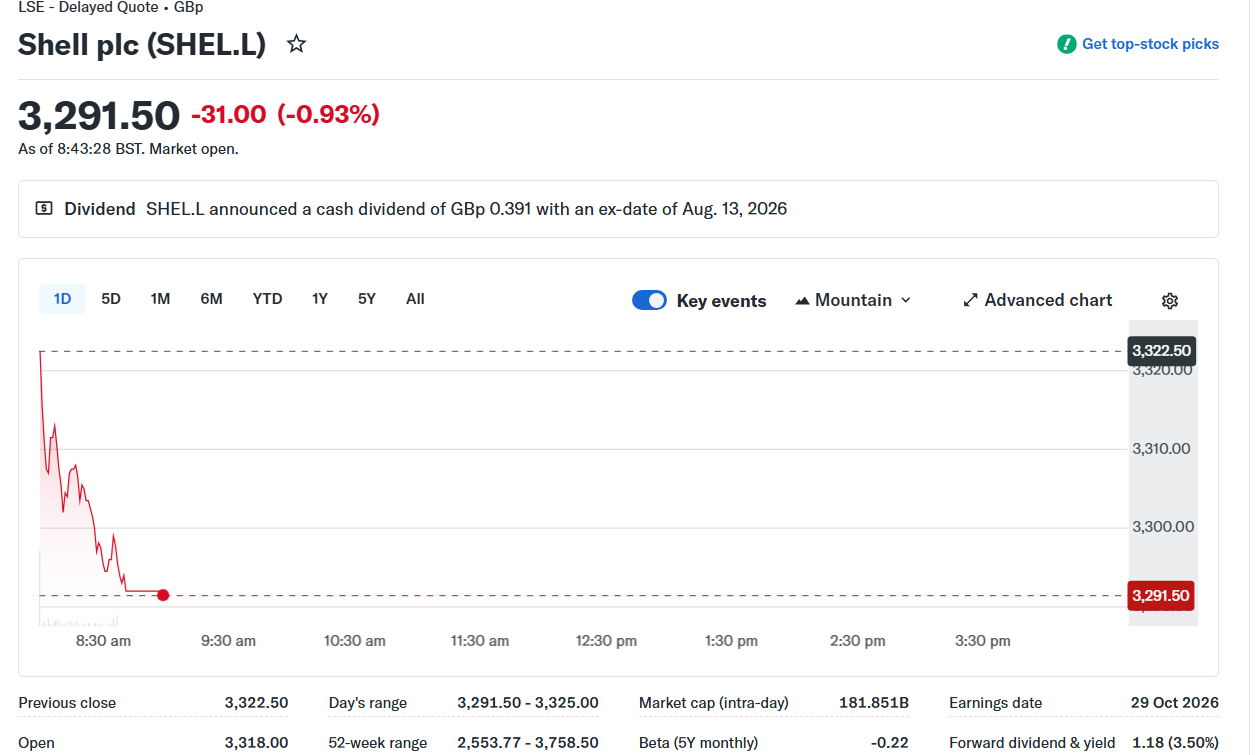
Shell shares fell 1% in London on August 12, dropping 33.50p to 3,322.50p as the oil major approached its August 13 ex-dividend date. The move placed dividend eligibility, Shell’s $9.8 billion quarterly profit and its latest multibillion-dollar share-buyback programme at the centre of investor attention.
The previous closing price was 3,356p. At 3,322.50p, one Shell ordinary share was worth £33.225, while the company’s quoted market value stood at approximately £183.54 billion. The price shown was a delayed London Stock Exchange quote recorded at 6:02pm BST while the market was marked open.
The timing matters for existing shareholders and anyone considering buying Shell for income. Investors purchasing the ordinary shares on or after August 13 will not qualify for the second-quarter dividend. Those who acquired the shares before they went ex-dividend may qualify, subject to settlement, registration and their broker’s procedures.
Shell dividend amount and complete timetable
Shell officially declared a second-quarter 2026 interim dividend of $0.3906 per ordinary share. One important detail in the market screenshot requires clarification: its dividend banner describes the amount as “GBp 0.391,” but Shell’s official declaration is in US dollars, not 0.391 British pence.
The complete dividend timetable is:
- Dividend announcement: July 30, 2026
- Ex-dividend date for ordinary shares: August 13, 2026
- Ex-dividend date for US-listed ADSs: August 14, 2026
- Record date: August 14, 2026
- Currency-election deadline: August 28, 2026
- Sterling and euro equivalents announced: September 7, 2026
- Dividend payment date: September 21, 2026
The currency-election deadline is 11am GMT on August 28. A broker, bank or other financial intermediary may apply an earlier deadline, so investors who want a currency different from their default option should check their account instructions.
Eligible ordinary shareholders can elect to receive the dividend in US dollars, pounds sterling or euros. UK-registered shareholders and investors using the Shell Corporate Nominee will generally receive pounds sterling unless they make a valid alternative election. Holdings through Euroclear Nederland generally receive euros by default.
Each US-listed Shell American Depositary Share represents two ordinary shares. Consequently, the declared dividend is $0.7812 per ADS, payable in US dollars by default.
For illustration, 100 qualifying ordinary shares would generate a gross declared dividend of $39.06 before currency conversion, tax or broker charges. The exact sterling amount cannot be calculated until Shell announces the exchange-rate equivalent on September 7. Investors can verify the timetable and payment options in Shell’s official dividend announcement.
The latest distribution is higher than the $0.372-per-share dividend highlighted earlier in 2026, when Shell shares rose following the previous dividend announcement. Comparing the two declared payments shows an increase of approximately 5% per ordinary share, although currency movements will determine the final sterling comparison.
Does the 1% fall reflect the dividend?
The August 12 decline was recorded before the ordinary shares went ex-dividend. It therefore should not be treated as the automatic ex-dividend adjustment.
Once a stock trades ex-dividend, its price may open lower by an amount broadly linked to the distribution because new buyers no longer receive that payment. The adjustment rarely matches the dividend precisely. Oil prices, exchange rates, company developments and wider FTSE trading can move the shares in either direction during the same session.
Buying immediately before the ex-dividend date does not create a guaranteed profit. The investor receives the dividend entitlement, but the share price can fall to reflect the value leaving the company. Taxes, dealing costs and foreign-exchange conversion may further reduce the net return.
Latest Shell share data explained
The market snapshot showed several figures that investors may use when assessing Shell:
- Share price: 3,322.50p
- Daily movement: down 33.50p, or 1%
- Previous close: 3,356p
- Market capitalisation: £183.536 billion
- Trading volume: 730,000 shares at the time captured
- Average volume: approximately 9.34 million shares
- 52-week high shown: 3,758.50p
- Trailing price-to-earnings ratio: 9.92
- Trailing earnings per share: 3.35
- Five-year monthly beta: -0.22
- Indicated forward dividend and yield: 118p and 3.50%
- Quoted one-year analyst target: 3,718.76p
- Next earnings date shown: October 29, 2026
The quoted analyst target is an aggregate estimate, not a guaranteed future price. At 3,322.50p, a move to 3,718.76p would represent a potential gain of about 11.9%, excluding dividends, but changing oil prices, earnings forecasts and analyst revisions can move that target.
The beta figure of -0.22 suggests that Shell’s historical monthly movements had a low or slightly inverse relationship with the benchmark used by the data provider. It does not mean the stock will reliably rise whenever the wider market falls.
The screenshot displayed a day’s range of 0.00–0.00, an opening price of 0.00, unavailable bid and ask prices, and no intraday volume chart. Those readings do not mean Shell traded at zero. They indicate that parts of the live market feed were unavailable or had not populated correctly. The displayed 52-week range also began at zero, making its lower boundary unsuitable for investment analysis.
Read More
Profit, cash flow and the $3 billion buyback
Shell’s latest operating performance was considerably stronger than the single-day share decline suggests. Second-quarter adjusted earnings reached $9.8 billion, compared with $6.9 billion in the first quarter and $4.3 billion in the corresponding period a year earlier.
Cash flow from operations rose to $21.4 billion, supported by higher realised prices and a $3.4 billion working-capital inflow. Free cash flow totalled $17.5 billion, while net debt declined from $52.6 billion at the end of the first quarter to approximately $41.8 billion.
Shell reported gearing of 19% and maintained its 2026 capital-expenditure outlook of $24 billion to $26 billion. It also announced another $3 billion of new share repurchases, marking the nineteenth consecutive quarter in which the company announced buybacks of at least $3 billion.
The programme also includes $1.2 billion of repurchases not completed under the previous plan after buybacks were suspended in connection with Shell’s agreement to acquire ARC Resources.
Dividends and buybacks return money differently. A dividend pays cash directly to eligible shareholders. A buyback can reduce the number of outstanding shares when the purchased stock is cancelled, potentially supporting earnings and cash flow on a per-share basis. Neither measure removes exposure to weaker commodity prices, operational disruption or poor capital allocation.
The longer-term significance becomes clearer when the latest figures are viewed alongside Shell’s earlier dividend yield and multibillion-dollar buyback strategy, which shows how regular repurchases have become a central part of the company’s shareholder-return policy.
Risks and dates shareholders should watch
Shell’s share price remains sensitive to crude oil and natural-gas prices, refining margins, LNG trading, production levels and currency movements. Geopolitical disruption can lift energy prices and trading opportunities, but it can also interrupt production, shipping and access to important markets.
Investors should also consider the sustainability of buybacks, the cost and integration of acquisitions, future capital spending, debt levels, energy-transition policy and the possibility that subsequent dividends may differ from the current payment.
The immediate date is September 7, when Shell is scheduled to announce the sterling and euro dividend equivalents. Payment is expected on September 21, followed by third-quarter results and another dividend update on October 29.
For long-term shareholders, the more useful test will be whether Shell can continue converting earnings into cash while funding operations, controlling debt and maintaining competitive distributions. The 1% fall is a relevant market move, but the company’s cash generation, production outlook and total shareholder returns will carry more weight than one session around an ex-dividend date.

Make Swikblog your go-to source on Google for reliable updates, smart insights, and daily trends.