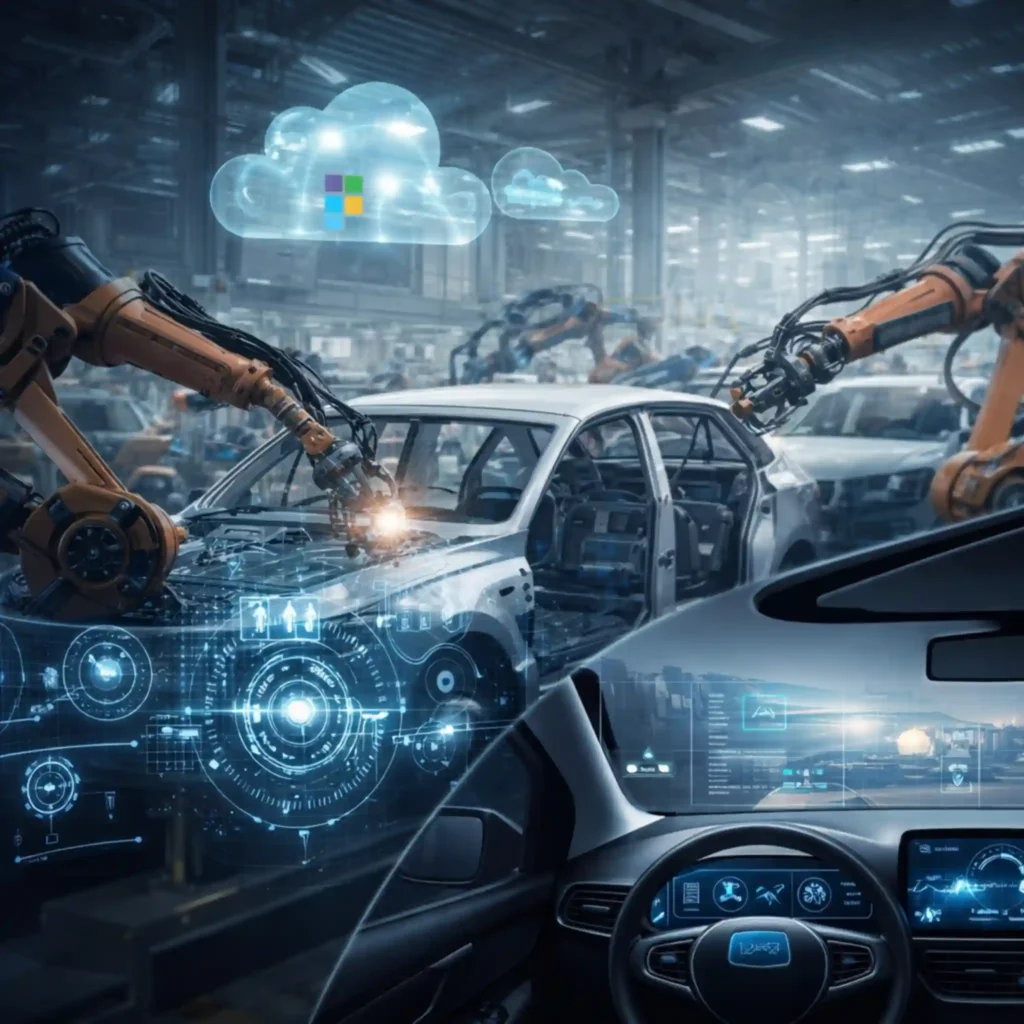

Stellantis stock moved higher on Thursday after the Jeep, Ram, Chrysler, Peugeot and Fiat parent unveiled a sweeping artificial intelligence partnership with Microsoft, giving investors a fresh reason to watch the automaker’s recovery story. Shares of STLA traded around $8.28 in U.S. trading and were up roughly 1.7% on the session as the market reacted to a deal that reaches far beyond a simple software upgrade.
The headline number grabbed attention immediately: Stellantis and Microsoft said they plan to co-develop more than 100 AI initiatives under a new five-year strategic partnership. For a global automaker trying to rebuild momentum, improve internal execution and make its vehicles smarter, that scale matters. This is not one pilot program or one chatbot rollout. It is a broad attempt to plug AI into engineering, cybersecurity, operations, employee workflows and the in-car experience itself.
Microsoft deal gives Stellantis a bigger AI narrative
According to the announcement, Stellantis will use Microsoft’s technology stack to accelerate AI-led transformation across the company. The partnership covers product development, digital engineering, cybersecurity and customer-facing experiences. That makes the Microsoft relationship important not only for efficiency but also for perception. Investors increasingly reward manufacturers that look capable of competing in a software-driven auto market, and Stellantis is clearly trying to show it can do that.
One of the most visible pieces of the plan is the idea of an AI agent that can appear directly in Stellantis vehicles. In practical terms, that could mean maintenance suggestions on the dashboard, smarter route recommendations, and more contextual digital assistance for drivers. Those kinds of features matter because the automotive market is shifting toward connected, software-defined vehicles where recurring digital value can become just as important as horsepower, design or fuel economy.
The Microsoft tie-up also reaches deep into the company’s internal systems. Stellantis said all employees now have access to Microsoft Copilot, while at least 20,000 employees have access to Microsoft 365 Copilot. That detail is easy to miss, but it shows the deal is designed to reshape day-to-day work across the enterprise, not just produce a few customer-facing AI tools. Faster internal workflows, better document handling, code support, analytics assistance and engineering productivity are all part of the broader pitch.
Cybersecurity, engineering and execution are now part of the story
Another major piece of the partnership is security. Stellantis said it plans to build an AI-driven global cyber defense center using Microsoft technology. That center is expected to monitor and help protect the company’s IT systems, connected vehicles and manufacturing sites. For automakers, cybersecurity is no longer a back-office issue. As vehicles become more connected and factories become more digitized, the risk surface expands dramatically. A security breach can hit production, customer trust and regulatory confidence at the same time.
Stellantis also pointed to AI-powered product development as part of the collaboration. That matters because the company has been under pressure to speed decision-making, improve model planning and sharpen execution after a difficult stretch. AI tools that can help engineering teams simulate outcomes, process data faster and identify inefficiencies earlier may not sound flashy, but they could have a real impact on margins and time to market if deployed well.
This is also not Stellantis’ first AI move. The company has already shown a willingness to lean on outside partners. In March, Palantir announced a renewed and expanded five-year relationship with Stellantis focused on data and artificial intelligence. That followed earlier AI-related projects, including marketing work and experimentation with generative tools. The Microsoft partnership, however, looks broader and more visible, especially because it touches both enterprise systems and the future driver experience.
Why the market reacted
The stock reaction was not only about AI buzz. Stellantis has also given investors signs that the operating picture may be stabilizing. The company recently reported that global first-quarter shipments rose about 12% year over year to roughly 1.36 million vehicles. North America was a key driver, with shipments up about 17% to approximately 379,000 units. Europe also improved, with volumes rising by about 12%. Those figures gave the market evidence that Stellantis still has meaningful scale and demand recovery potential even after a rough 2025.
That rough patch is still part of the valuation debate. Stellantis reported €153.5 billion in 2025 net revenues, down 2% from the prior year, and posted a €22.3 billion net loss tied largely to €25.4 billion in unusual charges. Industrial free cash flow in the second half of 2025 was negative €4.5 billion. Those are not small setbacks, and they explain why STLA has traded at a depressed level compared with some peers.
That is exactly why the Microsoft deal matters. Investors do not need Stellantis to become a pure software company overnight. They do need to see a credible path toward better execution, smarter vehicles, stronger digital services and tighter cost control. If AI helps the company streamline engineering, improve security, support employees and create better in-car experiences, the market may start assigning more value to that transition.
For now, the stock’s move reflects renewed interest rather than a final verdict. STLA remains a turnaround story, but Thursday’s announcement gave the market a tangible catalyst: a five-year Microsoft partnership, a plan for 100-plus AI initiatives, broader Copilot adoption across the workforce, and a stronger digital narrative at a time when traditional automakers are under pressure to prove they can evolve. Investors will get another important checkpoint when Stellantis reports first-quarter 2026 financial results on April 30, with its investor day scheduled for May 21. Until then, the Microsoft deal has clearly put Stellantis back on the radar.
For more on Microsoft’s enterprise AI ecosystem, see Microsoft 365 Copilot for business.
You may also like: Panda Mart Brisbane store expansion sparks safety concerns

Make Swikblog your go-to source on Google for reliable updates, smart insights, and daily trends.