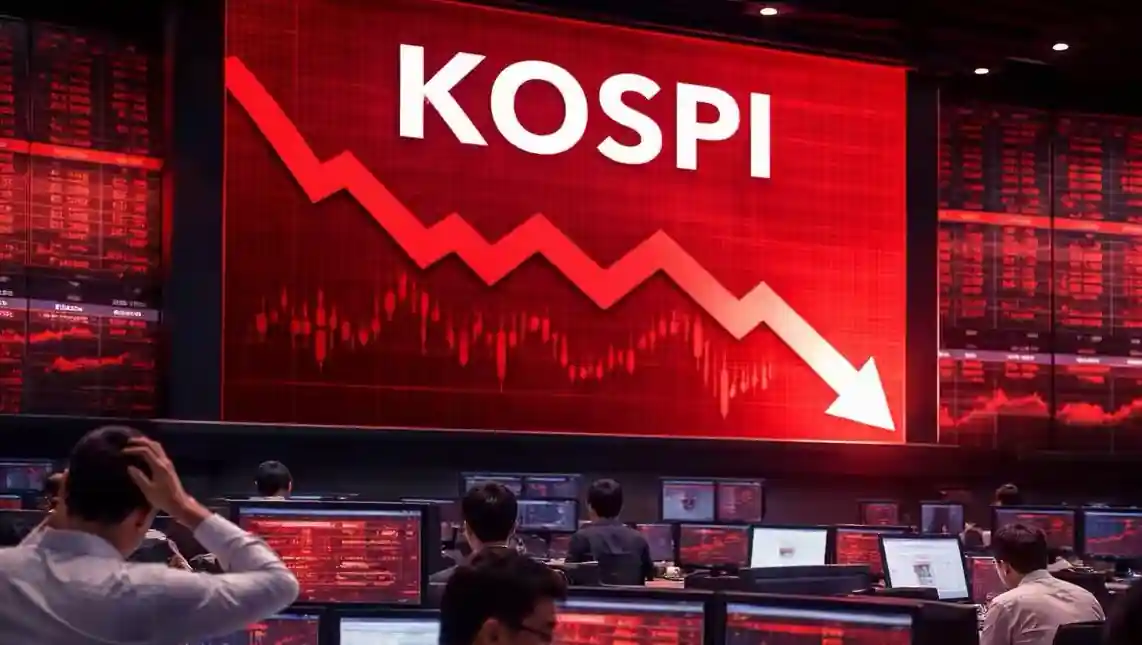
U.S. stock futures moved lower on Monday, September 14, with Nasdaq 100 futures falling approximately 1.2% to 1.3% as an AI-stock sell-off spread from Asia while oil prices climbed above $107 a barrel.
Nasdaq 100 futures were trading near 29,000, down roughly 370 to 387 points. S&P 500 futures fell approximately 0.5% to around 7,621.50, while Dow futures were down between 0.1% and 0.3%, near 52,525.
| Market | Latest level | Move |
|---|---|---|
| Nasdaq 100 futures | Around 29,000 | −1.2% to −1.3% |
| S&P 500 futures | Around 7,621.50 | −0.5% |
| Dow futures | Around 52,525 | −0.1% to −0.3% |
| Brent crude | About $107.66 | +2.9% |
| WTI crude | About $102.48 | +2.4% |
| 10-year Treasury yield | 4.97%–4.98% | Near multiyear high |
Futures and commodity prices change continuously. These figures represent a Monday morning snapshot and may differ by the U.S. opening bell.
AI sell-off spreads through global technology stocks
The Nasdaq decline followed losses in Asian companies closely connected to artificial intelligence and semiconductor spending. SoftBank shares plunged as much as 13% in Tokyo because of the company’s exposure to OpenAI and the wider AI investment cycle.
Kioxia Holdings dropped as much as 7.9%, while South Korea’s SK Hynix declined 4.3% and Samsung Electronics fell approximately 2.5%. Taiwan Semiconductor Manufacturing Company lost around 0.8%.
Japan’s Nikkei 225 fell as much as 1.6% to approximately 62,977, while South Korea’s Kospi dropped around 2.4%. The moves show that the AI warnings produced a measurable sector reaction beyond U.S. futures.
The selling followed Anthropic CEO Dario Amodei’s call for a slower and more closely supervised approach to developing advanced AI systems. OpenAI CEO Sam Altman and Elon Musk supported the broader demand for caution.
The executives did not announce an immediate halt to AI development. However, investors are considering whether stronger safeguards, independent testing or future government restrictions could slow deployments and weaken expected returns on costly AI infrastructure.
Those concerns arrive as markets are already examining whether unprecedented technology spending will generate profits quickly enough. The same question became important after Oracle’s results revealed the scale of AI cloud demand and infrastructure investment.
$107 oil adds another problem before the Fed meeting
The technology sell-off is only one side of the market story. Brent crude climbed approximately 2.9% to $107.66 a barrel, while WTI rose about 2.4% to $102.48.
The increase followed the shutdown of Saudi Arabia’s East-West pipeline after an attack. The pipeline can transport up to 7 million barrels per day and allows Saudi oil to reach the Red Sea without passing through the Strait of Hormuz.
Saudi Arabia had not provided a public timetable for completing repairs. If the disruption continues, it could affect supply equivalent to approximately 4% of global oil production.
Security concerns have also increased around Bab el-Mandeb, a narrow shipping route through which as much as 5% of global oil shipments normally pass. The combination of pipeline damage and threats to two major maritime routes explains why crude remained elevated rather than quickly giving back its initial gain.
Higher energy prices can increase gasoline, transport and manufacturing costs, complicating the Federal Reserve’s attempt to control inflation. Markets were indicating close to a 90% probability of a quarter-point rate increase at the Fed’s September 15–16 meeting.
The 10-year Treasury yield climbed to approximately 4.97%–4.98%, while the 30-year yield moved above 5.35%. Higher bond yields typically place greater pressure on expensive technology stocks because future corporate earnings are discounted at a higher rate.
Leadership questions can add further uncertainty at major technology companies, as seen in recent discussion surrounding Apple shares and Tim Cook’s future.
The difference between Nasdaq and Dow futures suggests that the selling remains concentrated in technology. Nasdaq futures were down more than 1.2%, compared with a decline of no more than 0.3% in Dow futures.
Investors will now watch the U.S. opening bell, Saudi Arabia’s pipeline assessment and any new signal from the Federal Reserve. A recovery in technology shares could reduce the Nasdaq loss, but another rise in oil or Treasury yields could extend the pressure across the broader market.
This report is for informational purposes only and does not constitute investment advice.
Sources: Financial Times, The Wall Street Journal, Barron’s and Federal Reserve.

Make Swikblog your go-to source on Google for reliable updates, smart insights, and daily trends.