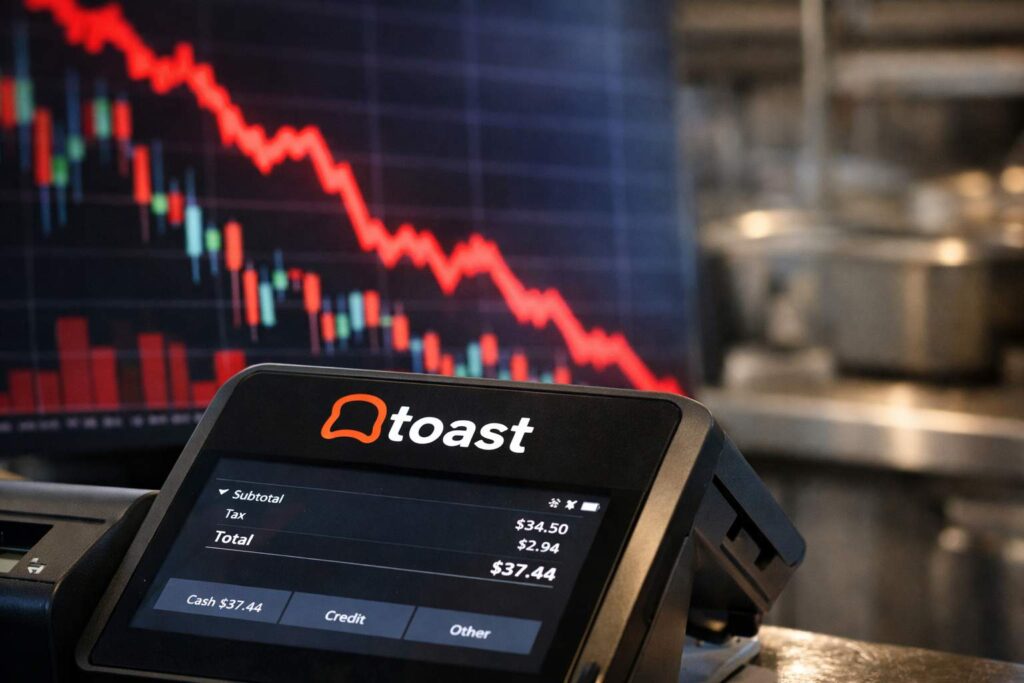

Toast (NYSE: TOST) shares have fallen roughly 25% in 2026, sliding to around $26 as investors reacted to weaker guidance, slowing payments momentum, and signs of softer restaurant demand. The stock’s decline reflects a fast change in investor mood: what was once treated as a premium growth story is now being judged through a tougher lens shaped by macro caution, valuation pressure, and rising concern about consumer-facing businesses.
The immediate issue for the market is not that Toast’s business has broken down. It is that expectations were high, and management’s outlook suggested the pace of growth may become more measured as the year unfolds. For a company valued for expansion, any sign of moderation can hit hard. Investors appear to be recalibrating what they are willing to pay for a platform tied closely to restaurant spending and payment volumes.
That helps explain why the selloff has been so sharp. Toast operates at the intersection of software, fintech, and restaurants, which means it has exposure to several parts of the market that have faced pressure this year. Software multiples have compressed, payments stocks have lost some of their premium, and restaurant-related names have become more sensitive to worries about consumer demand. Toast is feeling the effect of all three at once.
The company’s model makes that exposure especially important. Toast is not just a subscription software provider. It also earns money from payment processing, which ties a meaningful part of its revenue to the day-to-day performance of restaurant customers. If diners pull back, if average ticket sizes soften, or if restaurant openings slow, Toast can feel the impact in transaction activity as well as in broader investor sentiment.
Financially, the company is still growing at a healthy pace. In its latest results, Toast reported quarterly revenue of about $1.6 billion, reflecting strong year-over-year growth. Gross payment volume remained above the $50 billion annualized level, while subscription and financial technology gross profit continued to rise at a solid double-digit pace. Those numbers show that the platform is still adding scale even as the market questions how durable that growth will be.
Margins have improved as well, which is one of the more important pieces of the story. Toast has been working to prove that it can do more than grow rapidly. It wants investors to see a business capable of expanding profitably as it matures. Adjusted EBITDA has moved higher, and cost discipline has started to show through more clearly. That shift matters because the market is increasingly rewarding companies that can pair growth with stronger earnings quality.
Still, the tone of forward guidance appears to have unsettled investors. Management’s outlook pointed to continued growth, but not at the pace some shareholders may have hoped for. That is a critical distinction. In the current market, a company does not need to miss badly to see its stock fall. It simply needs to suggest that future upside may be more limited than the market had priced in before.
The payments business is central to that debate. It is a strategic strength because it deepens Toast’s customer relationships and creates recurring monetization opportunities beyond software subscriptions. But it also carries lower margins than pure software revenue, and it is more sensitive to transaction trends. If payment volume growth slows, investors naturally start asking whether overall profitability can keep improving at the same rate.
That is where investor sentiment has shifted. Bulls still see a large opportunity. Toast remains underpenetrated in a fragmented restaurant technology market, and many operators still rely on older systems. The company also has room to expand further into enterprise chains, food retail, and international markets. On that view, the recent decline looks more like a valuation reset than a sign of structural damage.
Bears see something different. They argue that Toast may continue to grow, but at a pace that no longer supports the premium multiple the stock once enjoyed. If restaurant spending stays uneven and payments growth keeps slowing, the market may treat Toast as a more cyclical, consumer-linked fintech name rather than a high-multiple software leader. That change in classification can have a major impact on how the stock trades, even if operations remain solid.
The broader backdrop adds another layer of pressure. Investors have become more selective across tech, especially in businesses tied to discretionary spending. While Toast is less exposed than many software companies to direct disruption from artificial intelligence, it is not immune to a wider sector rerating. Markets are favoring predictability, steadier margins, and cleaner earnings visibility, and Toast’s transaction-linked model naturally creates more debate around those points.
There are also macro questions hanging over the story. Restaurant demand is often a useful real-time measure of consumer confidence. If households become more cautious, dining out can be one of the first areas where spending softens. That does not necessarily mean Toast’s long-term thesis is in trouble, but it does mean near-term revenue growth can become harder to forecast, especially when investors are already uneasy.
Analysts and investors are now watching a few metrics very closely. Net location additions will matter because they show whether Toast can keep winning new business despite a tougher backdrop. Gross payment volume trends will offer a direct look into customer activity. Margin performance will show whether the company can continue turning scale into stronger profitability. Any commentary around demand, retention, and same-store sales could also influence how the market values the stock from here.
There is a credible argument that the recent weakness could create an opportunity if Toast proves the slowdown is temporary. The company remains deeply embedded in restaurant workflows, and switching away from its platform is not easy once operators depend on it for payments, payroll, online ordering, and front-of-house operations. That stickiness gives the business resilience that may not be fully reflected in a market focused on the next quarter or two.
For now, though, the market is demanding more evidence. Investors want to see that slowing payments growth and softer restaurant demand are manageable, not the start of a deeper issue. Until Toast can show that growth remains durable and margins can keep moving higher, the stock may continue to trade under pressure even if the business itself remains on a solid footing. One useful reference point for investors tracking broader market reaction to growth and consumer-linked tech stocks can be found on MarketWatch.
You may like: Oracle Building Hit in Dubai as Iran Targets US Tech Giants in Escalating ConflictAuthor Bio
Chetan is a Swikblog writer with 5 years of experience covering global news, stock market developments, and trending topics, focusing on clear reporting and real-world context for fast-moving stories.

Make Swikblog your go-to source on Google for reliable updates, smart insights, and daily trends.