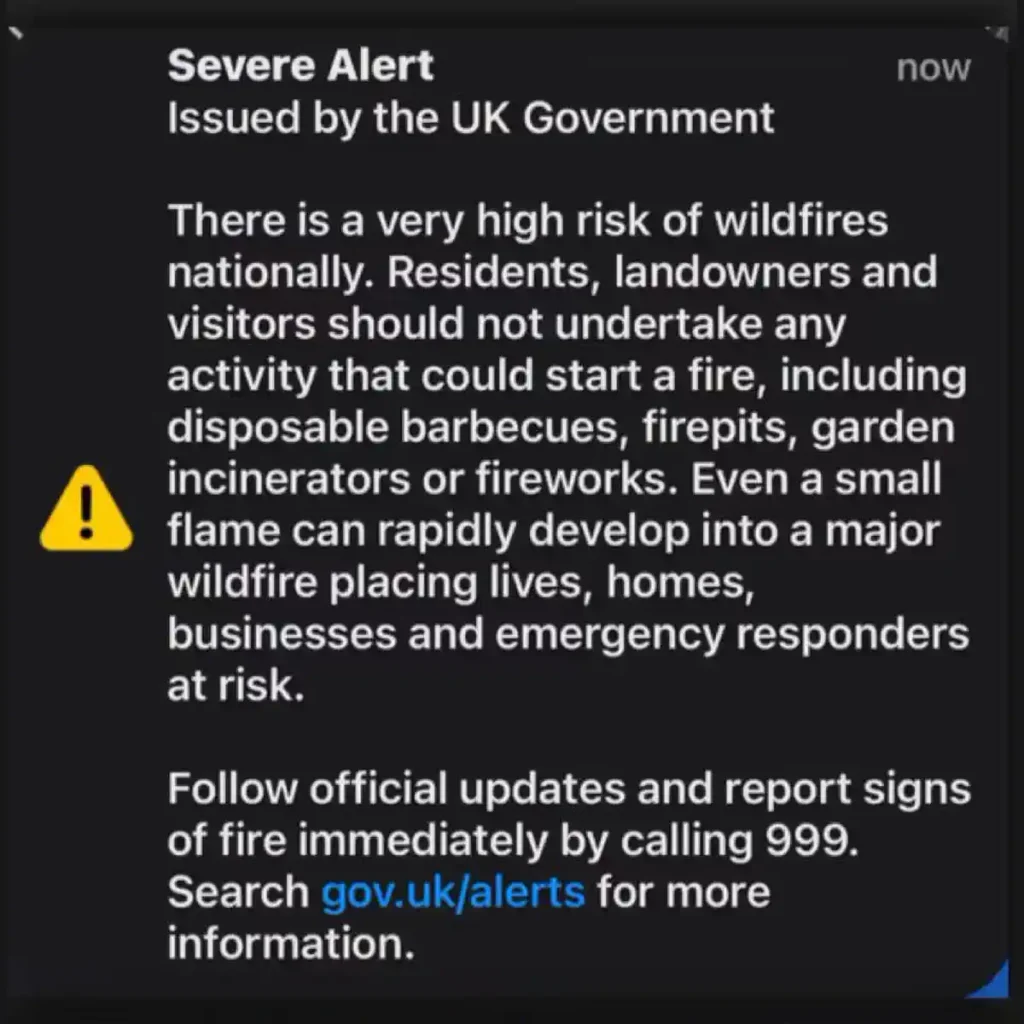

Millions of mobile phones across England and Wales sounded a loud emergency alarm on Friday evening after the UK Government warned that extreme heat and dry ground had created a very high risk of wildfires.
The English alert began reaching compatible devices at 7:01pm on 14 August 2026. Residents, landowners and visitors were advised not to use disposable barbecues, firepits, garden incinerators or fireworks because a small flame could quickly become a major fire.
Transmission ended at 11pm, but that did not mean the danger had passed. Grassland, gardens, woodland and moorland could remain highly combustible until sustained rain improved conditions.
Why phones received the UK severe alert
The message was distributed through mobile phone masts instead of conventional text messages. Compatible 4G and 5G devices inside the selected area could receive it automatically without registration, Wi-Fi or mobile data.
Emergency alerts are intentionally difficult to miss. A supported phone may make a siren-like sound, vibrate and display the warning even when set to silent. The alarm usually lasts around 10 seconds, although the notification can remain visible afterwards.
A Welsh-language alert was sent to Wales at 6:57pm, followed by the English version at 7:01pm. This helps explain why some people received two notifications. Other apparent repetitions may have involved delayed delivery or messages remaining in a phone’s notification centre.
A device may not receive the warning if it is switched off, in aeroplane mode, connected only to a 2G or 3G network, using unsupported software or outside the targeted area during transmission.
The alert’s wording, time and affected area can be checked through the official GOV.UK emergency alert record. A notification still visible on a phone does not necessarily mean another warning has been issued.
Wildfires, restrictions and misleading messages
The warning followed a series of serious fires during intense summer heat. More than 1,000 wildfires had been recorded across England and Wales during 2026, while officials said dozens were still smouldering.
Temperatures reached 38.1°C at Kew Gardens on Thursday before London recorded 34.3°C on Friday. Heat had already disrupted daily life, including measures similar to those introduced when Oxfordshire schools closed early during a rare red heat alert.
Stourbridge in the West Midlands suffered one of the most damaging incidents, with 19 homes destroyed and several residents and firefighters taken to hospital. Fires were also reported in South Wales, Tamworth, Sheffield, Stoke-on-Trent and Hornchurch.
13 Asylum Hotels Closing Across England — Will Migrants Be Moved to HMOs?
EES Border Checks for Brits: EU Considers Changes Before September 6
At Hornchurch Country Park, approximately 90 firefighters and 14 engines responded to a blaze producing substantial smoke. The scale of such incidents explained why authorities wanted to prevent further avoidable fires.
The government temporarily banned sales of disposable barbecues and instructed retailers to remove them from shelves. The measure concerned sales and did not make possession of every barbecue a criminal offence.
People were nevertheless advised to avoid outdoor flames. Barbecues should never be left unattended and must be fully extinguished. Cigarettes should be disposed of safely, glass bottles should not be left outdoors and vehicles should not be parked on dry grass.
Anyone seeing smoke or a developing fire should move to safety and call 999. People should not approach wildfires for photographs or attempt to fight a spreading blaze without suitable training.
Around 100 military personnel were deployed to assist operations in South Wales, with another 100 assigned to major-incident areas. Emergency funding was offered to pressured fire services, while councils could seek recovery support through the Bellwin Scheme.
The government also announced a national wildfire summit and referred to £97 million in investment for specialist equipment and training. The wider infrastructure risks of prolonged heat are explained in this report on Britain’s electricity grid warning during the 40°C heatwave.
One circulated image falsely claimed that the government had issued an alert about an “invasion” involving illegal immigrants. That wording is absent from the official archive. The genuine warning concerned wildfire danger exclusively.
Authentic UK emergency alerts identify the issuing authority and provide safety instructions. They do not ask for passwords, payments or banking details. Suspicious screenshots should be checked against the official government record before being shared.

Make Swikblog your go-to source on Google for reliable updates, smart insights, and daily trends.