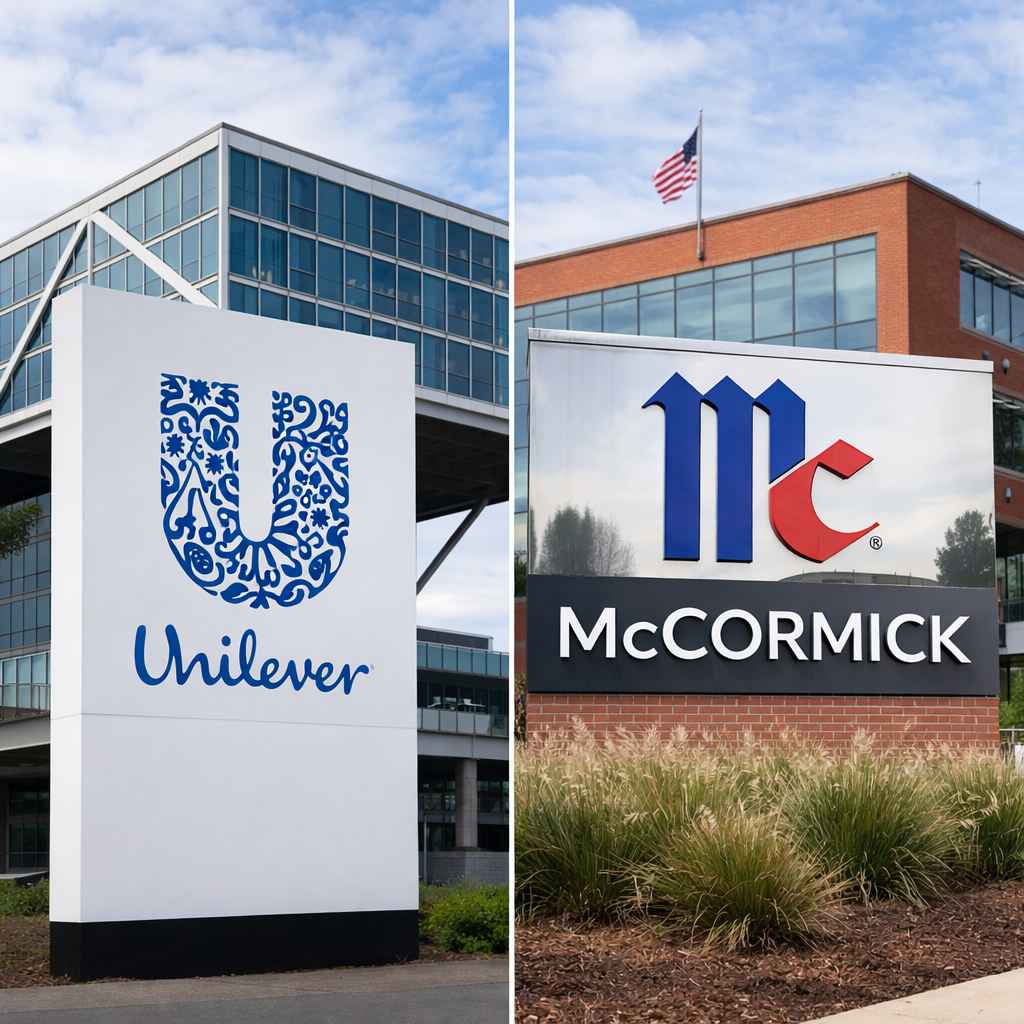

Unilever shares rose to 4,572 on Tuesday after the consumer goods giant confirmed it is in advanced talks to merge its food business with US-based McCormick & Company in a deal valued at around £11.9 billion ($15.7 billion). The potential transaction, which could be announced as early as today, would create a combined food entity worth close to $60 billion, marking one of the biggest strategic overhauls in Unilever’s recent history.
The proposed deal is expected to include a mix of cash and equity, with roughly $16 billion in cash forming part of the structure. Under the terms being discussed, Unilever and its shareholders would end up owning approximately 65% of the newly combined company. The transaction is also reportedly being structured as a reverse Morris trust, a move designed to maximize tax efficiency for shareholders.
Markets reacted positively to the development, with Unilever stock moving higher as investors interpreted the deal as a clear signal that the company is accelerating its shift away from slower-growth food operations and doubling down on higher-margin categories.
Deal signals major strategic shift
The food business has long been a core part of Unilever’s identity, anchored by globally recognized brands such as Hellmann’s mayonnaise, Knorr soups, Marmite, and Colman’s mustard. However, in recent years, the company has been steadily reducing its exposure to food and reshaping itself around beauty, personal care, and home products.
If completed, the deal would effectively separate Unilever’s food division into a standalone powerhouse alongside McCormick, which owns leading brands such as French’s mustard, Old Bay seasoning, and Cholula hot sauce. McCormick currently has a market value of just over $14 billion, but the combined entity would be significantly larger, creating a dominant global player in condiments, spices, and packaged food products.
The strategic logic is straightforward. By merging with McCormick, Unilever’s food assets gain scale, distribution strength, and category leadership, while the parent company becomes more focused on segments that have been delivering stronger growth.
Unilever’s beauty and wellbeing division has been a standout performer in recent quarters, benefiting from strong consumer demand and premium product positioning. Brands such as Dove, Vaseline, Radox, and Persil have continued to drive revenue momentum, reinforcing the company’s pivot toward higher-margin categories.
Part of a broader transformation
This is not an isolated move. Unilever has been actively reshaping its portfolio over the past few years. In 2025, the company spun off its ice cream business into a separate entity, the Magnum Ice Cream Company, which was listed in Amsterdam with secondary listings in New York and the UK.
It has also divested several food-related businesses, including snacking brand Graze and plant-based label The Vegetarian Butcher. At the same time, Unilever has been expanding its presence in personal care through acquisitions such as Wild and Dr Squatch, both fast-growing brands in the premium segment.
The potential McCormick deal fits neatly into this broader strategy. Rather than exiting food entirely, Unilever would retain a significant stake in a much larger and more competitive food company, while simplifying its own corporate structure.
From an investor perspective, this kind of restructuring often leads to improved valuation clarity. Conglomerates with diverse business lines can sometimes trade at a discount because of complexity. By focusing on fewer, higher-growth segments, Unilever may be aiming to unlock stronger long-term shareholder value.
Investor reaction and market implications
McCormick shares also moved higher following the news, rising around 1.5% in after-hours trading, signaling confidence that the deal could deliver meaningful synergies. Analysts expect cost efficiencies, improved global distribution, and stronger pricing power to emerge from the combination.
The timing of the deal is also notable. Reports suggest the announcement could align with McCormick’s quarterly earnings release, a move that could help frame the transaction within a broader financial narrative for investors.
Still, Unilever has cautioned that while discussions are at an advanced stage, there is no certainty that a final agreement will be reached. Deal negotiations of this scale often involve complex considerations, including governance, valuation adjustments, and regulatory approvals.
For now, the market appears to be pricing in optimism. The rise in Unilever’s share price reflects growing confidence that the company is moving decisively toward a more focused and potentially higher-growth future.
If the transaction goes through, it would mark a defining moment for Unilever, transforming it from a broad-based consumer conglomerate into a more streamlined business centered on beauty, personal care, and home products, while still maintaining a strong economic interest in a newly formed global food giant.
Further details on the deal discussions were reported by Yahoo Finance.

Make Swikblog your go-to source on Google for reliable updates, smart insights, and daily trends.