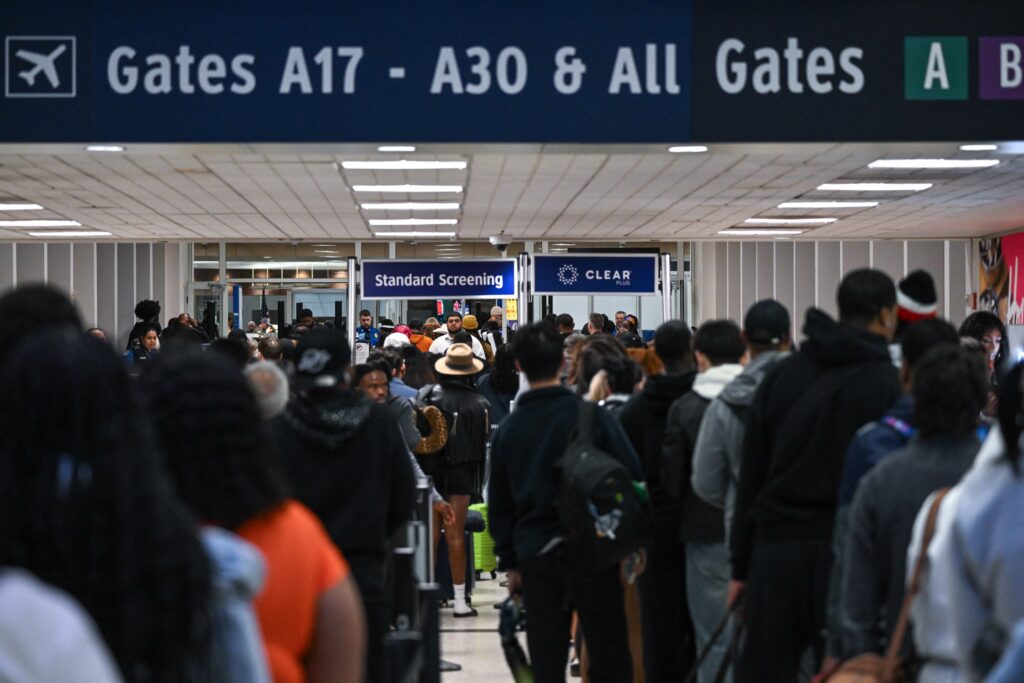

Travel disruptions across the United States are intensifying as a prolonged federal funding crisis begins to directly impact airport operations. US Government Shutdown Causes Airport Delays Due to TSA Staffing Shortages, Wait Times Hit 2 Hours is no longer a warning — it is now a widespread reality for passengers navigating security checkpoints nationwide.
With the Department of Homeland Security (DHS) shutdown stretching into weeks, Transportation Security Administration (TSA) officers — classified as essential workers — are continuing to report for duty without pay. The result is mounting staffing shortages, rising absenteeism, and sharply longer screening lines at some of the busiest travel hubs in the country.
Security wait times surge at major US airports
Airports in Houston, Texas, and Queens, New York, have reported some of the most severe delays, with security wait times reaching up to two hours during peak travel periods. At New York’s John F. Kennedy International Airport, one of the busiest international gateways in the world, wait times climbed as high as 42 minutes at Terminal 4, even outside extreme peak congestion.
Houston’s George Bush Intercontinental Airport issued a direct warning to travelers: long lines are continuing and wait times can fluctuate significantly throughout the day. Similar scenes have been captured in viral videos showing passengers stuck in slow-moving queues stretching across terminals.
Even airports attempting to manage crowd flow are struggling to keep up. Officials at JFK acknowledged the issue, stating that due to federal shutdowns, TSA wait times may be longer than usual and advising passengers to allow extra time before departure.
TSA staffing crisis deepens as workers miss paychecks
The root of the disruption lies in a growing staffing imbalance. TSA officers have now gone for weeks without pay, a situation that is increasingly affecting attendance and morale. While they are legally required to work, the financial strain is beginning to translate into higher call-out rates, leaving fewer officers available at checkpoints.
Acting deputy TSA administrator Adam Stahl issued a stark warning earlier this week, noting that the agency has already exhausted its national deployment resources. “We’re fully stretched,” he said, adding that if absenteeism continues to rise, authorities may have to consider shutting down operations at certain airports — particularly smaller regional facilities.
This marks a significant escalation in concern, as TSA staffing is a critical component of the entire aviation system. Unlike airline delays or gate changes, bottlenecks at security checkpoints affect nearly every passenger and can quickly cascade into broader travel disruptions.
Flight delays and cancellations rise across the network
The strain on airport operations is already visible in flight data. As of Friday morning, there were 2,551 flight delays and 105 cancellations within, into, or out of the United States, according to aviation tracking platforms.
These numbers reflect how quickly localized issues at security checkpoints can ripple through the broader airline network. Passengers delayed at screening may miss boarding windows, forcing rebookings and contributing to downstream congestion at gates, customer service counters, and connecting flights.
Travelers are also reporting discrepancies between official wait-time estimates and real-world conditions. At Miami International Airport, for example, a posted wait time of 18 minutes turned into nearly two hours for some passengers, highlighting the unpredictability of the current situation.
Shutdown driven by political deadlock over immigration policy
The ongoing disruption stems from a broader political impasse in Washington. The Department of Homeland Security has been shut down since mid-February after lawmakers failed to reach an agreement on funding, largely due to a Senate deadlock over stricter federal immigration enforcement policies.
The standoff is tied to broader debates surrounding nationwide immigration crackdowns and enforcement priorities, making a near-term resolution uncertain. Until funding is restored, TSA and other DHS-linked operations will continue to operate under constrained conditions.
Transportation Secretary Sean Duffy has warned that the current level of disruption may only be the beginning. With TSA workers set to miss additional pay cycles, he cautioned that what travelers are experiencing now could “look like child’s play” compared to what lies ahead if the shutdown persists.
Spring travel demand adds pressure to an already strained system
The timing of the crisis is particularly challenging. Airlines for America estimates that approximately 121 million passengers will travel in the coming weeks, representing a 4% increase compared to the same period last year.
This surge in demand is colliding directly with reduced TSA staffing capacity, creating a high-risk environment for widespread delays. Even small inefficiencies at checkpoints can quickly escalate when passenger volumes spike, especially during peak morning and evening travel windows.
For airlines and airports, this creates a difficult balancing act. While carriers are prepared for seasonal demand, they have limited control over federal security operations, making it harder to mitigate delays at the source.
What travelers should expect and how to prepare
For passengers, the immediate takeaway is clear: airport travel in the United States is currently less predictable and requires more preparation than usual. Experts recommend arriving significantly earlier than standard guidelines, particularly for international flights and departures from major hubs.
Travelers should also monitor real-time updates on security wait times and flight statuses. Official guidance and checkpoint updates can be accessed via the TSA website, while broader flight delay trends are available through platforms like FlightAware.
Additional strategies include enrolling in expedited screening programs where available, avoiding tight layovers, and being aware of airline flexibility policies. In some cases, airlines may accommodate passengers who miss flights due to extended security delays under informal policies such as the “flat-tire rule.”
Growing uncertainty if shutdown continues
The longer the DHS shutdown continues, the more fragile the travel system becomes. With staffing reserves depleted and TSA officers under financial strain, the risk of deeper disruptions — including potential airport operational limits — is increasing.
For now, travelers should expect longer lines, fluctuating wait times, and the possibility of cascading delays. Until a political resolution is reached, the current airport chaos is likely to remain a defining feature of the US travel landscape.

Make Swikblog your go-to source on Google for reliable updates, smart insights, and daily trends.