
A water bill in the United States can look simple at first glance, but the amount due usually reflects much more than the water coming out of a kitchen tap. In 2026, many households are paying closer attention to utility bills as local water systems deal with aging pipes, treatment costs, energy expenses, drought pressure and higher maintenance needs.
The clearest way to understand a water bill is to look at three things: how much water the household used, which rate structure the local utility applies, and which fixed fees or sewer charges are added on top. Once those pieces are clear, a confusing bill becomes much easier to read.
CCF, gallons and household water usage
Most US water bills measure usage in either gallons or CCF. CCF stands for centum cubic feet, also called HCF, or hundred cubic feet. One CCF equals 748 gallons. That means a bill showing 10 CCF of usage represents about 7,480 gallons of water for that billing period.
This matters because a household may see a small usage number on the bill and underestimate how much water was actually used. A family of four can use roughly 10,000 gallons in a 30-day period, depending on showers, laundry, toilet use, dishwashing, outdoor watering and leaks.
Usage also changes by region. Homes in drier states often use more water outdoors for lawns, gardens and irrigation. Homes in wetter areas may rely more on rainfall and use less water outside. This is one reason water bills can look very different across the US even when household size is similar.
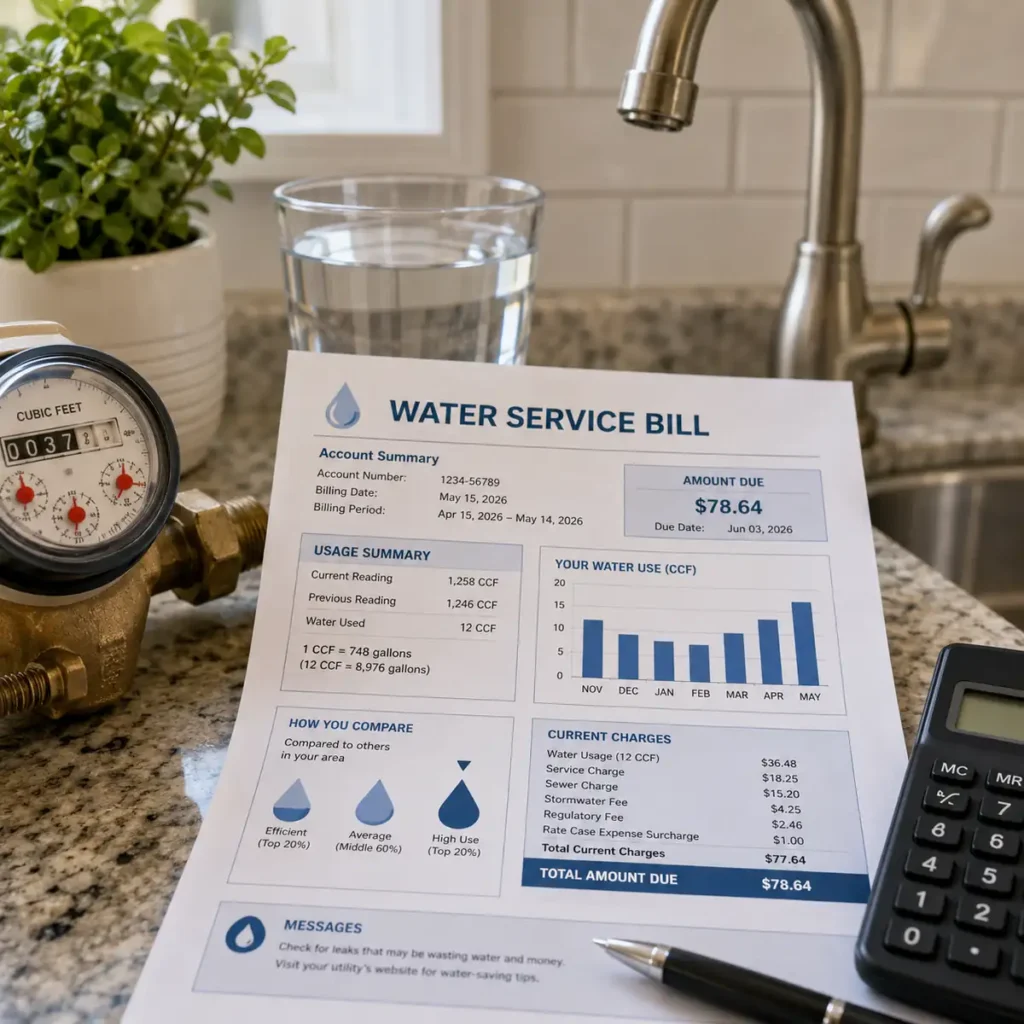
Simple reading tip: If your bill lists usage in CCF, multiply the number by 748 to estimate gallons. For example, 12 CCF equals about 8,976 gallons.
Many utilities also show a usage trend on the bill. This may appear as a graph comparing recent months or the same period from the previous year. A higher summer bill may be linked to lawn watering, pools, gardens or longer outdoor use. A sudden jump during a normal month can point to a leak or meter issue.
Some utilities also compare a household’s usage with nearby homes or similar customers in the same climate area. This comparison is not perfect, but it can help a homeowner see whether their water use is unusually high. In some places, utilities use this kind of information alongside tiered pricing to encourage lower consumption.
Fixed fees, sewer charges and rate tiers
A monthly water bill usually has both fixed and variable charges. The fixed charge is often called a base fee, facility charge or service charge. It helps pay for the pipes, storage tanks, treatment plants, meters, staff, maintenance and loans used to keep the water system running. This charge may appear even when very little water is used.
Water bill price calculation example
A water bill is usually calculated by adding the base service charge, the water usage charge, sewer charges and any local fees or surcharges. The exact numbers vary by city, but the basic calculation is easy to understand.
For example, if a household uses 12 CCF of water in one month, that equals about 8,976 gallons, because 1 CCF equals 748 gallons. If the local utility charges $3.04 per CCF for water usage, the water usage charge would be:
12 CCF × $3.04 = $36.48
The bill may then add a fixed service charge, sewer charge and local fees. A simple example would look like this:
Water usage charge: $36.48
Base service charge: $18.25
Sewer charge: $15.20
Stormwater fee: $4.25
Regulatory fee: $2.46
Other surcharge: $1.00
In this example, the estimated monthly total would be:
$36.48 + $18.25 + $15.20 + $4.25 + $2.46 + $1.00 = $77.64
This is why two households with similar water use may still have different bills. One city may charge a higher base fee, another may have higher sewer rates, and another may apply seasonal or drought-related pricing. The water usage number matters, but the final bill depends on every charge listed in the billing summary.
If the bill uses tiered pricing, the calculation can change again. For example, the first 8 CCF may be charged at a lower rate, while the next 4 CCF may be charged at a higher rate. In that case, the household does not simply multiply total usage by one price. It must calculate each block separately and then add the fixed fees and sewer charges.
The variable charge is tied to the volume of water used. This is the part of the bill households can usually control most directly. Using less water can lower this portion, especially in areas where the price increases after a customer crosses into a higher usage tier.
Many bills also include sewer charges. In some communities, water entering the home and wastewater leaving the home are measured separately. In many others, there is only one meter, so the sewer charge is estimated from the amount of water entering the property. This means a long shower, a leaking toilet or heavy lawn watering can affect more than one part of the bill.
Water utilities use different pricing models. A flat fee charges the same amount regardless of use, though this is now less common because it does not encourage conservation. A uniform rate charges the same price per unit of water throughout the year. An increasing block rate charges more as usage rises, so a household using more water pays a higher price for later blocks of usage.
Some rural or industrial areas may use declining block rates, where higher usage is charged at a lower per-unit price. Seasonal rates are also common, with higher prices during peak months when demand rises. In drought-prone areas, utilities may use drought rates, where prices increase during water shortage conditions to reduce demand.
Another approach is a water budget rate. Under this system, a household receives a water budget based on expected need, such as household size or property size. Water used within the budget is billed at one rate, while water above the budget is charged at a higher rate. This kind of pricing is designed to reward efficient use and discourage waste.
Extra line items can also appear on a bill. These may include regulatory assessment fees, rate case expense surcharges, stormwater charges or capital improvement fees. These charges often help utilities pay for compliance, rate-setting costs, infrastructure upgrades, reservoirs, treatment facilities or long-term pipe replacement.
A high water bill does not always mean the household used more water by choice. One of the most common causes is leakage. A running toilet, dripping faucet, broken sprinkler head or hidden pipe leak can waste thousands of gallons over time. If the bill rises sharply and outdoor watering has not changed, the first step is to check toilets, faucets, irrigation systems and the meter.
The most useful part of a bill is often the billing detail or summary of charges. That section usually separates water use, base fees, sewer charges and surcharges. Reading this section each month can show whether the increase came from actual usage, a higher rate, a new local fee or a seasonal change.
For households trying to manage costs in 2026, the goal is not only to use less water but to understand how the local utility charges for it. A home that stays within a lower usage tier may avoid higher per-unit prices. A family that finds a leak early may prevent both water and sewer charges from rising. A bill that once looked confusing can become a practical tool for spotting waste, tracking seasonal patterns and keeping monthly utility costs under control.

Make Swikblog your go-to source on Google for reliable updates, smart insights, and daily trends.