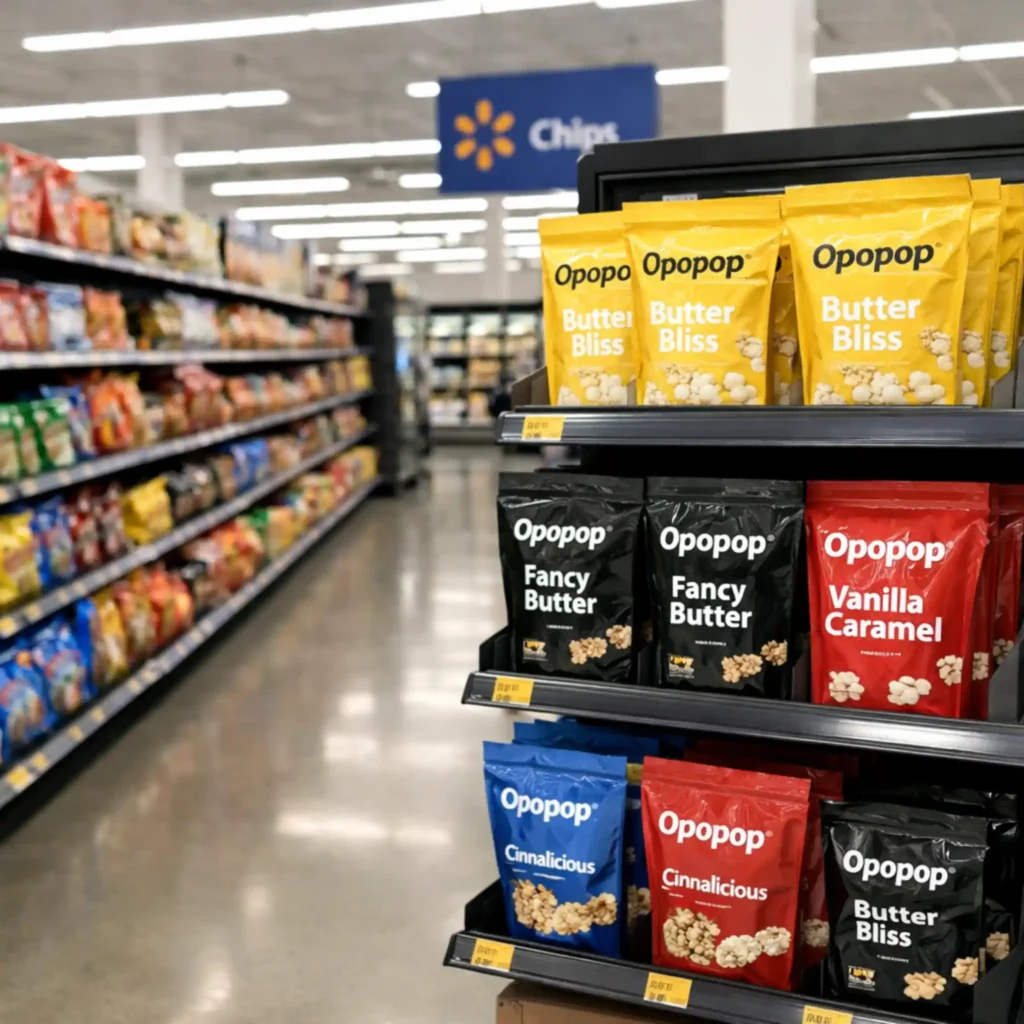

Walmart stock rose 0.84% to $125.79 after the company rolled out Opopop’s premium microwave popcorn line across its U.S. stores, including an exclusive Butter Bliss flavor created specifically for Walmart. The move looks modest on the surface, but investors often pay close attention when the world’s largest retailer uses its shelf space to test a more curated, higher-margin growth idea inside core grocery aisles.
The broader reaction reflects how the market is viewing Walmart’s trajectory rather than any single product launch. The company has already delivered 11.6% year-to-date gains and a strong 52.5% return over the past year, with its five-year gain reaching 188.3%. That sustained performance has shifted investor expectations, with the focus now on whether Walmart can continue expanding margins and unlocking new growth levers beyond its traditional value-driven model.
What makes this rollout notable is that it fits a larger pattern. Walmart is not just trying to sell more groceries. It is trying to make its stores more productive, its assortment more distinctive, and its customer mix more valuable. An exclusive branded snack line gives Walmart a product that competitors cannot directly replicate in the same way, while also reinforcing its push to combine mass-market convenience with selective premium offerings.
That matters because Walmart’s investment story has changed. It is no longer seen only as a defensive retailer that performs well when households trade down. The market increasingly values Walmart as a company with multiple earnings levers: store traffic, e-commerce, membership, advertising, logistics, and data-driven merchandising. Exclusive launches like this one sit right in the middle of that shift. They can support traffic, improve basket mix, and create stronger vendor partnerships without requiring Walmart to move away from its scale-based advantage.
Why investors are paying attention
At a time when many retailers are still navigating cautious consumers and uneven discretionary spending, Walmart is trying to keep its stores fresh without losing its value credentials. A premium snack brand may seem like a small test, but it speaks to a much bigger retail question: can Walmart sell shoppers on convenience and discovery, not just low prices?
If the answer is yes, that has implications for margins. A curated product line can do more than add incremental sales. It can help Walmart increase the quality of those sales. Specialty grocery products often carry stronger pricing power than purely commoditized items, and exclusive partnerships can make shelf space work harder by giving customers a reason to browse rather than simply restock essentials.
The company is also targeting a customer base that has become increasingly important to its recent performance: higher-income shoppers who value convenience, consistency, and broader product choice. Walmart has spent the past several years proving it can attract those consumers while still serving budget-focused households. Premium assortment moves support that balancing act. They can keep Walmart relevant to shoppers who might otherwise split purchases between discounters, grocers, specialty chains, and online platforms.
That is where the bullish case becomes more compelling. Walmart’s scale allows it to take emerging or premium brands national very quickly, while its data advantage gives it a better read on what products may stick. If exclusive launches create repeat demand rather than one-time curiosity, Walmart can improve customer loyalty and strengthen category economics at the same time.
Still, the strategy is not risk-free. The bearish argument is that premium grocery partnerships can complicate inventory management and create pressure on shelf productivity if demand fades after the initial launch window. Walmart’s stores operate on efficiency at massive scale, so any product expansion has to prove it can earn its place. Investors will want evidence that these partnerships are supporting profitable traffic and not simply adding novelty to already crowded aisles.
That debate is unfolding in a market that continues to reward companies with durable demand and multiple profit streams. Interest-rate uncertainty, selective consumer spending, and a more competitive retail environment have made investors more sensitive to execution quality. Walmart has largely stayed in favor because it has shown unusual flexibility: it can benefit from value-seeking behavior during pressure periods, while also expanding into higher-margin businesses when consumer demand stabilizes. As Reuters has highlighted in its coverage of Walmart, investors have increasingly focused on how the retailer is broadening its earnings model beyond its traditional discount roots.
That broader model is important here. A differentiated product does not only matter at the shelf. It can also feed into Walmart’s growing advertising and retail media ecosystem. Brands that want visibility across Walmart’s physical and digital channels can become more valuable partners if the retailer can offer both scale and exclusivity. In other words, an item like Opopop is not just inventory. It can become part of a larger monetization loop that includes promotions, sponsored placement, seasonal campaigns, and data-driven targeting.
For sentiment, this is the kind of development that reinforces confidence rather than radically changes the story. No one is arguing that a premium popcorn rollout will transform Walmart’s earnings on its own. But investors are watching whether management keeps proving that growth can come from a collection of smart, disciplined moves across the business. Each of those moves matters more when the stock already trades with higher expectations than it did a few years ago.
That is also where valuation comes in. Walmart’s recent share performance shows that the market is willing to pay for consistency, resilience, and a more modern retail model. To keep that support, the company has to show that it can defend margins, hold traffic, and keep finding new ways to increase spend per visit. A selective premium rollout inside grocery may look minor, but it fits neatly into that larger effort.
For investors, the key takeaway is not the product itself so much as the signal behind it. Walmart appears increasingly willing to use its physical footprint not just as a distribution advantage, but as a testing ground for more differentiated, service-linked, and margin-aware growth. That is a meaningful message from a retailer whose next phase is being judged not only by scale, but by how intelligently it can turn that scale into better-quality earnings.
You May Also Like
Author Bio
Swikriti is a Swikblog writer with 9 years of experience focusing on financial markets, stock analysis, and high-impact global news with a strong editorial perspective.

Make Swikblog your go-to source on Google for reliable updates, smart insights, and daily trends.