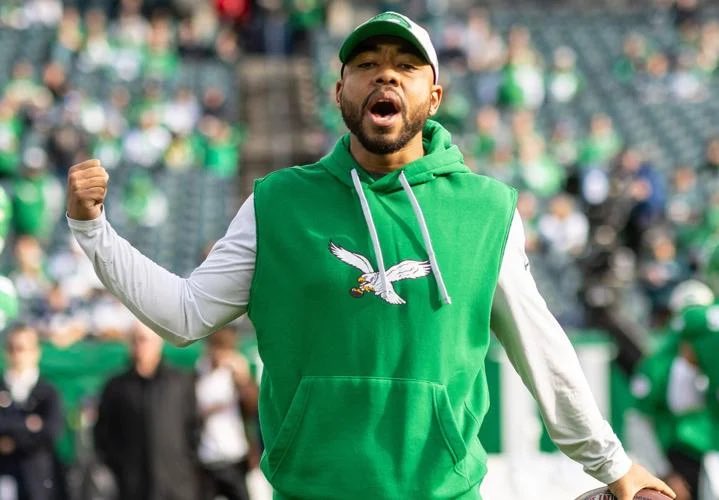
The Dallas Cowboys’ defensive rebuild has taken them straight into familiar enemy territory. After a season in which Dallas was carved up through the air and finished at the bottom of the league in points allowed, the franchise has moved to make one of the offseason’s boldest coaching bets: prising an up-and-coming assistant from the Philadelphia Eagles and asking him to fix what looked broken at every level.
Christian Parker, 34, is the name at the center of that gamble — a fast-rising secondary coach and passing game coordinator whose profile has surged inside NFL coaching circles in just a few years. Dallas has been working to bring Parker in as defensive coordinator, a move reported by NFL Network as the Cowboys search for a new identity on defense after a miserable 2025 campaign.
For casual fans, Parker can seem like an overnight figure — the sort of assistant whose name appears on a hiring ticker and is immediately paired with words like “rising star”. But his path explains why Dallas sees promise. Parker’s NFL coaching career began in Green Bay in 2019 as a defensive quality control coach, the kind of role built on film study, game-plan detail and the quiet daily grind that rarely comes with public credit. From there, he moved to Denver and took on the defensive backs room, working in a system shaped by Vic Fangio’s defensive principles.
That connection matters because it helped set up Parker’s biggest leap. When Fangio’s influence reached Philadelphia, Parker followed — and his two seasons with the Eagles have become the clearest “why now” argument for a promotion. Philadelphia’s pass defense has been a consistent strength under his watch, and the numbers tell the story in blunt contrast: the Eagles were among the league’s most difficult teams to throw on in recent seasons, while the Cowboys turned into the opponent quarterbacks circled on the calendar.
In 2024, Philadelphia ranked first in passing yards allowed and kept passing touchdowns conceded among the NFL’s lowest totals. This past season, the Eagles again finished among the league’s better pass defenses — top-10 in passing yards allowed — while also leading the NFL in limiting passing scores, surrendering just 14 touchdown passes. It’s the kind of profile that gets assistants noticed, especially when the rest of a defense is functioning and the secondary looks coached, connected and disciplined.
Dallas, meanwhile, is hiring for urgency. The Cowboys’ 2025 defense was routinely overwhelmed, finishing last in points allowed and near the bottom in yards conceded. Through the air, it was especially bleak: Dallas ranked last in passing yards allowed and was among the league’s worst in passing touchdowns surrendered, giving up 35 scores via the pass. It was a collapse that forced ownership and the new coaching staff to treat the defensive coordinator role as the quickest lever to pull.
The result was a swift exit for Matt Eberflus after just one season, and a search that reportedly spanned a long list of interview requests. Parker stood out not only because of the improvement in Philadelphia’s coverage unit, but because his rise suggests a modern coordinator prototype: younger, system-literate, and specific about how coverage ties into pressure and disguise. For Dallas, that last piece matters. The Cowboys don’t just need better players — they need a coherent plan that stops the bleeding on third down, reduces explosive plays, and restores confidence to a roster that spent 2025 chasing shadows.
There’s also the rivalry edge. Hiring within the NFC East always comes with extra heat, and the symbolism is hard to miss: Dallas turning to an Eagles coach for answers about how to defend. It is, in its own way, an admission that Philadelphia has looked more stable, more modern and more aligned on defense — and that the Cowboys want some of that DNA in their own building.
Parker’s market this offseason underlines the point. Green Bay also showed interest, and the timing became part of the story: Dallas appeared ready to move quickly, while other teams were still in the early stages of their searches. In a league where coaching cycles can stretch for weeks, momentum often decides outcomes. The Cowboys pushed to act before the field fully settled.
The challenge, however, will be immediate and unforgiving. Coordinating a top-five pass defense as a position coach is one thing; becoming the public face of a failing unit in Dallas is another. The Cowboys’ defense needs a makeover — technique, scheme, confidence, and credibility — and the job rarely grants patience. Every blown coverage becomes a talking point. Every late-game collapse becomes a referendum.
Still, that is precisely why Parker is being viewed as a swing worth taking. He arrives with recent proof of concept, a reputation built around secondary detail, and experience in the kind of structure that helped Philadelphia limit damage through the air. If Dallas can translate that into fewer explosive plays and a defense that stops panicking when teams throw deep, Parker won’t just be “the Eagles coach who crossed the line” — he’ll be the hire that signaled the Cowboys were finally serious about fixing what 2025 exposed.

Make Swikblog your go-to source on Google for reliable updates, smart insights, and daily trends.