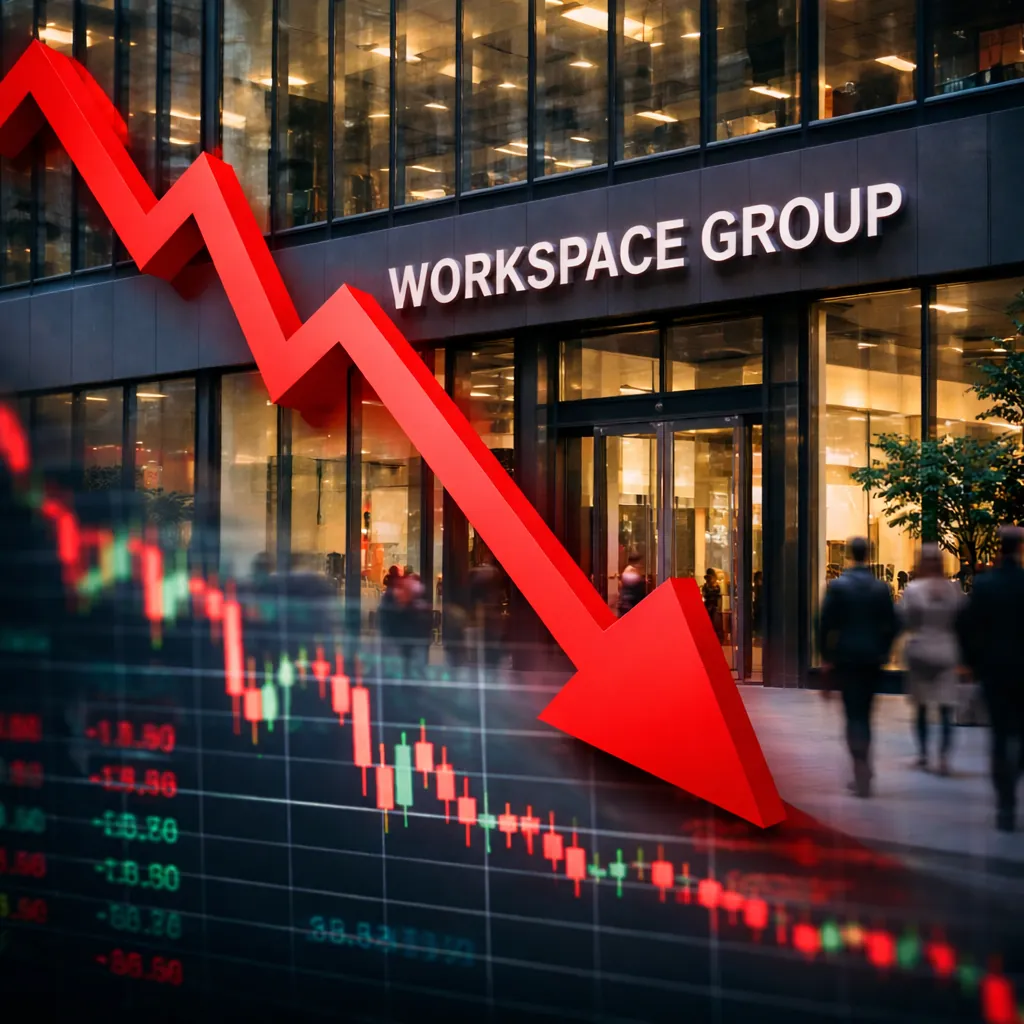

Workspace Group (LSE: WKP) shares plunged 15% to 317.94p after the London-based flexible office provider warned of a substantial drop in profitability for the financial year to March 2027, triggering a sharp investor selloff. The FTSE 250 firm’s latest update pointed to a mix of weakening rental income, rising costs, and asset disposals weighing on future earnings.
The decline in the stock reflects growing concern over the company’s earnings trajectory at a time when the commercial property sector continues to face pressure from higher interest rates and cautious tenant demand. The warning came alongside its fourth-quarter trading update, where underlying performance showed signs of strain despite modest improvements in occupancy.
Workspace reported that its total rent roll fell 1.4% to £127.3 million, while rent per square foot dropped 1.3% to £41.96, highlighting ongoing pricing pressure across its portfolio. While occupancy improved slightly, the gains were not enough to offset the income decline. Overall occupancy rose 0.6 percentage points to 79.4%, and the stabilised portfolio saw occupancy increase to 81.6%, up 0.3 percentage points.
Despite these modest operational improvements, the company’s forward-looking commentary drove the market reaction. Workspace flagged several headwinds expected to significantly impact profitability, including a lower opening rent roll, higher interest costs, reduced capitalised interest, and rising operating expenses. Additionally, the company pointed to the dilutive effect of higher-yielding asset disposals, which will reduce income contribution from sold properties.
This combination of factors suggests that even if demand stabilises, the company’s earnings base is set to weaken in the near term. Investors tend to react sharply to such multi-layered pressure, especially when it impacts both revenue and margins simultaneously.
The disposal programme itself has become a key focus. Workspace completed or exchanged £38.1 million of asset sales during the quarter, bringing total disposals to £125.7 million against a £200 million two-year target. A further eight assets, valued at approximately £58 million, are currently under active negotiation.
However, the pricing of recent sales has raised concerns. Havelock Terrace in Battersea was sold for £20 million, representing a 16% discount to its September 2025 valuation. Meanwhile, The Planets in Woking was sold for £7.3 million, reflecting a much steeper 44% discount. These markdowns have amplified investor worries about asset valuations and the broader commercial real estate environment.
On the balance sheet side, there were some positive developments. Net debt decreased by £20 million to £759 million, while the company maintained £241 million in cash and undrawn facilities. The loan-to-value ratio stood at 35%, indicating a relatively stable leverage position compared to sector peers.
Still, balance sheet strength alone was not enough to offset concerns about earnings quality and future returns. Investors are increasingly focused on how effectively companies can generate income from their asset base, particularly in a higher-rate environment where financing costs remain elevated.
The leadership transition adds another dimension to the story. New chief executive Charlie Green, who took over in February, acknowledged that the business will require further investment to reposition its offering toward start-ups, small businesses, and scale-ups. While this strategic shift is aimed at long-term growth, it is expected to take time to deliver results, adding to near-term uncertainty.
At the same time, Workspace announced a revision to its dividend policy, targeting a return to 1.2 times earnings cover from the financial year to March 2026 onwards. The move signals a more disciplined capital allocation approach but also reflects management’s expectation of lower earnings in the near term.
Market sentiment around the stock has turned cautious following the update. The combination of declining rent metrics, discounted asset sales, rising costs, and a weaker profit outlook has raised questions about the company’s ability to maintain stable returns in the short term. The sharp share price fall indicates that investors are repricing the stock to reflect these risks.
Looking ahead, much will depend on Workspace’s ability to stabilise rental income, manage costs, and execute its repositioning strategy effectively. Occupancy gains will need to translate into stronger pricing power, while future disposals will be closely watched for signs of stabilising asset values.
The broader commercial property market also remains a critical factor. With interest rates still elevated and business confidence mixed, demand for flexible office space could remain uneven. Any improvement in macro conditions would provide support, but until then, companies like Workspace may continue to face operational and financial pressure.
For now, the market’s reaction underscores a clear message: investors are prioritising earnings visibility and margin stability. Until Workspace can demonstrate a turnaround in rent performance and profitability, the stock may remain under pressure despite its strategic repositioning efforts.
Investors seeking further details on the company’s latest update can refer to the official filing via Investegate.
You may like: Uber takes $270 million stake in Delivery Hero to deepen Europe food delivery ties

Make Swikblog your go-to source on Google for reliable updates, smart insights, and daily trends.