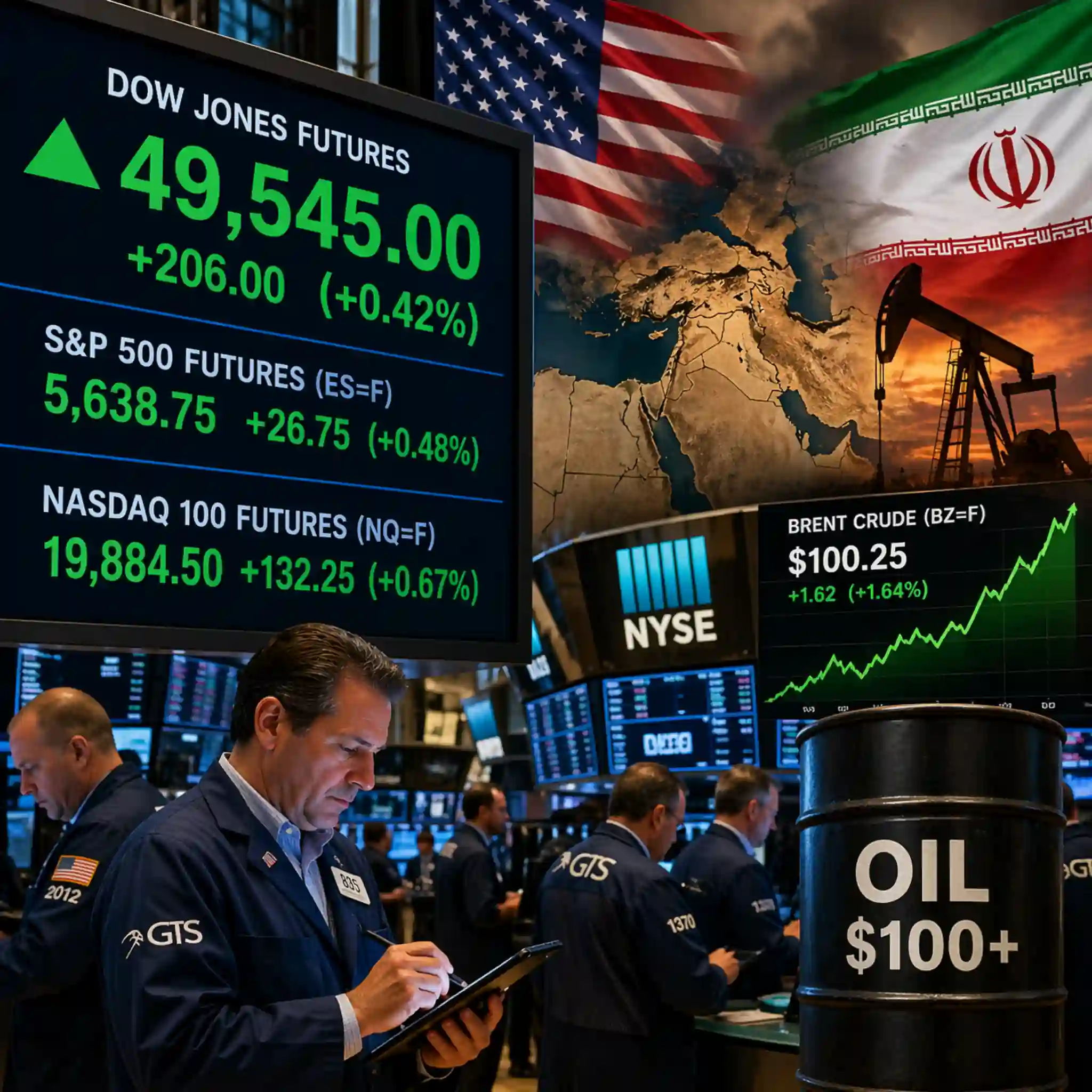

Global financial markets are entering a highly volatile phase, as escalating tensions in the Middle East trigger sharp swings across equities, commodities, and currencies. The Australian share market is now on the brink of a technical correction, with billions wiped off valuations in just weeks.
Market Snapshot: Global Weakness Spreads
- ASX 200: -0.6% to 8,443 points
- Australian Dollar: Flat at 70.84 US cents
- S&P 500: -0.3% to 6,606 points
- Nasdaq: -0.2% to 22,090 points
- FTSE: -2.4% to 10,064 points
- EuroStoxx: -2.3% to 597 points
- Spot Gold: -0.1% to $US4,653/ounce
- Brent Crude: -2.6% at $US105.75/barrel
- Bitcoin: +0.7% to $US70,395
ASX Quotes: Broad-Based Declines
| Index | Opening | Closing | Change |
|---|---|---|---|
| All Ordinaries | 8690.70 | 8656.60 | -0.4% ↓ |
| S&P/ASX 200 | 8497.80 | 8463.90 | -0.4% ↓ |
| Small Ordinaries | 3317.80 | 3292.20 | -0.8% ↓ |
| All Technology | 2607.00 | 2609.60 | +0.1% ↑ |
| ASX 20 | 4954.80 | 4930.40 | -0.5% ↓ |
| ASX 50 | 8330.00 | 8296.30 | -0.4% ↓ |
| ASX 100 | 7118.20 | 7092.20 | -0.4% ↓ |
| ASX 300 | 8427.50 | 8393.10 | -0.4% ↓ |
| All Australian 200 | 8502.00 | 8472.10 | -0.4% ↓ |
| Midcap 50 | 10415.80 | 10405.90 | -0.1% ↓ |
| A-REIT | 1529.40 | 1530.10 | 0% |
| Consumer Discretionary | 3373.20 | 3377.00 | +0.1% ↑ |
$250 Billion Erased as Market Nears Correction
The Australian share market has lost more than $250 billion in value since early March, as geopolitical tensions intensified following military actions involving Israel, the United States, and Iran.
The All Ordinaries index has already declined around 8%, and a further 2% drop would officially push the market into correction territory. Analysts now warn that this downturn could extend further, potentially reaching a 15% decline depending on how the conflict evolves.
War Escalation Raises Oil and Supply Shock Risks
The conflict has reached a critical phase, with attacks on key LNG infrastructure in Qatar and threats to vital shipping routes like the Strait of Hormuz. These developments are raising fears of prolonged energy disruptions.
Analysts warn that the situation could trigger not just energy shortages, but also ripple effects across fertiliser production and food supply chains in Asia-Pacific economies.
Even if the conflict ends soon, damage to infrastructure could have lasting impacts on global supply, keeping energy prices elevated for an extended period.
Oil Volatility Shakes Investor Confidence
Brent crude has seen extreme swings, trading in a wide range between $US105 and $US119 per barrel. Such volatility reflects deep uncertainty around supply disruptions and geopolitical outcomes.
Additional risks are emerging from other regions as well. Analysts are closely monitoring the potential involvement of Houthi forces, which could threaten alternative oil export routes through the Red Sea.
If these routes are disrupted, oil prices could surge even higher, intensifying inflationary pressures globally.
Sector Moves: Miners Drag, Defensives Rise
On the ASX, mining stocks have been the biggest drag on the index, with companies like BHP and Rio Tinto declining sharply amid weaker commodity prices.
Meanwhile, defensive sectors such as healthcare and utilities have posted gains, reflecting a shift in investor preference toward safer assets.
Retail stocks have shown mixed performance, with some companies outperforming expectations despite broader market weakness.
Economic Growth Slows as Rate Hike Risks Rise
Economic data suggests growth is already moderating, with GDP expected to expand by just 0.6% in the first quarter of 2026.
At the same time, markets are pricing in the possibility of three additional interest rate hikes, which could push the RBA cash rate to 4.85%, the highest level since 2008.
This combination of slowing growth and rising borrowing costs is creating a challenging environment for equities.
Stagflation Concerns — Not Yet a Base Case
Despite rising inflation risks, economists are not yet forecasting stagflation. While inflation pressures are building due to higher energy prices, unemployment has not surged significantly.
However, the risk remains if supply disruptions worsen and economic growth slows further.
Government and Regulators on Alert
Australian financial regulators have already convened emergency discussions to assess the economic impact of the conflict. Authorities are taking steps to ensure fuel supply stability and prevent price manipulation.
Measures include releasing fuel reserves, increasing market surveillance, and strengthening supply chain resilience.
Understanding a Market Correction
A market correction occurs when prices fall by more than 10% from their recent peak. While corrections are a normal part of market cycles, the current situation is being driven by multiple high-risk factors, including war, inflation, and monetary tightening.
Learn more about corrections from Investor.gov, or follow ongoing developments via ABC market updates.
Outlook: Volatility Likely to Persist
Markets are unlikely to stabilize in the near term, as investors continue to react to geopolitical developments and economic signals.
If the conflict escalates further, the ASX could enter a confirmed correction phase, with additional downside risks for global equities.
For now, investors remain cautious, with volatility expected to remain elevated across asset classes.
Disclaimer: This article is for informational purposes only and does not constitute financial advice.

Make Swikblog your go-to source on Google for reliable updates, smart insights, and daily trends.