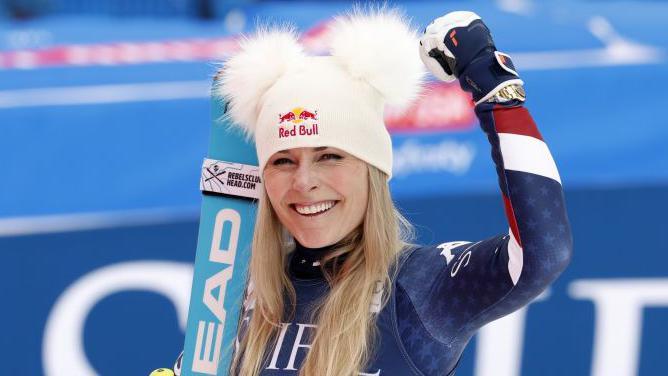

Updated: December 12, 2025 • St Moritz, Switzerland • Swikblog Sports Desk
The strange thing about time is that it doesn’t just pass — it judges. In sport, it becomes a quiet voice that follows you everywhere: too old, too slow, too fragile, too late. On Friday in St Moritz, Lindsey Vonn didn’t argue with that voice. She didn’t negotiate. She didn’t plead for a sentimental “one last run”. She simply did what the clock is supposed to prevent. She won.
On paper, the headline is simple: Vonn, 41, World Cup downhill winner again — her first victory since 2018, her 83rd overall, and a history-making moment as the oldest winner of a World Cup race. But anyone who has watched elite careers fade knows the truth: moments like this are never just about the finish line. They’re about everything that happened after the last time the cameras moved on.
For Vonn, “after” has included retirement, reinvention, and a body that has been asked to carry a lifetime of speed. She’s returned to racing with titanium in her right knee — not as a gimmick, not as a slogan, but as a reality she has to live inside every training run and every decision to push when the course turns ugly. In St Moritz, she pushed anyway.
The race itself was emphatic. Vonn won by nearly a second — an enormous margin in downhill — finishing 0.98 seconds clear of Austria’s Magdalena Egger, with another Austrian, Mirjam Puchner, also on the podium. The details matter because they erase the “fairytale” framing. This wasn’t a lucky day or a friendly course. It was domination — the kind that reminds you why people once called her the queen of downhill.
If you want the straightforward recap, it’s widely reported — including by The Guardian’s coverage from St Moritz and the official Alpine World Cup race report published by the FIS (International Ski and Snowboard Federation) . But the bigger story sits underneath the stats.
Because the older you get, the “comeback” isn’t just about form — it’s about identity. It’s about walking into rooms where people remember your past more clearly than they believe in your future. It’s about listening to the well-meaning comments that still sting: “It’s inspiring you’re even trying.” Inspiring can be another way of saying not threatening.
Vonn’s win punctures that comfortable narrative. It forces a more uncomfortable question: what if the limits we repeat about age are not laws of nature, but habits? What if the “right time to stop” is sometimes just the time other people feel most at ease?
And yet, nobody who has followed Vonn would pretend this has been a clean, cinematic arc. Her career has been brilliant and brutal in equal measure — the kind of greatness that costs something. A downhill racer doesn’t age gently. The discipline is violent: the speed, the vibration, the impacts that travel from the ski edge through the boot into the bones. A fraction late and the mountain takes the argument out of your hands.
That’s what makes St Moritz feel so loud. Not because it’s a “nice story”, but because it’s a direct contradiction to how the sport usually works. In alpine skiing, the pipeline is relentless. New champions arrive younger, faster, fearless. The margins get tighter. The body collects receipts. The calendar stops caring about your legacy.
Vonn’s win is a reminder that experience isn’t only memory — it’s an advantage when you can still access it at speed. It’s the ability to read a line before it becomes obvious. It’s the muscle of calm when the course tries to rush you. It’s knowing which risks are worth taking, and which are only there to impress.
It also reframes what the next 14 months could look like. Milan-Cortina 2026 has been hanging over this comeback like a lighthouse: bright, distant, and easy to talk about. But medals aren’t won by storylines. They’re won by timing, by health, by a run that holds itself together when the air turns thin and your legs start to shake. A downhill victory this decisive doesn’t guarantee anything — but it changes what is believable.
Maybe that’s why this moment travelled so quickly across feeds. People aren’t only watching Vonn because they care about the sport. They’re watching because her win touches something bigger than skiing: the fear of being “past it”, the shame of trying again, the quiet hope that skill and stubbornness might still outrun the calendar.
If you’re building a life or a career, you’ll recognise the feeling: that moment where you look at the thing you once did best and wonder if it belongs to a previous version of you. Vonn answered that question the only way elite athletes can — with a clock that doesn’t flatter, and a course that doesn’t forgive. She didn’t just return. She proved she still belongs at the very top.
Recommended read: If you’re browsing Swikblog, here’s another story to keep your session going: North London Derby: the moment that took over timelines .
Swikblog note on verification: Details of the St Moritz result, margins, and the historical age record are reflected in major coverage and official race reporting. If you’re updating this post later, add any new quotes only after they appear in a primary outlet or official federation release.
Written by: Swikblog Sports Desk • About Swikblog

Make Swikblog your go-to source on Google for reliable updates, smart insights, and daily trends.