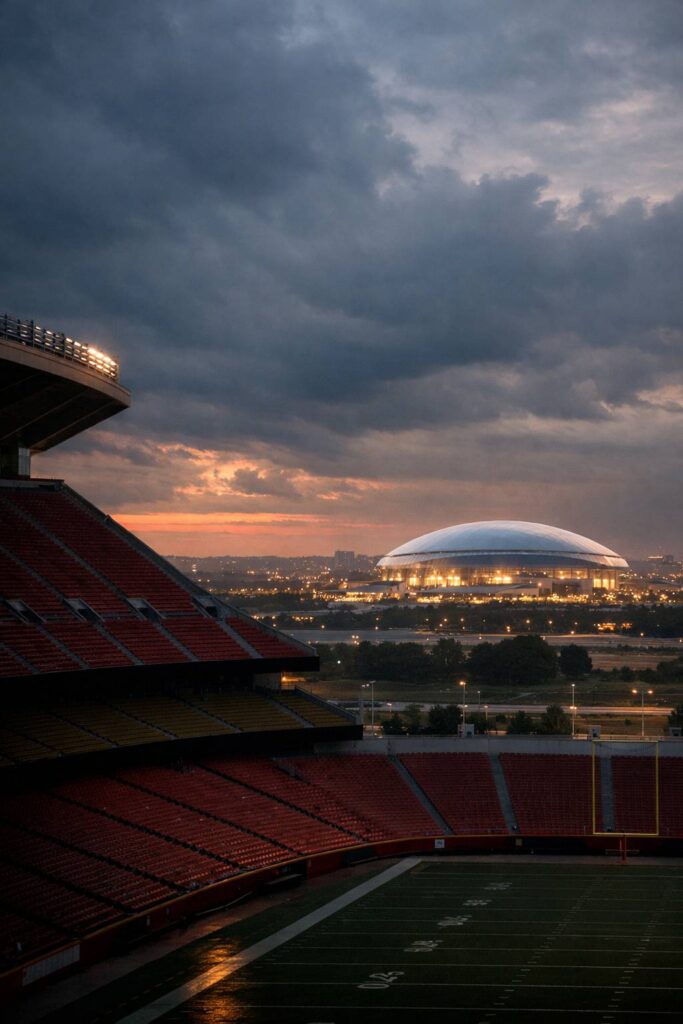

The Kansas City Chiefs have agreed to move their home games across the state line into Kansas, setting the stage for a $3 billion domed stadium that would open for the start of the 2031 NFL season and bring one of the league’s most iconic franchises into a new era of year-round events and premium revenue growth.
The shift became real after Kansas leaders voted to approve an incentives package that clears the way for the project, with Gov. Laura Kelly calling the agreement “truly historic” and framing it as the largest economic development effort in Kansas history. State officials said the broader plan would drive at least $4 billion in total development and support more than 20,000 jobs, tying the stadium to a wider mixed-use district rather than a stand-alone venue.
Chiefs owner Clark Hunt said the franchise has “agreed with the State of Kansas to host Chiefs football beginning with the 2031 NFL season,” a timeline that aligns with the end of the team’s current lease in Missouri. Hunt also leaned into the theme of continuity despite the relocation, telling supporters that while the address will change, the culture around Chiefs football will not: the noise, the tailgates, and the expectation of competing for championships.
The new stadium is planned for Wyandotte County, Kansas, with the Chiefs pointing to a site near the Kansas Speedway and the retail and entertainment area known as The Legends. The location places the project in an existing destination corridor that already draws major crowds, and it sits near Children’s Mercy Park, home of MLS side Sporting Kansas City. In addition to the stadium, the team plans to build a new headquarters and a practice facility in Olathe, Kansas, expanding the footprint of the organization beyond game days.
At the heart of the agreement is the financing structure. Kansas lawmakers approved the use of the state’s Sales Tax and Revenue (STAR) bond program, which allows future tax revenues generated inside a defined project district to be used to repay bonds tied to the development. Under Kansas law, the state can cover up to 70% of eligible stadium costs using those future revenues, rather than raising taxes statewide. State leaders emphasized that their portion would be paid using revenue generated by the project itself, rather than new taxes or cuts to existing state services.
This approach has become the central lever Kansas used to outmaneuver Missouri, where leaders were working on a competing package that would have covered up to 50% of the cost of new or renovated stadiums, plus tax credits and potential local support. The political pressure has been building for months, driven by the reality that both the Chiefs and the Kansas City Royals have leases at the Truman Sports Complex in Jackson County that expire in January 2031.
The pressure intensified after Jackson County voters rejected a local sales tax extension in April 2024 that would have funded a renovation of Arrowhead alongside support for a new Royals ballpark. That defeat not only slowed Missouri’s renovation plan, it also gave Kansas a clearer opening to present a replacement stadium pitch with a more aggressive public financing framework.
For Missouri officials, the move is an unmistakable blow. The Chiefs are not leaving the region, but they are leaving the state that has hosted them for decades. Kansas City, Missouri mayor Quinton Lucas publicly described the decision as a setback rooted in business reality, while stressing what Arrowhead represents as a cultural landmark: family, tradition, and a shared identity that does not neatly follow state lines.
Arrowhead Stadium has long been treated as an NFL monument — famed for its tailgating and its punishing decibel levels — and it has held a Guinness-recognized mark for the loudest stadium roar. The building opened in 1972 and has been renovated through the years, but the Chiefs and their backers have argued that the stadium’s age, limited premium inventory, and the lack of surrounding development constrain long-term growth. A new dome, by contrast, is designed to operate as a year-round events machine: concerts, college football showcases, Final Four-style tournaments, and — perhaps most symbolically — a realistic Super Bowl bid.
The story also carries a global sporting coda before the move. Arrowhead is scheduled to host multiple matches at the 2026 FIFA World Cup, giving the stadium a major international moment late in its life cycle as a Chiefs venue. The team will still play in Missouri for several seasons, but the timeline now feels fixed: a last run at Arrowhead before an engineered future across the line.
What happens next is less about slogans and more about execution. The Chiefs are expected to begin hiring architects and contractors in the coming months as the project enters design and planning. State officials have not disclosed the exact stadium site within Wyandotte County, and the ultimate public subsidy figure remains a point of scrutiny, even as leaders argue the project will pay for itself through district-generated revenues.
For fans, the moment lands as both a shock and a familiar pattern in modern American sports: nostalgia meets the economics of the next stadium. The Chiefs are trying to keep the emotional center of the franchise — the community, the tailgates, the identity of “Kansas City” — while shifting the business foundation to a dome built for premium seating, event flexibility, and a new development district designed to keep spending on-site long after the final whistle.
Kansas Gov. Laura Kelly described the agreement as a “total game changer” for the state, saying the stadium project represents the largest economic development effort in Kansas history. State officials emphasized that the broader plan is expected to generate billions in economic activity and support thousands of jobs across Wyandotte County, according to the Kansas Governor’s Office.
Related on Swikblog: Can Bill Belichick or Bobby Petrino Save UNC After a 4–8 Season?

Make Swikblog your go-to source on Google for reliable updates, smart insights, and daily trends.