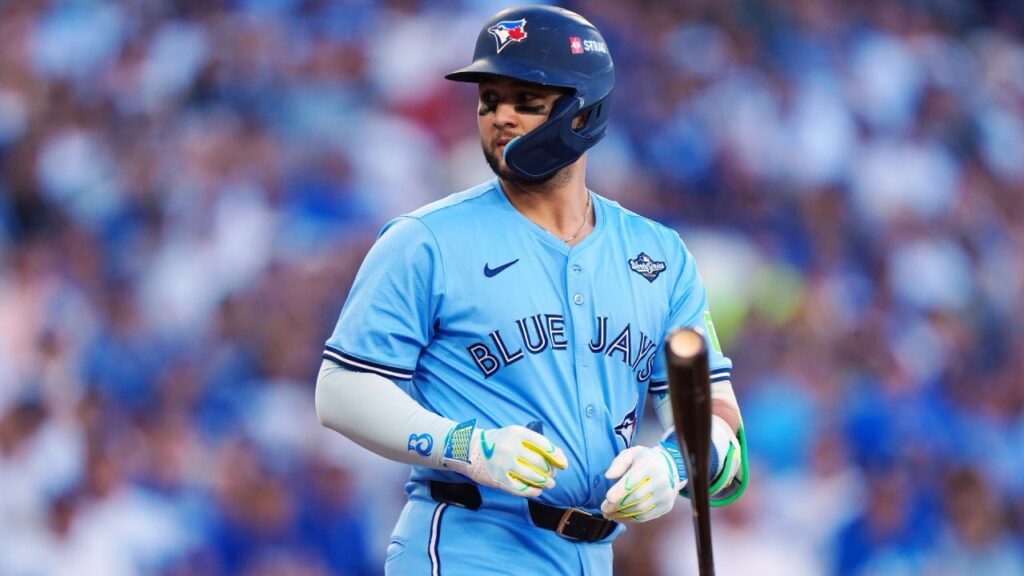

As the Toronto Blue Jays continue to take shape after a costly but incomplete offseason, one quiet detail has begun to draw outsized attention: Bo Bichette’s reported concern about playing on artificial turf. It is not a trade demand, nor a public grievance — but in a winter defined by fine margins, it may prove influential in how Toronto plans its next move.
According to an insider report from MLB.com, Bichette has privately expressed concern about the physical toll of playing half his games on the artificial surface at Rogers Centre. While not a formal stance, the report introduces a health-driven variable into an already delicate roster equation.
Why Turf Is a Real Issue for Infielders
Artificial turf has long divided opinion in Major League Baseball, particularly among infielders who transition repeatedly between dirt and turf during live play. Unlike outfielders, shortstops accelerate, stop, and pivot constantly — movements that place repeated stress on knees, calves, and ankles.
Bichette’s concern lands in context. Over the past three seasons, the 27-year-old has dealt with knee, calf, and quad injuries that disrupted stretches of what should be his physical prime. While no injury has been directly attributed to turf, teams increasingly factor surface load into long-term durability projections.
As MLB clubs continue to invest hundreds of millions into cornerstone players, these considerations now carry contract-level importance.
Why This Matters Now for Toronto
The timing is significant. The Blue Jays recently missed out on marquee targets, including Kyle Tucker, narrowing their remaining pathways to sustained contention. Internally, Bichette remains one of the franchise’s most valuable assets — both competitively and symbolically.
Toronto has built much of its identity around the idea of Bichette and Vladimir Guerrero Jr. anchoring the lineup for a generation. Any signal, however subtle, that one half of that vision may be weighing alternatives inevitably shapes front-office calculus.
Importantly, the same report noted Bichette’s close relationship with Guerrero and his openness to the idea of a lifelong Blue Jays career. That balance — loyalty versus longevity — is what makes the situation complex rather than confrontational.
The Phillies, and the Market Reality
The Philadelphia Phillies have emerged as a serious suitor, reportedly holding discussions with Bichette earlier this month. Other clubs, including the Red Sox, Yankees, and Cubs, have also been linked.
From a player’s perspective, interest is logical. Philadelphia offers a contending roster, a natural-grass infield, and a market that has shown willingness to commit long-term to elite talent. For Toronto, it underscores the importance of clarity — either reinforcing Bichette’s future role or preparing contingency plans.
What the Blue Jays Can Do Next
There is no immediate crisis. Turf concerns alone are unlikely to dictate a decision. But they may influence how aggressively Toronto approaches contract talks, roster flexibility, and long-term risk management.
Options include monitoring Bichette’s workload more closely, adjusting infield usage patterns, or — longer term — revisiting stadium surface strategies that have already drawn scrutiny across the league.
A Signal, Not a Verdict
Bichette’s reported concern should not be read as an exit sign. Instead, it reflects the modern reality of elite athletes weighing marginal advantages that can extend careers by years, not months.
For the Blue Jays, acknowledging those realities — rather than dismissing them — may be the most important move of the offseason.
More MLB coverage and analysis is available in our Baseball section.

Make Swikblog your go-to source on Google for reliable updates, smart insights, and daily trends.