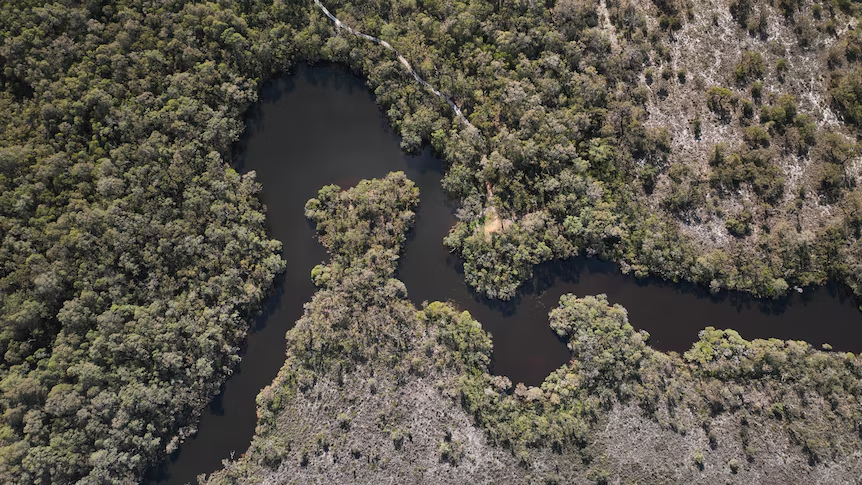

Western Australia’s renewable energy pipeline has taken another major step forward after planning authorities approved Synergy’s proposed $500 million Scott River wind farm, a 100-megawatt project that has become one of the most closely debated energy developments in the state’s South West.
The Regional Development Assessment Panel gave the project the green light after a lengthy public meeting in Margaret River, clearing the way for the state-owned energy provider to continue work on a proposal that could place 20 large wind turbines near Scott River, about 300 kilometres south of Perth.
While the decision is a significant planning win for Synergy and supporters of clean energy, it has also intensified local concerns. The project attracted more than 400 objections during consultation, with many residents warning that the development could permanently change the character of the area.
The proposed wind farm would have a generation capacity of 100MW and would connect to the Beenup substation. Electricity produced at the site would first support nearby homes and businesses before entering the South West Interconnected System, the main power grid serving much of Western Australia’s south-west region.
According to details reported by ABC News, the project was approved unanimously, but only with a range of environmental and planning conditions attached. Synergy now has five years under the initial development approval to decide how and when to progress the proposal.
Read More
Why the Scott River wind farm has become so controversial
The scale of the development is central to the debate. The planned turbines would reach up to 250 metres at their highest point, measured to the tip of the blades. For supporters, that scale reflects the size of the energy challenge facing WA as the state moves away from coal-fired generation and toward renewable power. For opponents, it raises serious questions about visual impact, noise, land use and long-term disruption.
The project area covers a 3,597-hectare development envelope, although the actual disturbance footprint is listed at 107 hectares. The proposal also states that no more than one hectare of native vegetation would be cleared. These figures have been used by proponents to argue that the physical environmental footprint is limited compared with the broader size of the site.
However, local opposition has not been driven by vegetation clearing alone. Concerns have included the effect of industrial-scale turbines on a rural landscape, possible noise impacts, floodplain conditions, environmental sensitivity and the broader history of the Scott River area, which was previously associated with a titanium mine that closed after environmental problems.
Community reaction has been sharply divided. During public consultation, 405 objections were lodged against the development, while 155 submissions supported it. That split was reflected at the Margaret River meeting, where both opponents and supporters turned out in large numbers.
Save the Scott River coordinator Scott Baxter said opponents were shocked by the decision and argued that planning authorities had not given enough weight to concerns about the project’s size, noise and environmental impact. He warned that placing 20 turbines on a floodplain would change the area permanently.
Supporters of the wind farm see the issue differently. Augusta Margaret River Clean Community Energy chair Jessica Worrall described the approval as a major milestone for local climate action, saying the push for renewable energy had been driven by people who wanted the shire to reduce emissions and take climate change seriously.
The difference between those positions shows why the Scott River proposal has become more than a planning application. It has become a test case for how regional communities respond when climate policy, local identity and large-scale infrastructure meet in the same place.
Approval does not mean construction is guaranteed
Although the planning approval is a major step, Synergy has not committed to immediate construction. The company said it would review the panel’s decision, the conditions attached to the approval and the project’s commercial viability before determining the timing of the wind farm.
That next stage matters. Renewable energy projects can face rising construction costs, grid connection challenges, supply chain delays and local resistance even after planning approval is secured. Synergy will need to decide whether the project remains financially and technically workable under the final approval conditions.
The project has already passed through important environmental checkpoints. In December, Western Australia’s environmental watchdog decided the proposal did not require a formal environmental assessment. In March, the federal Department of Climate Change, Energy, the Environment and Water determined that the project was not a controlled action if carried out in a particular manner. More information about federal environmental assessment processes is available through the Department of Climate Change, Energy, the Environment and Water.
For planning authorities, the number of objections alone was not enough to stop the project. RDAP deputy presiding member Clayton Higham acknowledged community concern but said planning decisions were based on planning arguments and likely impacts rather than a simple count of submissions for or against a proposal.
That explanation may be consistent with the planning process, but it is unlikely to end the public debate. For many opponents, the approval will feel like a decision made despite strong local resistance. For supporters, it will be viewed as a necessary step toward cleaner electricity and lower emissions.
The wider energy context is important. Western Australia is preparing for a major shift in its electricity system as older coal-fired generation is phased out and replaced with renewable energy, storage and grid upgrades. Wind power can play a useful role because it often generates at different times from solar, helping balance supply across the day and night.
Still, the Scott River decision shows that the transition will not be simple. Building clean energy infrastructure requires more than technical approval and investment. It also depends on public trust, transparent conditions and ongoing engagement with the communities asked to host major projects.
If Synergy proceeds, the Scott River wind farm could become a prominent part of WA’s renewable energy network. If the company later decides the project is not commercially viable, the approval may instead become an example of how difficult it can be to convert planning success into a finished energy asset.
For now, the project sits at a turning point. It has cleared a major regulatory barrier, but the hardest questions remain: whether it can be built, whether the community will accept it, and whether the benefits of new renewable power can outweigh the concerns of those living closest to the turbines.
Read more energy and infrastructure coverage in our business news section.

Make Swikblog your go-to source on Google for reliable updates, smart insights, and daily trends.