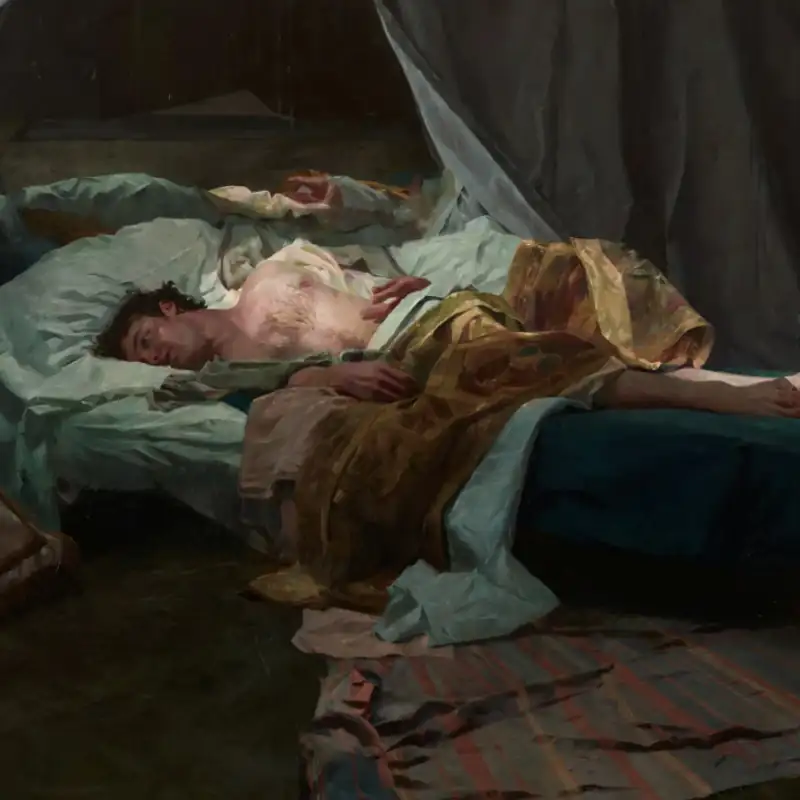

The Archibald Prize 2026 has opened with a striking early talking point, as Melbourne artist Sean Layh won the $3,000 Packing Room Prize for his portrait of British Australian actor Jacob Collins. The work, titled The tragicall historie of Hamlet, Prince of Denmarke, places Collins in the emotional world of Shakespeare’s Hamlet and has immediately become one of the most discussed entries from this year’s finalist announcement.
The win is important because the Packing Room Prize is usually the first major moment of the Archibald season. It gives audiences an early look at the portraits likely to dominate conversation before the main $100,000 Archibald Prize is announced. This year, Layh’s painting has gained extra attention because of its theatrical subject, classical mood and the public curiosity around Collins himself.
While some readers may assume Jacob Collins won an award, the prize belongs to Sean Layh as the artist. Collins is the sitter, portrayed through the lens of Hamlet after Layh saw him perform the role in Melbourne in 2024.
Why Sean Layh’s Jacob Collins Portrait Stands Out
Layh’s winning portrait does not present Hamlet through the usual symbols of tragedy. There are no swords, poisoned cups or dramatic stage gestures. Instead, Collins is shown lying in a dishevelled bed, caught in a private moment of exhaustion and uncertainty. That choice gives the painting a quieter but more powerful emotional charge.
The idea came after Layh watched Collins perform Hamlet in an intimate candlelit production. The atmosphere of that performance appears to have shaped the final image, which focuses less on the violence of Shakespeare’s ending and more on the character’s inner conflict. Hamlet is remembered for thought, hesitation, grief and paralysis, and Layh’s painting leans into those qualities.
The title, The tragicall historie of Hamlet, Prince of Denmarke, uses an older spelling connected with early versions of Shakespeare’s play. That detail gives the work a literary weight and shows that the portrait is not simply a celebrity painting. It is a layered interpretation of an actor, a role and a cultural text that has been performed for centuries.
Layh has also pointed to classical art as an influence, with the composition referencing Albert Maignan’s The Last Moments of Chlodobert, a work held by the National Gallery of Victoria. That connection matters because Layh is a self-taught artist who developed much of his technical eye through studying major gallery collections rather than following a conventional art-school path.
For official prize details and exhibition information, readers can visit the Art Gallery of New South Wales Archibald Prize page.
The Packing Room Prize Adds Pressure Before the Main Archibald
The Packing Room Prize has a character of its own within the Archibald tradition. Unlike the main Archibald Prize, which is selected by the trustees of the Art Gallery of New South Wales, this award is chosen by gallery staff who receive, unpack and install the entries. Their decision often reflects the immediate impact of a work when seen in person.
That makes the prize popular with audiences. It feels closer to a first reaction than a formal institutional verdict. The staff who handle the artworks see hundreds of submissions at close range, so the painting that stays with them often becomes an early public favourite.
There is also a curious history attached to the award. Since the Packing Room Prize began in 1991, no artist who has won it has gone on to win the main Archibald Prize in the same year. This has led to its well-known “kiss of death” reputation, although each new winner gets a chance to challenge that pattern.
Layh will find out whether his portrait can break that long-running streak when the main Archibald Prize winner is announced on May 8. Even before that result, the Packing Room win has already lifted his profile and placed his work at the centre of this year’s conversation.
The 2026 competition drew more than 1,000 entries before being reduced to 59 finalists. That shortlist includes portraits of figures from the arts, media, sport, politics and public life. Among the sitters this year are Governor-General Sam Mostyn, Bondi hero Ahmed Al Ahmed, broadcasters Virginia Trioli and Jan Fran, musician Daniel Johns, surfer Layne Beachley, actor Chloé Hayden, artist Khaled Sabsabi and AFL player Mitch Brown.
Layh’s recognition is also notable because this is his first time as an Archibald finalist. Before focusing on painting full-time, he had pursued biological science and later moved away from academia during the COVID-19 period. His path gives the story a human element beyond the prize announcement: an artist shaped by literature, theatre, museum study and a major career shift.
The wider Archibald, Wynne and Sulman Prize exhibition opens at the Art Gallery of New South Wales on May 9 and runs until August 16. The Wynne Prize recognises landscape painting or figure sculpture, while the Sulman Prize focuses on subject painting, genre painting or mural projects. Together, the three competitions form one of Australia’s most closely watched annual art events.
Layh’s portrait has given the 2026 Archibald season a memorable opening image. It succeeds because it does more than record Jacob Collins’ appearance. It captures the tension between performer and character, between public role and private emotion, and between classical influence and contemporary portraiture. Whether or not it wins the main prize, The tragicall historie of Hamlet, Prince of Denmarke has already become one of the defining works of this year’s Archibald conversation.
You may also like: Royal Mail Dog Warning Sign: 4-Word Notice That Could Stop Your Deliveries

Make Swikblog your go-to source on Google for reliable updates, smart insights, and daily trends.