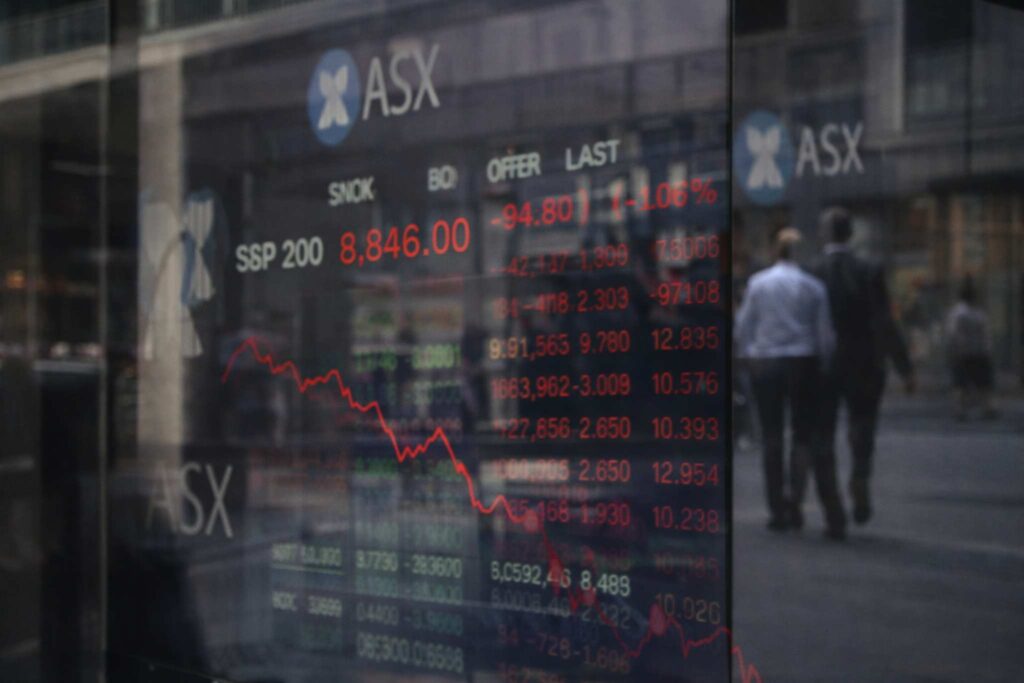

Australia’s share market remained under pressure through Friday trade, with the S&P/ASX 200 (AXJO) sliding to 8,846 and extending a brutal weekly pullback that has now wiped out February’s gains. The move came as investors continued to price in the risk of a longer conflict in the Middle East, a fresh oil shock, and the possibility that inflation pressures could stay hotter for longer. By the afternoon session, the benchmark index was down roughly 1.0%, while the broader market damage for the week had climbed beyond $100 billion.
The selling was broad enough to hit many of the market’s usual pillars. Major banks and heavyweight miners were both under pressure, showing that this was not a narrow sector rotation but a wider risk-off move. At one point during the session, the ASX 200 was quoted near 8,843.80, down 96 points or 1.08%, before stabilising around the mid-afternoon level near 8,846. That left the index down about 3.86% for the week, a sharp reversal for a market that had entered the month on firmer footing.
Market snapshot around 3:00pm AEDT: ASX 200 at 8,846, Australian dollar at 70.39 US cents, S&P 500 at 6,830, Nasdaq at 22,749, FTSE at 10,413, EuroStoxx at 605, spot gold at US$5,131 an ounce, Brent crude at US$84.55 a barrel, iron ore at US$100.25 a tonne, and Bitcoin at US$71,098.
Oil and inflation fears remained at the center of the sell-off
The biggest market concern remained energy. As traders watched developments around the Strait of Hormuz and broader Middle East shipping risks, crude prices stayed elevated even after intraday swings. Brent crude was still around US$84.55 a barrel in the later market snapshot, after earlier updates showed it up about 3.6% at US$85.41. The ABC live coverage also noted that oil had surged more than 15%, or roughly US$10 a barrel, since the war began.
That matters for Australian investors because higher oil prices can quickly feed into local inflation through petrol, freight, logistics, and other imported energy costs. NAB senior economist Taylor Nugent said the inflation starting point is already uncomfortable and that the Reserve Bank would be watching inflation expectations closely. He added that, based on current oil pricing, headline CPI could peak more than 0.5 percentage points above previous expectations, while retail fuel prices could rise more than 15% in March if current pricing holds.
That mix of slower growth and sticky inflation is exactly the kind of backdrop investors fear most. It raises the risk of a stagflation-style environment, where household budgets are squeezed, corporate margins come under pressure, and central banks have less room to ease policy. For equity markets, that tends to hit confidence fast.
Banks, miners and cyclicals took the heat
The ASX weakness was especially notable because it hit sectors that often anchor local portfolios. Big banks were sold, major miners weakened, and cyclical names remained exposed to any repricing in global growth expectations. Even though Australia is a net energy exporter, the local market was not insulated from the broader shock. Investors appeared more focused on the inflationary hit from imported fuel and the knock-on effect on consumer demand than on the slower and narrower benefit that higher export earnings could bring.
Iron ore was one of the few major commodities showing resilience. Spot references in the live market update put iron ore near US$100.25 a tonne, while earlier reports showed the Singapore benchmark April contract up to roughly US$101.05. Supply concerns added support after restrictions linked to China’s buying of new seaborne cargoes from BHP raised questions about near-term availability. Still, firmer iron ore was not enough to shield the miners from the wider equity sell-off.
Global signals stayed mixed but fragile
The Australian market was also reacting to weakness across overseas benchmarks. The snapshot showed the S&P 500 down 0.6%, the Nasdaq off 0.3%, the FTSE lower by 1.5%, and the EuroStoxx down 1.3%. Japan’s Nikkei had also been hit hard earlier in the week, with reports indicating the index had fallen nearly 6% across the week before a tentative rebound.
There were some signs of dip-buying late in the session, with brokers telling ABC that retail investors were stepping in after the sharp declines. Wall Street futures also edged modestly higher and Japan’s Nikkei recovered from steeper intraday losses. Even so, the broader tone remained cautious rather than confident. A market can bounce technically without resolving the bigger macro concern.
Defensive assets told the story clearly
The rise in gold and the firmness in the Australian dollar added another layer to the story. Spot gold climbed to around US$5,131 an ounce, reflecting a clear move toward defensive assets. Bitcoin, often treated as a sentiment barometer for risk appetite, was still holding around US$71,098, though earlier updates showed it fluctuating lower intraday. Those cross-asset moves suggested investors were still rotating carefully rather than returning fully to risk.
Meanwhile, the ACCC said it would closely monitor local petrol pricing and market behaviour, warning that any false or misleading conduct would face consequences. That has kept a public focus on the domestic fallout from the global oil move, especially as households prepare for the possibility of higher bowser prices over the coming weeks.
Pressure has shifted from headline shock to durability risk
The most important shift for the market is that the story is no longer just the initial shock. Investors are now weighing how long the conflict could drag on and whether the energy disruption risk becomes more entrenched. If oil remains elevated and shipping uncertainty grows, the ASX may struggle to regain momentum quickly, especially with inflation expectations rising and central bank flexibility potentially narrowing.
For now, the numbers tell the story plainly. The S&P/ASX 200 (AXJO) at 8,846, more than $100 billion wiped from the market this week, banks and miners under pressure, gold higher, and crude still elevated near US$85 a barrel. February’s gains have been erased, and investors are trading a market that suddenly looks much more sensitive to every geopolitical headline.
For broader coverage on the market backdrop and live developments, see the latest reporting from ABC News business coverage.

Make Swikblog your go-to source on Google for reliable updates, smart insights, and daily trends.