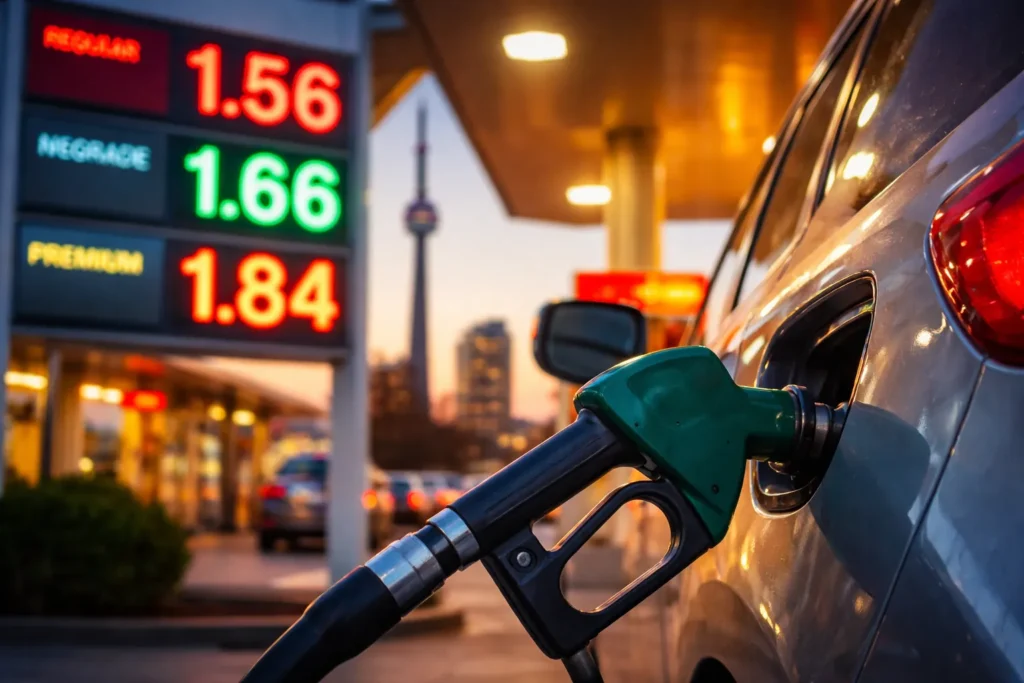

Calgary drivers woke up to another painful move at the pump on Friday, with gas prices across the city climbing past $1.50 per litre as oil markets reacted sharply to intensifying tensions in the Middle East. The move landed just as West Texas Intermediate crude hovered around the mid-$80s per barrel, putting fresh pressure on household fuel budgets while reviving a familiar Alberta debate: when oil surges, the province’s energy sector benefits, but consumers feel the squeeze almost immediately.
The latest jump in Calgary fuel prices reflects how quickly geopolitical risk can travel from global energy markets to local gas stations. Once traders begin pricing in the possibility of supply disruption from one of the world’s most critical oil-producing regions, wholesale fuel costs can rise fast. That pressure then works its way through refiners, distributors and retailers, eventually showing up on roadside signs in cities like Calgary.
What changed today: Many Calgary stations are now showing prices above $1.50/L, while rising crude prices have pushed fresh attention toward Alberta’s export capacity, pipeline economics and the province’s role in supplying North American energy markets.
Why Calgary gas prices are rising so quickly
The immediate driver is the sharp move in crude oil. Markets have been jolted by fears that worsening conflict in the Middle East could disrupt supply flows from a region that remains central to the global oil trade. When traders worry about interrupted production, damaged infrastructure, or shipping bottlenecks, crude prices usually react before any real shortage is seen at the retail level.
That is exactly the dynamic now weighing on fuel prices. Even though Alberta produces large volumes of oil, gasoline prices in Calgary do not operate in isolation from global benchmarks. Local drivers may live in an oil-producing province, but the price at the pump is still shaped by international crude moves, refining margins, transportation costs, taxes and local retail competition. In periods of market stress, the global component can dominate very quickly.
With oil climbing toward levels not seen in months, Calgary motorists are being hit by the consumer side of that equation. A few cents per litre may not sound dramatic at first glance, but over a full tank and over repeated fill-ups, the impact becomes noticeable for commuters, delivery operators and families already juggling higher living costs.
Why the oil rally is a double-edged sword for Alberta
For Alberta, higher oil prices rarely produce a simple story. On one side, stronger crude prices can support producer cash flow, improve royalty revenues and brighten the fiscal picture for governments tied closely to energy activity. Higher prices can also boost investor sentiment around pipeline operators, service companies and producers with strong exposure to Western Canadian output.
On the other side, those same gains can be offset in daily life by more expensive gasoline and diesel. Consumers feel the cost immediately, while the broader economic upside often takes longer to filter through. Businesses that depend heavily on transportation, construction equipment or freight movement can also see margins tighten when fuel spikes rapidly.
That tension is especially visible in Alberta because energy is not just another industry there. It is a core part of the province’s economy, employment base and investment story. So when oil jumps, it can create a strange split-screen effect: positive headlines for producers and pipeline companies on one side, and frustration from drivers staring at pump prices on the other.
Pipeline capacity is back in focus
The latest price shock has also put renewed attention on how Alberta crude reaches market. That is where Calgary-based South Bow Corp. enters the picture. The company is holding an investor call Friday morning, and executives are expected to discuss potential growth projects connected to the Keystone Pipeline System.
South Bow has launched an open season, a process used to gauge long-term shipper interest before moving ahead with pipeline expansion commitments. In practical terms, the company is seeking commitments from customers that want to move crude from Hardisty, Alberta to delivery hubs in the United States. Those commitments matter because they help determine whether proposed growth projects are commercially viable.
The development is significant because it highlights a broader issue that resurfaces every time oil markets turn volatile: Alberta can benefit more from high crude prices when it has dependable, efficient access to downstream markets. When transport capacity is constrained, regional producers can struggle to fully capture stronger global pricing.
South Bow says the proposal would largely build on existing Keystone system infrastructure rather than recreate the cancelled Keystone XL in its original form. That distinction matters because it points to a potentially more practical, commercially grounded approach focused on expanding capacity and optionality within an established corridor.
Why Hardisty matters: Hardisty is one of Alberta’s most important crude hubs, acting as a key gathering and shipping point for Western Canadian production heading toward U.S. refining and storage destinations.
What this means for drivers and the broader market
For drivers, the near-term takeaway is straightforward: unless crude prices cool quickly, pump prices could remain elevated. Retail fuel markets do not always move in a perfectly straight line with oil, but sharp geopolitical rallies tend to keep upward pressure on gasoline. That means Calgary motorists may need to brace for further volatility rather than expect an immediate reversal.
For investors and policymakers, the story is broader. The current spike is another reminder that Alberta’s energy advantage depends not only on what it produces, but also on how efficiently it can move that production to high-value markets. When global tensions send crude prices higher, pipeline access, export flexibility and storage logistics become even more important.
That is why South Bow’s open season is drawing attention right now. In calmer oil markets, transport expansion can seem like a long-cycle infrastructure topic. During a sudden price rally, it becomes part of a much more urgent conversation about market access, producer economics and the province’s ability to respond when global supply risk returns to the spotlight.
For now, Calgary residents are seeing the most visible effect at neighborhood gas stations. Prices above $1.50/L are a tangible sign that even distant geopolitical shocks can hit local budgets in a matter of hours. If crude remains elevated and tensions keep traders on edge, that pressure is unlikely to disappear overnight.
And that leaves Alberta in a familiar place: positioned to gain from stronger oil markets at the macro level, while many of its own consumers absorb the immediate cost at the pump. It is the province’s old oil paradox, now back in plain view on Calgary forecourts.

Make Swikblog your go-to source on Google for reliable updates, smart insights, and daily trends.