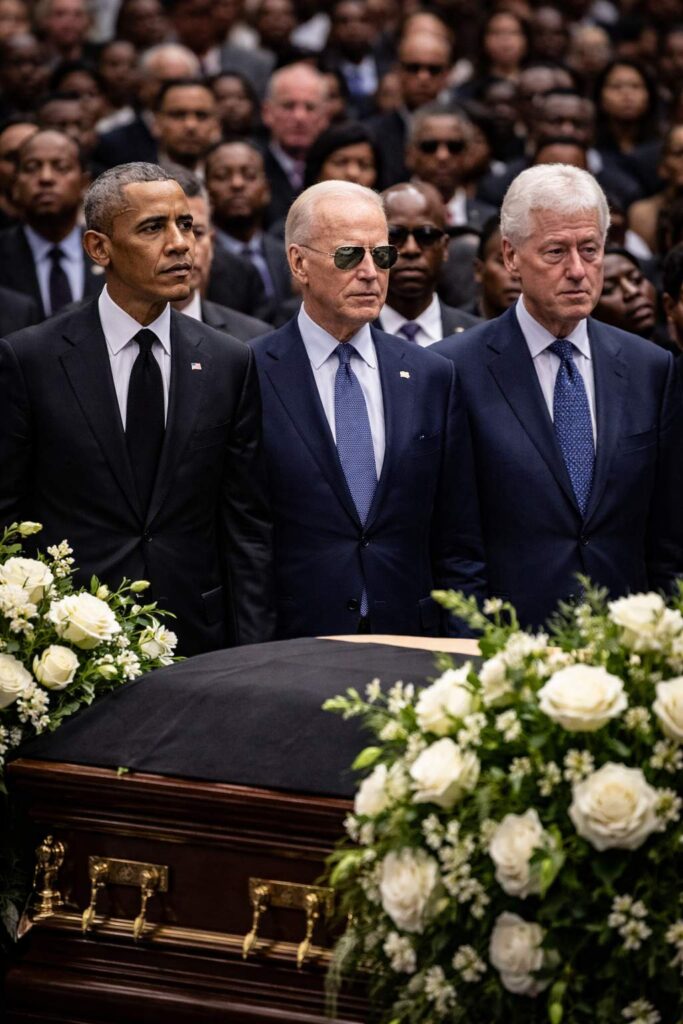

Chicago turned into the center of a national farewell on Friday as Jesse Jackson’s funeral drew Barack Obama, Joe Biden and Bill Clinton, bringing together three Democratic presidents to honor one of the most influential civil rights figures of the last half-century. The scale of the gathering underscored something larger than a memorial service. It reflected the extraordinary reach of a man whose activism stretched from the American South to Chicago’s political machine, from voting rights campaigns to presidential politics, and from Martin Luther King Jr.’s movement to a new generation of Black political leadership.
The public celebration was held at the House of Hope on Chicago’s South Side, a venue large enough to reflect Jackson’s national standing. Thousands of mourners, elected officials, clergy, activists and longtime supporters gathered to pay tribute to a leader whose voice shaped major conversations around race, economic opportunity and political representation in the United States. The service carried both the weight of history and the tone of a homegoing, mixing tributes, music and remembrance for a man whose public life spanned decades.
Jackson died on February 17 at age 84, closing the chapter on a public career that made him one of the best-known civil rights leaders in modern American history. His funeral in Chicago became a major national event because Jackson was never only a local leader. He was a movement figure, a presidential candidate, an organizer and a constant public presence in American civic life.
Obama’s expected remarks gave the memorial added historical force. Jackson’s career helped create the political conditions that made Obama’s rise possible, and the symbolic connection was difficult to miss. Before the first Black president entered the White House, Jackson had already shown that national campaigns led by Black candidates could mobilize broad coalitions and reshape the Democratic Party. His presidential runs in the 1980s did not end in victory, but they helped widen the path for those who followed.
Biden and Clinton also brought their own ties to Jackson’s legacy. Their attendance reinforced how deeply Jackson remained woven into the modern Democratic coalition, not just as a civil rights icon but as a political strategist who pushed the party to take Black voters, poor communities and working-class concerns more seriously. In that respect, the funeral was as much a recognition of political impact as it was a reflection on moral leadership.
That dual identity defined Jackson’s public career. He emerged nationally as a protégé of Martin Luther King Jr. and stayed in the spotlight after King’s assassination in 1968, helping carry forward campaigns centered on racial justice, economic fairness and voter participation. Over time, he became one of the most recognizable voices in American public life, known for combining pulpit-style oratory with practical politics. His speeches could sound moral and urgent, but his organizing was rooted in turnout, negotiation and coalition-building.
Chicago was the natural setting for this moment. The city was central to Jackson’s rise and remained one of the strongest anchors of his public identity. It was here that he built networks, led campaigns and turned local activism into national relevance. That local foundation never disappeared, even as his influence expanded internationally through anti-apartheid advocacy, diplomatic interventions and human rights work. For many mourners, Friday’s memorial was not simply about remembering a national figure. It was about saying goodbye to a Chicago force who helped define the city’s civic and political culture.
The funeral also reflected the breadth of Jackson’s appeal. Organizers and family members emphasized that the services were open to all, a message consistent with a leader who spent his career trying to build broad coalitions across race, class and ideology. That inclusive framing mattered because Jackson’s public life was always larger than one constituency. He spoke most directly to Black America and the civil rights movement, but his language of dignity, access and opportunity reached much wider.
Music and faith were also central to the service, fitting for a Baptist minister whose public cadence often sounded like a sermon even when he was speaking from a campaign stage. The memorial’s celebratory elements matched the life being honored. Jackson was not remembered only for protest or confrontation. He was also remembered for charisma, optimism and the insistence that public struggle had to remain connected to hope. That is one reason his most famous language still echoes in American political memory.
There was also an unmistakable historical message in the guest list. The presence of Obama, Biden and Clinton together in Chicago made the funeral one of the rare public moments where multiple presidents appeared to honor a civil rights leader whose influence crossed generations. It elevated the service from a major funeral to a civic landmark. In practical political terms, it was recognition that Jackson changed the shape of American public life. In emotional terms, it was a final acknowledgment that his work touched millions far beyond the institutions where he held formal power.
Jesse Jackson’s funeral was not only a farewell. It was a reminder of the coalition politics, moral language and public pressure that helped move the country forward. Chicago honored him as a hometown giant, but the crowd, the speakers and the national attention showed that his legacy belongs to a much bigger American story. For supporters inside the House of Hope and the many more watching from outside, the moment landed with unusual clarity: one era was being laid to rest, and one of its loudest, most persistent voices was being remembered in full.
External source: Read the latest reporting from Reuters on the Chicago memorial and attending dignitaries.

Make Swikblog your go-to source on Google for reliable updates, smart insights, and daily trends.