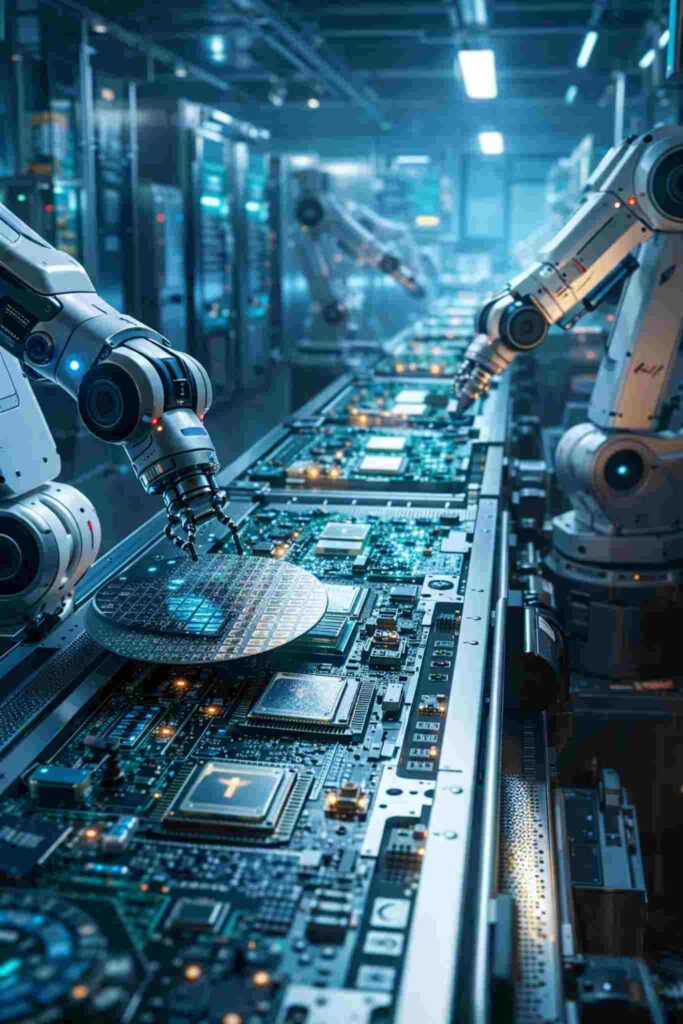

Tesla stock was back in the spotlight Monday after shares climbed 1.62% to $397.55, gaining $6.35 during the session as investors reacted to Elon Musk’s latest push into artificial intelligence infrastructure. The rally comes as Tesla revealed new details about its “Terafab” semiconductor manufacturing initiative, a project designed to produce custom AI chips at scale to power the company’s growing ecosystem of autonomous driving software, robotics, and high-performance computing.
The announcement signals another step in Tesla’s transformation from an electric vehicle manufacturer into what Musk increasingly describes as a vertically integrated AI and technology company. Alongside Terafab, Tesla also revealed a new collaboration called “Macrohard,” sometimes referred to as Digital Optimus, which aims to combine Tesla’s AI agent technology with xAI’s Grok large language model.
Together, the projects highlight Tesla’s ambition to control both the hardware and software layers of the artificial intelligence stack, from chips and supercomputing infrastructure to autonomous software systems.
Tesla stock rises as AI narrative strengthens
The move higher in Tesla shares reflects investor interest in the company’s expanding AI strategy. At $397.55, Tesla stock continues to trade near the upper end of its recent range, even though the shares have experienced volatility over the past month. Over the previous 30 days, Tesla stock declined roughly 6.3%, showing that enthusiasm around AI announcements has not completely offset broader market concerns about valuation and execution risk.
Still, investors appear increasingly willing to view Tesla through the lens of a technology platform rather than a traditional automaker. In recent years the company has invested heavily in projects such as Full Self-Driving software, the Dojo AI training supercomputer, and the Optimus humanoid robot. Terafab now adds a semiconductor manufacturing component to that ecosystem.
Investors tracking Tesla’s daily price movements and financial metrics can follow the stock through platforms such as Yahoo Finance, where analysts continue to debate whether Tesla’s valuation accurately reflects its future AI potential.
What the Terafab chip factory means
Terafab is intended to serve as a large-scale semiconductor manufacturing facility focused on producing custom AI chips. These chips are expected to support Tesla’s autonomous driving systems, AI training infrastructure, and robotics programs. By manufacturing more chips internally, Tesla could reduce reliance on external suppliers and optimize hardware specifically for its software stack.
The strategy follows a broader trend across the technology sector, where companies are increasingly designing custom silicon to power artificial intelligence workloads. Firms such as Apple, Amazon, and Google have already invested heavily in proprietary chips to improve efficiency and reduce dependence on third-party semiconductor manufacturers.
For Tesla, custom chips could accelerate development in several areas:
- Full Self-Driving software training and deployment
- Dojo AI compute infrastructure
- Optimus humanoid robot development
- Real-time AI processing inside vehicles
However, semiconductor manufacturing is one of the most capital-intensive industries in the world. Building and operating chip fabrication facilities requires billions of dollars in investment and years of development. That makes Terafab both a strategic opportunity and a major execution challenge.
Macrohard: Tesla and xAI collaboration
Alongside the Terafab project, Musk revealed details about “Macrohard,” also referred to as Digital Optimus. The initiative is described as a joint effort between Tesla and Musk’s artificial intelligence startup xAI. The project aims to combine Tesla’s AI agent capabilities with xAI’s Grok large language model to create advanced real-time software emulation systems.
In practical terms, Macrohard could enable Tesla to integrate conversational AI and decision-making capabilities across its products, including vehicles, robots, and software platforms. The technology could eventually enhance driver assistance features, robotic automation, and user interaction with Tesla systems.
The announcement also highlights how Musk is increasingly connecting his different ventures into a larger AI ecosystem. Tesla’s hardware capabilities, xAI’s language models, and large-scale computing infrastructure could work together to build new AI-powered products and services.
Industry observers note that Tesla’s strategy increasingly resembles that of major technology companies that control both hardware and software platforms. Coverage from Barron’s suggests the Terafab initiative could become a key catalyst for Tesla stock if the company successfully executes its semiconductor strategy.
Valuation concerns remain
Despite Monday’s gain, Tesla’s valuation continues to spark debate among analysts and investors. According to recent estimates, Tesla’s price-to-earnings ratio stands near 386.9, dramatically higher than the broader automotive industry average of roughly 23.4. That premium reflects expectations that Tesla will eventually generate large profits from AI software, robotics, and energy technologies.
Analyst price targets also show a wide range of opinions about the company’s future. While the average analyst target is around $421.61, estimates range from as low as $125 to as high as $600 per share. The wide spread highlights the uncertainty surrounding Tesla’s long-term growth prospects.
Some valuation models suggest Tesla’s stock could be trading significantly above estimated fair value, emphasizing how much optimism is already embedded in the share price.
Risks investors are watching
While Tesla’s AI expansion offers long-term growth potential, investors are also monitoring several near-term risks.
One concern is declining profitability. Tesla’s profit margins have recently fallen to about 4%, compared with roughly 7.3% in the previous year. Rising competition in the electric vehicle market and ongoing investments in new technologies have pressured earnings.
Another issue is shareholder dilution. Tesla has issued additional shares in recent periods, which can reduce earnings per share and weigh on investor sentiment.
Finally, large-scale initiatives such as Terafab could require significant capital spending. If the project demands sustained funding over many years, it may place additional pressure on Tesla’s financial performance in the short term.
The bigger picture for Tesla
Tesla’s latest announcements reinforce a narrative that has been building for years: the company wants to be seen not just as an electric vehicle maker, but as a vertically integrated AI and robotics platform.
Terafab and Macrohard sit alongside existing Tesla initiatives such as Full Self-Driving, the Dojo AI supercomputer, and the Optimus robot. Together, they represent an ambitious attempt to build a complete technology ecosystem spanning hardware, software, and artificial intelligence.
For investors, the question is whether Tesla can successfully execute these projects while maintaining growth in its core automotive business. Monday’s rise to $397.55 suggests the market is intrigued by Musk’s vision. But as Tesla expands deeper into semiconductors, robotics, and AI software, the stakes—and expectations—continue to grow.

Make Swikblog your go-to source on Google for reliable updates, smart insights, and daily trends.