
Qatar Airways has taken a major operational hit as the escalating Iran war forces the airline to cut flights by nearly 68%, triggering a sharp shift in global aviation dynamics. The airline has reduced its daily operations from around 135 flights to just 43, highlighting the severity of disruption caused by airspace closures and rising security risks in the Middle East.
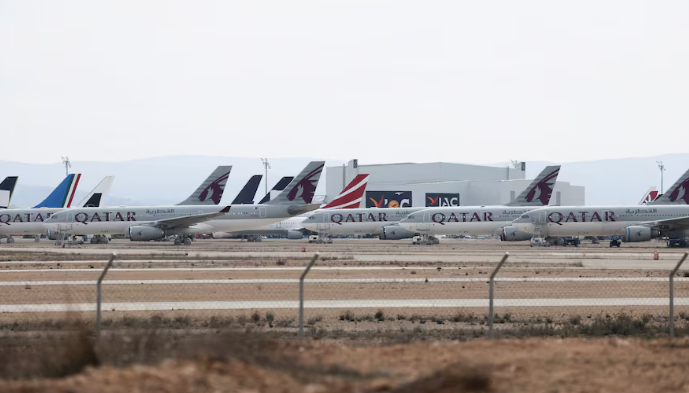
In response, Qatar Airways is now moving several high-capacity aircraft, including Airbus A380s and A350s, into long-term storage in Europe. This sudden fleet adjustment reflects both declining demand and growing concerns over aircraft safety in conflict zones.
Why Qatar Airways Slashed Flights by 68%
The primary reason behind this drastic capacity cut is the widespread closure and restriction of airspace across the Middle East. Ongoing missile and drone activity linked to the Iran conflict has made several routes unsafe, forcing airlines to reroute or suspend flights entirely.
Qatar Airways, which relies heavily on its Doha hub for global connectivity, has been particularly affected. The airline initially resumed operations on March 18 with plans to scale up quickly, but within days, it was forced to reduce flights sharply as demand remained weak and risks continued to rise.
Airlines are now operating under limited safe corridors, significantly reducing the number of flights that can be scheduled. According to official updates on Qatar Airways travel alerts, operations remain constrained and subject to rapid changes based on the evolving security situation.
A380, A350 and 787 Aircraft Moved to Spain
One of the most notable developments is the relocation of widebody aircraft to Teruel Airport in Spain, a facility known for long-term aircraft storage and maintenance. Qatar Airways has already begun transferring multiple aircraft, including Airbus A380s, A350s, A330s, and Boeing 787 Dreamliners.
Among the aircraft moved:
- 1 Airbus A380 relocated from London Heathrow
- Multiple A350-900 jets from Cape Town, Nairobi, and Durban
- 1 Boeing 787-9 from Johannesburg
- 4 Airbus A330 aircraft flown from Doha under non-commercial operations
Additionally, around 17 Qatar Airways aircraft are expected to arrive at Teruel within a short period, contributing to nearly 20 total aircraft scheduled at the airport.
Why Teruel Airport Became a Global Aircraft Parking Hub
Teruel Airport has once again emerged as a critical hub for grounded aircraft. Located about 300 km from Madrid, this former military base offers ideal conditions for aircraft storage.
Key advantages include:
- Dry, salt-free climate that helps preserve aircraft
- No passenger operations, allowing planes to remain parked long-term
- Massive capacity: up to 250 wide-body and 400 narrow-body aircraft
The airport previously stored around 140 aircraft during the COVID-19 pandemic, and it is now seeing a similar surge in demand as airlines scramble to protect their fleets.
According to airport management, operations are currently being planned on a “week-to-week” basis due to uncertainty around how long the conflict will continue.
Global Aviation Disruption Intensifies
The Iran war has triggered widespread disruption across global aviation networks. Airspace closures in multiple countries have forced airlines worldwide to cancel flights, reroute operations, and adjust schedules.
This has resulted in thousands of flight disruptions globally, with major hubs facing delays and reduced connectivity. Airlines are also dealing with rising fuel costs and longer flight paths, adding further pressure on margins.
According to industry estimates reported by Reuters aviation coverage, the conflict is now reshaping airline route planning and fleet utilization across continents.
Safety Risks and Cost Pressures Drive Fleet Decisions
Safety remains the top priority for airlines operating in or near the conflict zone. The risk of missile strikes and drone activity near major airports has made it increasingly dangerous to keep aircraft stationed in the region.
By relocating planes to Europe, airlines like Qatar Airways can safeguard high-value assets while avoiding potential damage.
At the same time, cost considerations are playing a major role. Operating large aircraft such as the Airbus A380 is expensive, especially when passenger demand is weak. Parking these aircraft at busy hubs like Heathrow incurs high fees, making specialized storage facilities a more economical option.
This dual pressure—safety and cost—is forcing airlines to rethink their fleet strategies in real time.
Sharp Drop in Demand Signals Weak Recovery
The rapid drop from 135 to 43 daily flights suggests that travel demand remains unstable despite initial recovery attempts. The decision to ground large aircraft further indicates that airlines do not expect a quick rebound.
Widebody aircraft like the A380 are typically deployed on high-demand long-haul routes. Their removal from active service is a strong signal that airlines are preparing for a prolonged slowdown.
Emirates vs Qatar Airways: Two Different Strategies
While Qatar Airways is taking a cautious approach by cutting capacity and storing aircraft, Emirates is pursuing a more aggressive recovery strategy.
The Dubai-based airline is currently operating over 350 daily flights, significantly higher than Qatar Airways. However, it remains uncertain whether Emirates can sustain this level of operations if the conflict continues.
This contrast highlights the uneven recovery across the aviation industry, with airlines adopting different strategies based on risk tolerance and operational priorities.
Market Impact and Aviation Outlook
The aviation sector is now facing increased volatility as geopolitical risks rise. Reduced capacity directly impacts airline revenues, while higher operational costs put additional pressure on profitability.
Investors are closely monitoring the situation, as prolonged disruption could lead to further cuts across the industry.
For Teruel Airport, the surge in aircraft storage provides short-term business opportunities. However, airport operators emphasize that their core business is maintenance, which depends on aircraft being in active service.
“The more planes fly, the greater activity our airport has,” management noted, underlining the broader impact of reduced aviation activity.
Final Outlook
The future of global aviation now depends heavily on how the Iran conflict unfolds. If tensions ease and airspace restrictions are lifted, airlines could gradually restore operations and reactivate grounded aircraft.
However, if the situation worsens, more airlines may be forced to follow Qatar Airways’ path—cutting flights, parking fleets, and delaying expansion plans.
For now, the sight of A380 and A350 aircraft parked in remote Spanish airports serves as a powerful reminder of how geopolitical events can rapidly reshape the global aviation industry.

Make Swikblog your go-to source on Google for reliable updates, smart insights, and daily trends.