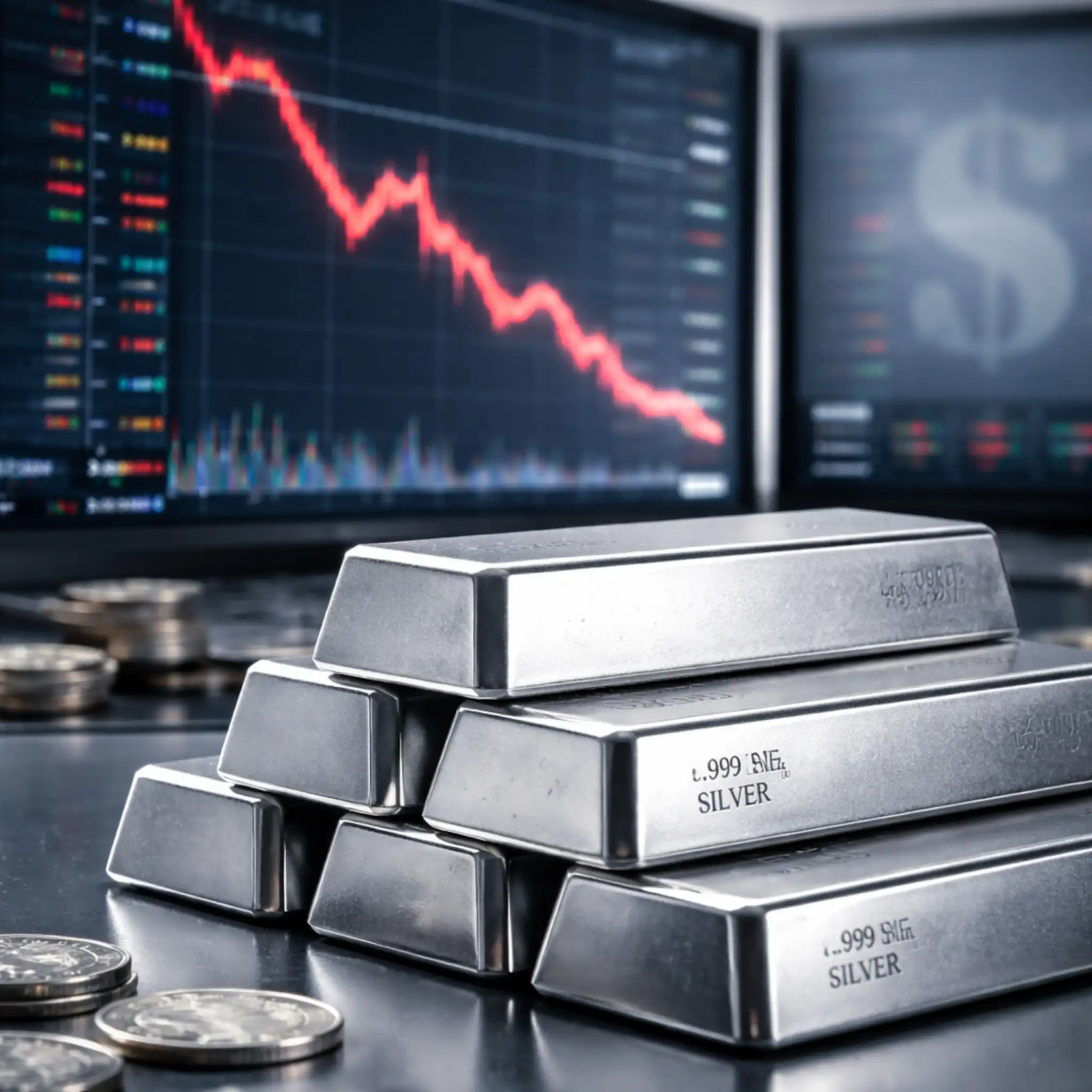
Gold prices moved lower today, extending recent weakness as macro pressures weighed on sentiment across global commodity markets. COMEX gold futures (GC=F) slipped below the $4,560 mark, trading near $4,552 in late session deals, down around 1.1% on the day. Spot gold followed a similar trajectory, hovering close to $4,540 after failing to hold early gains.
The session reflected a clear shift in tone. Gold initially attempted to stabilize above $4,600 but quickly lost momentum as selling picked up, pushing prices toward the $4,520–$4,530 zone. The inability to sustain rebounds signaled fading buying interest, with short-term traders stepping in on every uptick.
Pressure Builds as Dollar Firms and Yields Edge Higher
The decline in gold prices was largely driven by a firmer U.S. dollar and a steady rise in Treasury yields. A stronger dollar typically reduces the appeal of gold for overseas investors, while higher yields increase the opportunity cost of holding non-yielding assets such as bullion.
Markets are also adjusting expectations around U.S. monetary policy. While hopes for rate cuts remain intact, recent economic data has introduced uncertainty around the timing. This has created intermittent volatility in gold, with traders reacting quickly to shifts in interest rate outlook.
According to data from the CME Group, gold futures continue to see strong participation from institutional players, making the metal particularly sensitive to macroeconomic cues such as currency movements and central bank policy signals.
Intraday Structure Points to Short-Term Weakness
From a technical perspective, today’s price action highlighted a bearish intraday structure. Gold formed a series of lower highs after failing to reclaim the $4,600 level, indicating that selling pressure remained dominant throughout the session.
Immediate support is now seen near $4,520. A decisive break below this level could expose further downside toward the $4,480–$4,500 range. On the upside, resistance remains clustered between $4,580 and $4,610, a zone that repeatedly capped recovery attempts during the day.
This type of price behavior is often interpreted as a “distribution phase,” where stronger hands gradually exit positions while weaker rallies fail to gain traction. For now, the short-term bias remains tilted to the downside unless gold can reclaim higher ground.
ETFs and Mining Stocks Mirror Gold’s Decline
The softness in bullion prices was reflected across gold-linked financial instruments. SPDR Gold Shares (NYSEARCA: GLD) traded around $416, down roughly 1%, while iShares Gold Trust (NYSEARCA: IAU) slipped toward $85.40.
Gold mining stocks showed more pronounced declines. Newmont Corporation (NYSE: NEM) fell close to 2% to $107, while Agnico Eagle Mines (NYSE: AEM) dropped over 2% to near $183. These companies tend to react more sharply to movements in gold prices due to their operational leverage and cost structures.
Silver also tracked the broader weakness. COMEX silver futures declined over 2% to trade near $71.50, indicating that the selloff was not limited to gold alone but extended across the precious metals complex.
Global Context and Broader Trend
Despite the current pullback, gold remains significantly elevated compared to levels seen over the past year. Strong central bank buying, geopolitical tensions, and inflation hedging demand have supported prices over the longer term.
Data from the World Gold Council continues to highlight sustained demand from both institutional investors and central banks, which has played a key role in maintaining gold’s broader upward trajectory.
In India, gold prices remain firm near ₹1.50 lakh per 10 grams, supported by currency dynamics and local demand trends. While global weakness can influence domestic prices, factors such as import duties and seasonal buying patterns often provide a cushion.
Key Levels to Watch Going Forward
For traders and investors, the near-term outlook hinges on whether gold can hold above its current support zone. A break below $4,520 could accelerate selling, while a recovery above $4,600 would be needed to signal a shift back toward bullish momentum.
Much will depend on upcoming economic data and signals from the Federal Reserve. Any indication of easing inflation or a clearer path toward rate cuts could revive interest in gold, while continued dollar strength may keep prices under pressure.
For now, the market remains in a wait-and-watch mode, with volatility likely to persist as traders respond to evolving macro cues. Investors tracking gold can follow broader market trends and analysis on Swikblog for regular updates.
You may like: SoFi Stock Plunges After Earnings Q1 2026

Make Swikblog your go-to source on Google for reliable updates, smart insights, and daily trends.