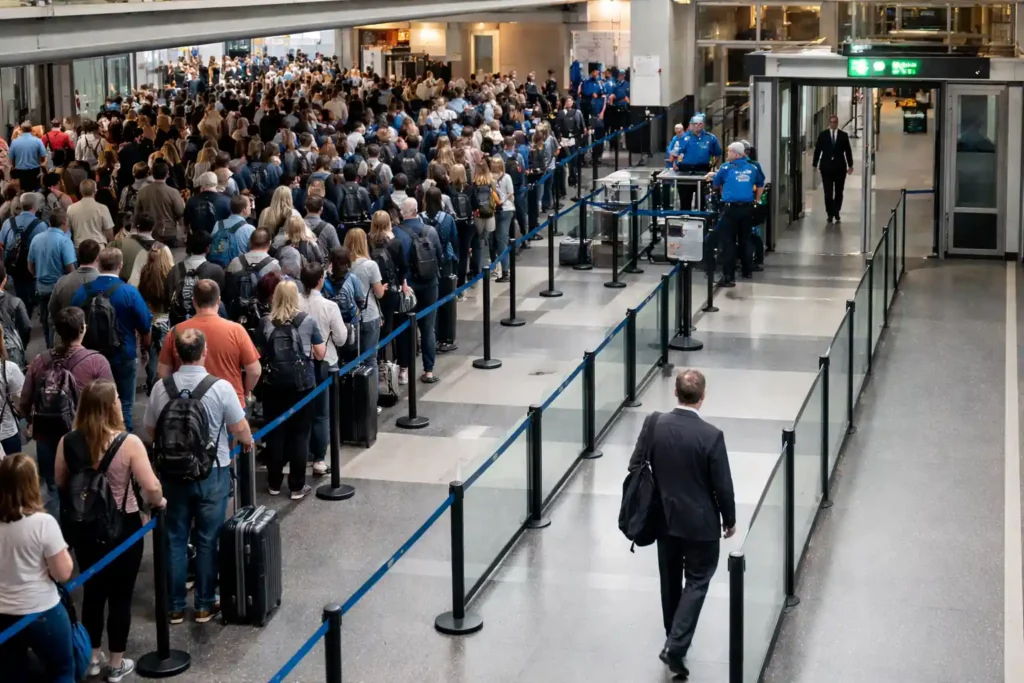

Travelers passing through one of the world’s busiest airports faced significant disruption early Sunday, as security lines at Hartsfield-Jackson Atlanta International Airport stretched beyond two hours, triggering frustration and unusual workarounds among passengers.
By 5:30 a.m., wait times at the airport’s main TSA checkpoint had climbed to a staggering 2 hours and 33 minutes, reflecting a broader wave of congestion affecting major U.S. airports.
The situation in Atlanta mirrors similar scenes reported at LaGuardia in New York and Houston’s William P. Hobby Airport, where travelers have also encountered delays exceeding 2.5 hours during peak travel periods.
Passengers attempt to bypass security lines
With queues growing longer by the hour, some domestic passengers began trying to sidestep delays by heading toward international security checkpoints. Airport officials quickly responded, warning that the tactic was worsening congestion rather than solving it.
“We are seeing increased congestion at the International Terminal Checkpoint caused by domestic travelers attempting to bypass lines in the Domestic Terminal,” airport authorities said in a public advisory.
Officials urged passengers flying within the United States to remain in designated domestic screening areas, noting that the international checkpoint was not a shortcut and, in some cases, had become even slower.
Technology offers limited relief
While long lines persisted, some travelers turned to newer technology to speed up the process. The TSA’s PreCheck Touchless ID system has become one of the most sought-after options, allowing passengers to verify identity through facial recognition rather than physical documents.
The system works by linking a passenger’s airline profile with passport data, enabling quicker movement through designated security lanes. According to the TSA, the program is expected to expand to 65 airports by spring 2026.
Travelers using the feature reported smoother experiences, though availability remains limited and dependent on enrollment.
More details about the program can be found through the official TSA PreCheck system, which outlines eligibility and enrollment requirements.
Pressure builds on TSA workforce
Behind the scenes, the strain on airport security operations is becoming increasingly visible. TSA personnel across the country are dealing with mounting pressure as staffing and funding challenges begin to affect daily operations.
Union representatives have warned that prolonged disruptions could worsen conditions for both workers and passengers. Many agents are reportedly facing financial stress while continuing to manage high passenger volumes and maintain security standards.
The growing backlog has raised broader concerns about airport efficiency and national travel infrastructure, particularly as passenger demand remains strong.
Travelers face uncertain weeks ahead
For passengers, the immediate reality is longer wait times, earlier airport arrivals, and unpredictable security conditions. The situation has also sparked debate about funding priorities and the need for improved staffing across the aviation system.
With peak travel seasons approaching, the scenes in Atlanta offer a clear signal of what could unfold nationwide if delays continue unchecked. For now, travelers are adapting in real time—arriving earlier, exploring alternative checkpoints, and relying on emerging technology to navigate increasingly crowded airports.

Make Swikblog your go-to source on Google for reliable updates, smart insights, and daily trends.