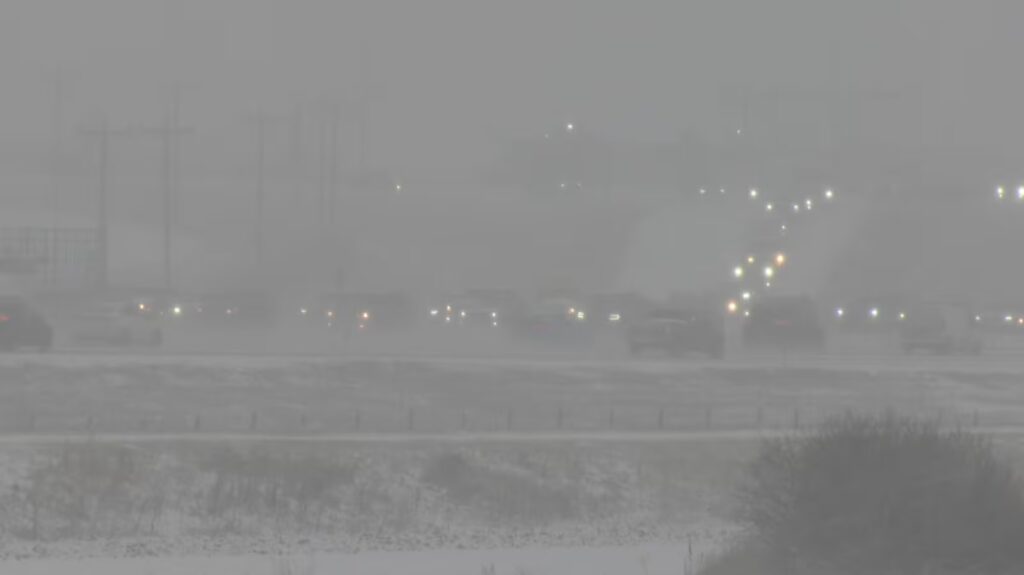

Calgary woke up to a brutal spring weather shock on Wednesday as heavy snow turned major commuter routes into hazard zones, grounded travel plans and left large parts of the city crawling through dangerous conditions. What began as a snowy morning quickly became a citywide disruption story, with 159 collisions reported between midnight and noon, multiple injury crashes, major road closures and flight delays at Calgary International Airport.
The scale of the disruption was enough for authorities to send an unusually direct message to residents: stay off the roads if you can. In a city used to winter driving, the combination of sudden snowfall, poor visibility and slick pavement still managed to overwhelm key routes. The impact was felt fastest and hardest across northern Calgary, where traffic maps showed widespread slow-moving or stop-and-go conditions as emergency crews responded across several locations.
Much of the trouble centred on two of Calgary’s busiest corridors. Police and traffic reports flagged multiple collisions on the north section of Stoney Trail, while the north section of Deerfoot Trail near Country Hills Boulevard N.E. also saw crashes that blocked lanes and triggered closures. For drivers trying to move across the city during the morning rush, the result was a long chain of backups, detours and standstills that stretched far beyond the crash sites themselves.
The numbers underline just how severe the conditions became. Calgary police said that from midnight to noon there were 159 collisions in total, with 27 resulting in injuries. Earlier in the day, police had already warned of multiple crashes across north Calgary and urged motorists not to travel because of the road conditions. The warning reflected what many drivers were already discovering for themselves: roads that looked manageable in one stretch could suddenly turn icy, snow-packed and nearly impossible in the next.
That unpredictability is part of what made the storm so disruptive. A fresh burst of snow arrived after milder weather, creating a messy and uneven surface that made traction difficult. Hills, bridge decks, intersections and higher-speed routes became especially risky. Even outside the biggest highway incidents, city traffic reports showed scattered road closures and a long list of smaller crashes that added to the sense of gridlock.
The disruption did not stop with road traffic. At YYC Calgary International Airport, the snow and reduced visibility also led to multiple flight delays and cancellations. Airport officials said safe operations remained the top priority and noted that winter response plans include clearing runways, taxiways and aprons so aircraft can land, take off and taxi safely. Extra staff were placed on standby, a sign of how seriously the airport was treating the weather event as conditions continued through the day.
For travellers, that meant double uncertainty: the drive to the airport was difficult, and even those who made it there still faced disrupted schedules. Spring storms often catch people off guard because expectations have already shifted toward milder weather, but this one served as a sharp reminder that late-season snow in Alberta can still hit with full winter force.
The weather setup itself added to the concern. According to Environment Canada, Calgary was facing a band of heavy snow that settled over northern parts of the city and moved slowly, dropping snow at a rate of close to 3 centimetres per hour. The forecast called for roughly 10 to 15 centimetres of snow through Wednesday morning, with winds gusting to around 40 km/h later in the day. Snow was expected to continue overnight before easing on Thursday morning.
That forecast helps explain why conditions deteriorated so quickly. Heavy snowfall rates reduce visibility almost instantly, and when gusty winds are added, drivers can lose their sense of lane position and stopping distance in seconds. Officials warned that snow could accumulate rapidly and that visibility might suddenly be reduced, which is exactly the kind of weather pattern that causes chain-reaction crashes on high-volume roads.
There was also a very human side to the storm playing out across Calgary. Images and reports from the city showed drivers stranded, vehicles stuck on slick inclines and crews trying to keep traffic moving while assisting people caught in the worst stretches. In one sense, the storm was a transportation story. In another, it was a reminder of how quickly an ordinary weekday can turn into a citywide emergency when weather, speed and timing collide.
For many residents, the biggest question through the day was not simply whether it was snowing, but whether the city could regain some normal rhythm before the next commute. That answer remained uncertain as long as snow kept falling and temperatures stayed low enough for icy patches to persist. Even after the heaviest snowfall eases, the after-effects of compacted snow, frozen slush and overnight refreezing can continue to make roads treacherous well into the next morning.
What is already clear is that this storm has become one of those memorable Calgary weather days that people talk about long after it passes: a spring morning that looked manageable on the calendar, but delivered winter conditions severe enough to shut down roads, snarl traffic across the city and disrupt flights at the airport. With officials urging caution and more snow still in the system, Calgary’s message on Wednesday was simple and unmistakable: this was not a routine commute day.
You May Also Like

Make Swikblog your go-to source on Google for reliable updates, smart insights, and daily trends.