
By Swikblog News Desk
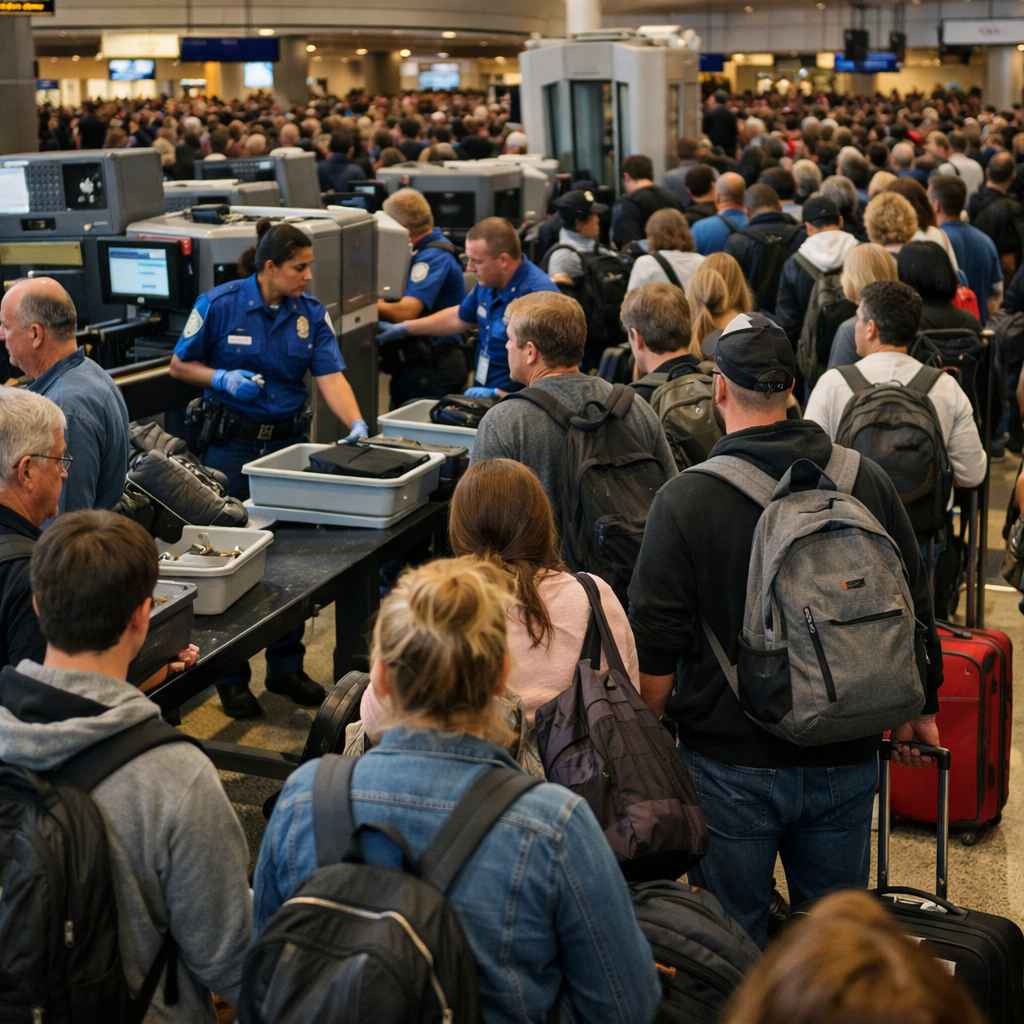
Air travel across the United States is slipping into chaos, and the warning signs are no longer subtle. At major airports, passengers are now facing security lines stretching up to four hours, missed flights are piling up, and airline stocks are reacting to the growing uncertainty. Delta Air Lines (DAL) fell around 3% in the latest session, while JetBlue (JBLU) dropped more than 6%, as investors weighed the financial damage from a system under pressure.
The disruption is being driven by a prolonged government shutdown that has now crossed the 40-day mark, leaving nearly 50,000 Transportation Security Administration (TSA) officers working without pay. As the situation drags on, absenteeism has surged sharply, with some airports reporting that 40% to 55% of staff are not showing up for shifts. The result is fewer open security lanes, longer queues, and a growing breakdown in normal airport operations.
At New York’s JFK Airport, the contrast has become striking. While premium screening lanes such as TSA PreCheck and Clear are still moving relatively quickly, general security lines are stretching well beyond manageable limits. In other terminals, particularly those serving budget carriers like JetBlue, passengers are reporting waits that run into hours, forcing many to arrive at airports far earlier than planned just to avoid missing their flights.
Shutdown-driven staffing crisis hits airports
The core of the problem lies with TSA staffing. With workers missing paychecks for weeks, the financial strain has become severe. Some officers are reportedly dealing with eviction notices, struggling to cover basic expenses, and even taking on second jobs just to stay afloat. The average TSA salary, around $35,000 a year, leaves little room for prolonged financial disruption, and that reality is now directly affecting attendance levels.
More than 480 TSA employees have already quit during the shutdown, further deepening the shortage of trained personnel. This is not a gap that can be filled quickly. Training new officers can take four to six months, meaning even if the shutdown ends soon, the system will continue to feel the effects well into the busy travel season.
The numbers are already alarming. At Houston’s George Bush Intercontinental Airport, wait times reportedly reached four hours, with absentee rates exceeding 40%. At other airports, officials have warned that delays are reaching the highest levels ever recorded, with some checkpoints seeing wait times of more than four and a half hours.
There is also a growing risk that smaller airports could face partial or complete shutdowns if staffing continues to deteriorate. TSA leadership has warned lawmakers that the situation is becoming unsustainable, raising concerns that the disruption could spread even further if no resolution is reached soon.
Airlines sound alarm as financial pressure builds
The airline industry is no longer staying quiet. Executives from major carriers including Delta, American Airlines, United Airlines, Southwest, and JetBlue have issued a joint warning to Washington, urging immediate action to end the shutdown. Their message has been blunt: the current situation is damaging both passengers and the broader economy.
Airlines are already being forced to absorb the operational fallout. Flights are being delayed to accommodate late-arriving passengers stuck in security lines. Rebooking costs are rising, customer service teams are under strain, and schedules are becoming harder to maintain. These disruptions are not just logistical headaches — they translate directly into financial losses that grow with each passing day.
Delta CEO Ed Bastian went further, calling the situation “inexcusable” and expressing outrage that frontline security workers are continuing to operate without pay. For airlines, the crisis is particularly frustrating because it comes at a time when demand is surging and the industry should be preparing for one of its strongest seasons.
The timing could not be worse. Airlines are expecting a record 171 million passengers this spring, with major global events such as the FIFA World Cup 2026 and America’s 250th anniversary celebrations set to drive even higher travel demand in the months ahead. Instead of gearing up for growth, the industry is dealing with a system bottleneck that threatens to slow everything down.
Adding to the pressure is a separate challenge: rising fuel costs linked to geopolitical tensions. Delta alone has flagged a potential $400 million impact from higher fuel prices in March, compounding the financial strain already caused by operational disruption. Together, these factors are creating a difficult environment for airline stocks, which are highly sensitive to both cost increases and demand uncertainty.
Political deadlock leaves no clear timeline
Efforts to resolve the shutdown have so far failed to produce a clear outcome. While there have been attempts at bipartisan agreements in Washington, proposals have stalled between the Senate and the House, leaving funding for the Department of Homeland Security in limbo. Lawmakers are not expected to revisit the issue until at least the next working session, prolonging uncertainty for both workers and travelers.
There have also been discussions about emergency measures, including the possibility of executive action to ensure TSA workers are paid. However, the legal path for such a move remains unclear, and no immediate solution has been implemented.
For travelers, this uncertainty is becoming the biggest concern. Planning a trip now requires more than just checking flight times — it involves factoring in unpredictable security delays, potential rebooking issues, and the risk of missing connections altogether.
Passengers are already adapting by arriving hours earlier than usual, but even that may not guarantee a smooth journey. The longer the shutdown continues, the more strain it places on an already stretched system, increasing the likelihood that disruptions will persist into peak travel months.
Those preparing to fly are being advised to stay updated through official resources such as the TSA website, but real-time conditions at airports remain highly variable. For now, flexibility and extra time have become essential parts of any travel plan.
For the airline industry and investors watching stocks like DAL and JBLU, the message is becoming clearer. This is no longer just a temporary inconvenience. It is evolving into a broader operational and financial challenge, one that could shape travel demand, airline performance, and passenger confidence well into 2026.

Make Swikblog your go-to source on Google for reliable updates, smart insights, and daily trends.