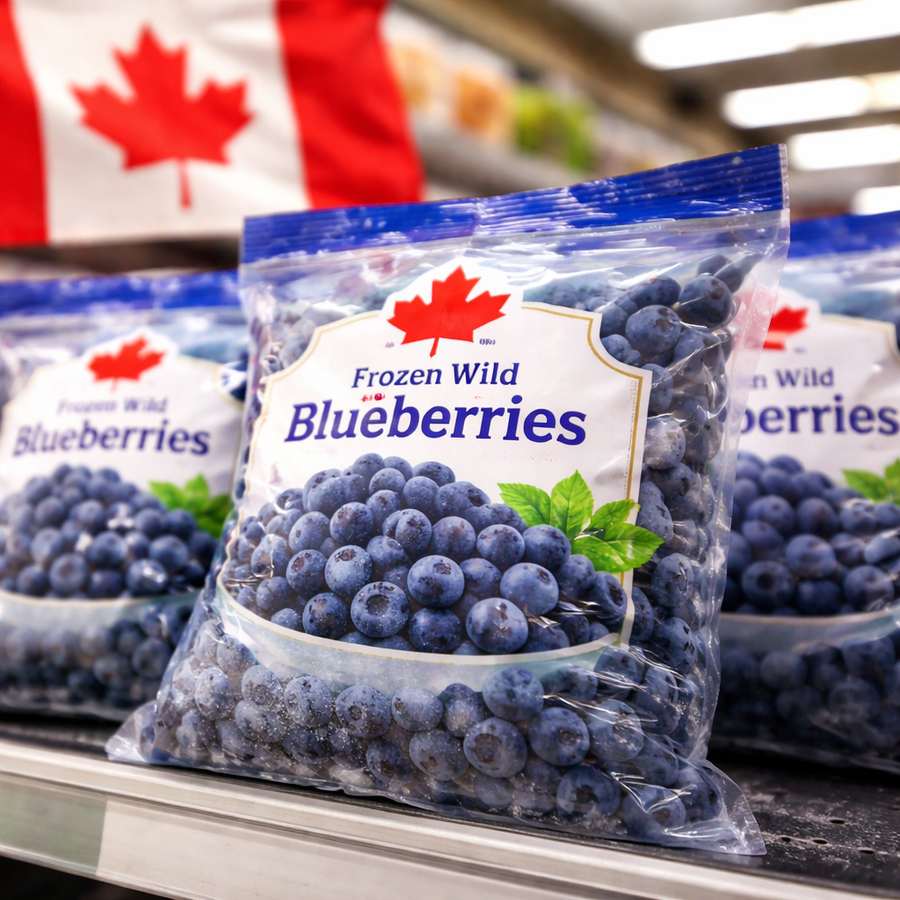

Oxford Frozen Foods, a Nova Scotia-based company known globally for its wild blueberries, has been fined $10,000 after Canadian regulators found issues with how some of its products were labelled. The company was cited for using “misleading or inaccurate” country-of-origin claims, raising fresh concerns at a time when more Canadians are actively trying to buy local.
The penalty was issued by the Canadian Food Inspection Agency (CFIA), which said Oxford Frozen Foods is one of five companies fined since April 2025. Altogether, those businesses faced $47,000 in penalties for similar labelling violations involving a range of food products.
For many shoppers, the story lands close to home. Over the past year, grocery habits across Canada have shifted, with more people deliberately choosing products labelled as Canadian. That shift has been driven in part by rising economic tensions with the United States, including tariff threats that pushed “Buy Canadian” from a slogan into a serious consumer trend.
What exactly went wrong
According to the CFIA, Oxford Frozen Foods used labelling or advertising that did not accurately reflect the true origin of its blueberries. While the agency did not disclose the exact details of the violation, it confirmed the fine was issued in September 2025 following inspections and complaint-based investigations.
The regulator emphasized that it checks origin claims not just on packaging, but also across advertisements and in-store signage. The goal, it said, is to ensure consumers can rely on labels when making purchasing decisions.
“Canadians have been clear that they want to support Canadian businesses and buy Canadian products,” the agency said in its statement, adding that shoppers deserve labels they can trust.
Oxford Frozen Foods did not respond to requests for comment, leaving unanswered questions about how the mislabelling occurred or whether corrective steps have been taken.
A major player under scrutiny
The case stands out because of the company involved. Oxford Frozen Foods describes itself as the world’s largest supplier of wild blueberries, with deep roots in Atlantic Canada. Its operations span multiple locations, including processing facilities in Oxford, Nova Scotia, and additional sites in Halfway River, Nova Scotia, and Bois-Gagnon, New Brunswick.
At the same time, the company also has storage and manufacturing operations in Maine, United States, highlighting the cross-border nature of its supply chain.
In Oxford, N.S., the company processes not only blueberries but also carrots and battered appetizers. It is also a major economic contributor, accounting for roughly one-third of the town’s tax revenues. That local importance makes the labelling issue even more sensitive, particularly in a region where agriculture and food production are closely tied to community identity.
Not an isolated case
Oxford Frozen Foods is part of a broader enforcement push. The CFIA said four other businesses were also fined for misleading origin claims. These included a Loblaw-owned grocery store in Etobicoke, an unidentified Real Canadian Superstore location, a Calgary-based business and an Edmonton food supplier.
The products involved in those cases ranged widely, from banana bread and ghee to broccoli slaw and cheese, suggesting that labelling confusion is not limited to one category.
Regulators say they are taking the issue more seriously as consumer awareness grows. “The CFIA takes labelling issues seriously and is directly addressing the growing concern… over inaccurate and misleading origin claims,” the agency said.
Why labels are under the spotlight
The controversy comes at a time when the meaning of “Canadian” on food packaging is being questioned more closely than ever. Experts say the language used on labels often leaves room for interpretation, making it difficult for shoppers to know exactly how Canadian a product really is.
Terms like “Product of Canada” and “Made in Canada” can have different definitions, and in some cases, products may be processed domestically using imported ingredients. For consumers who are trying to support local farmers or businesses, those distinctions matter.
The issue has even sparked discussions about so-called “maple-washing,” where branding leans heavily on Canadian imagery or identity without fully reflecting the product’s origin.
To address the confusion, the CFIA provides an online guide to help shoppers better understand food origin claims and what different labels actually mean.
Buy-local momentum adds pressure
The timing of the fine is significant. In early 2025, amid tariff threats from U.S. President Donald Trump, governments and consumers across Canada began pushing harder to prioritize domestic goods. Nova Scotia, for example, introduced a $300,000 pilot program aimed at making it easier for shoppers to identify local products in stores.
That growing emphasis on buying Canadian has increased pressure on companies to ensure their labels are accurate and transparent. Any mismatch between what a label suggests and what a product actually is can quickly erode consumer trust.
For a company like Oxford Frozen Foods, which is closely associated with Canadian agriculture, that trust is especially valuable.
The $10,000 fine may be relatively modest for a business of its size, but the broader impact could be reputational. As more Canadians pay attention to where their food comes from, even small discrepancies can trigger bigger questions about transparency across the industry.
For shoppers, the takeaway is clear: labels deserve a closer look. And for companies, the message from regulators is just as direct — in a market shaped by trust and local loyalty, getting the details right is no longer optional.

Make Swikblog your go-to source on Google for reliable updates, smart insights, and daily trends.