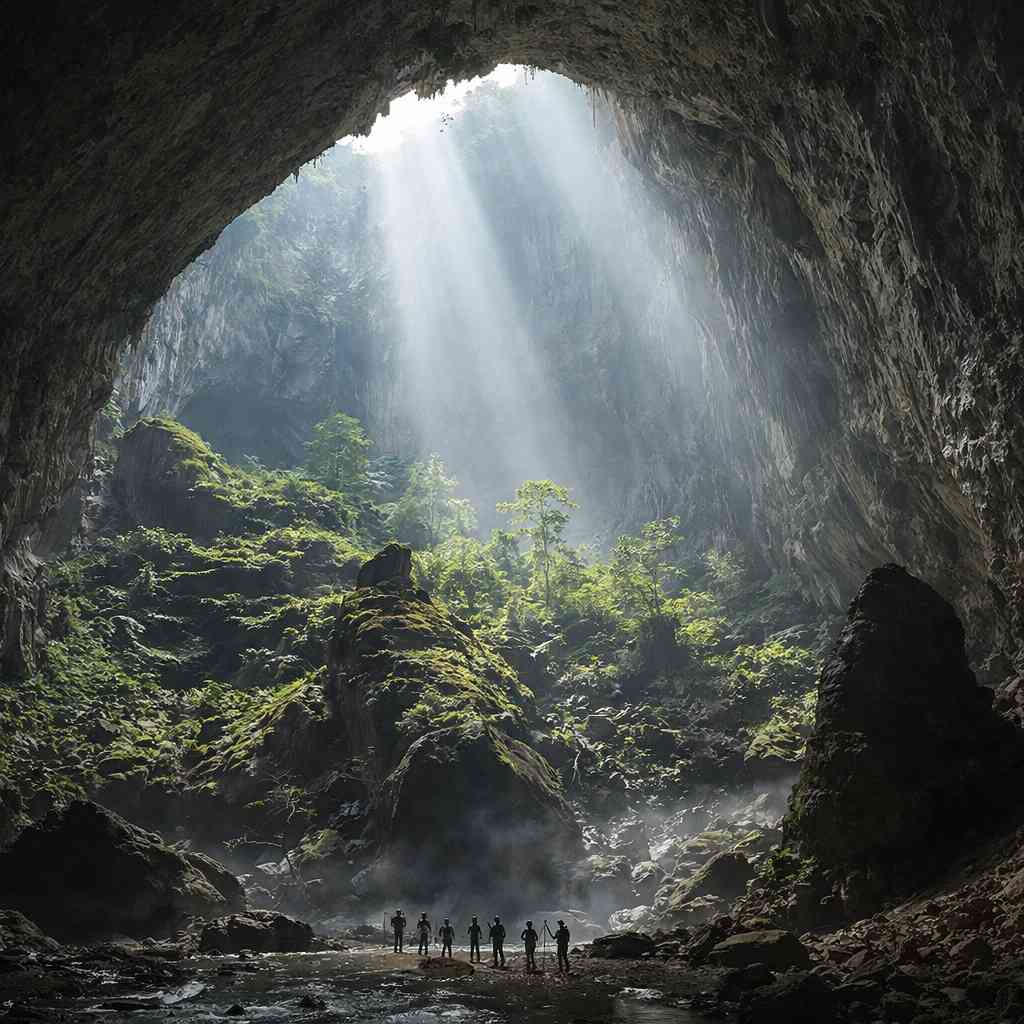

Hidden beneath the limestone mountains of central Vietnam, Son Doong Cave continues to capture global attention as the world’s largest known cave passage by volume. Located inside Phong Nha–Ke Bang National Park, the immense underground system has become one of Asia’s most remarkable natural attractions, drawing interest from scientists, explorers and adventure travellers while remaining carefully protected through strict visitor limits.
Although Son Doong was first discovered by local forest ranger Ho Khanh in 1990, the cave remained largely unexplored until 2009, when members of the British-Vietnam Cave Expedition Team led by Howard Limbert surveyed its enormous chambers. Their work revealed a cave unlike any previously documented, changing the way experts understood the scale of underground landscapes.
How Son Doong became one of Earth’s greatest geological discoveries
Ho Khanh accidentally found the cave entrance while taking shelter from heavy rain in the jungle near the Laos border. Strong winds and the sound of rushing water flowing from the opening suggested something extraordinary lay beneath the forest floor, but thick vegetation prevented him from finding it again for nearly two decades.
After relocating the entrance in 2008, international cave specialists carried out a full exploration the following year. Their measurements confirmed Son Doong contained the world’s largest documented cave passage in terms of diameter and continuity, a distinction later recognized internationally. The cave is located within UNESCO-listed Phong Nha–Ke Bang National Park, which is internationally recognized for its exceptional limestone karst landscape and biodiversity.
A cave so large it has its own landscape
Stretching for around 9 kilometres (5.6 miles), Son Doong reaches heights of more than 200 metres in some sections. Its largest chambers are so expansive that they have often been compared with aircraft hangars, leading to the widely cited comparison that a Boeing 747 could theoretically fit through parts of the cave.
The cave formed between two and five million years ago as underground river water slowly dissolved thick limestone, carving out an immense network of tunnels and chambers. The process continues today as flowing water gradually reshapes the cave’s interior.
Natural ceiling collapses, known as dolines, allow sunlight to reach the cave floor. Over thousands of years, these openings have created thriving underground forests filled with trees, moss, vines and unique plant life rarely associated with caves.
Temperature differences between the jungle and the cave interior can also produce mist and low clouds, creating localized weather conditions that add to Son Doong’s unusual environment. Travellers planning wider international adventures may also want to keep track of the latest Europe travel updates and border changes before arranging overseas itineraries.
Why visiting Son Doong remains a rare opportunity
Despite growing international recognition, Son Doong is not open to mass tourism. Access is tightly managed to reduce environmental impact, with only about 1,000 expedition participants permitted each year under conservation rules.
Visitors must join licensed multi-day expeditions led by trained guides and safety teams. The journey involves trekking through dense rainforest, river crossings, steep descents, underground camps and climbing the famous “Great Wall of Vietnam,” a towering calcite formation near the cave’s exit.
There is no mobile phone coverage inside the cave, and every expedition follows strict environmental guidelines. Waste is removed from the site, camps are temporary, and routes are carefully managed to minimize disturbance to the fragile ecosystem.
Growing international interest while conservation stays the priority
Demand for Son Doong expeditions continues to rise. Tour operators report that available places are booked well in advance, with travellers arriving from dozens of countries to experience one of the world’s most exclusive adventure destinations. As international tourism rules continue to evolve, many visitors are also preparing for upcoming ETIAS travel authorisation requirements for Europe when planning multi-country trips.
The controlled tourism model has also benefited nearby communities. Local residents work as guides, porters, cooks and logistics staff, creating sustainable employment while helping preserve one of Vietnam’s most valuable natural landmarks.
Scientists believe Son Doong will continue evolving naturally for millions of years as erosion, underground rivers and gradual rock collapse reshape its enormous chambers. For now, it remains one of the planet’s most extraordinary geological discoveries—a place where forests grow beneath mountains, rivers disappear into darkness, and nature continues to reveal just how vast the underground world can be.
Read More:
- Primark opening two new US stores in July 2026
- HomeGoods opening two new stores in July 2026
- Visit the Swikblog homepage for more latest news

Make Swikblog your go-to source on Google for reliable updates, smart insights, and daily trends.