
Sydney’s housing shortage has sparked a new planning dispute, with Randwick City Council moving to curb the rapid expansion of purpose-built student accommodation across one of the city’s busiest university precincts. The proposal follows figures showing that more than 5,200 student accommodation rooms have been approved along the Anzac Parade corridor between Kensington and Kingsford over the past six years, while fewer than 500 conventional homes received approval during the same period.
The imbalance has prompted the council to argue that planning incentives are encouraging developers to prioritise commercial student housing over homes for permanent residents. The issue has now become part of a broader debate about how Sydney should use limited land as demand for housing continues to outpace supply.
Randwick Council seeks planning changes
At its first council meeting of the year, Randwick City Council unanimously endorsed an in-principle proposal supporting a moratorium on new for-profit student accommodation developments within the local government area. The council also resolved to write to NSW Planning Minister Paul Scully requesting changes to state planning rules.
Mayor Dylan Parker said the current planning framework has produced an outcome that is increasingly difficult to defend, with large numbers of student housing projects replacing opportunities for traditional residential developments.
The council argues that existing planning policies provide significant incentives for purpose-built student accommodation, including additional floor space allowances, reduced parking requirements and exemptions from some apartment design standards. According to local representatives, these concessions have made student housing a more attractive option for developers than building apartments aimed at Sydney’s broader housing market.
While the council has outlined its position, the NSW Government has indicated it is not currently considering broad exemptions that would allow individual councils to block these developments, meaning any policy changes would require further discussions between local and state authorities.
Why the Kensington–Kingsford precinct has changed so quickly
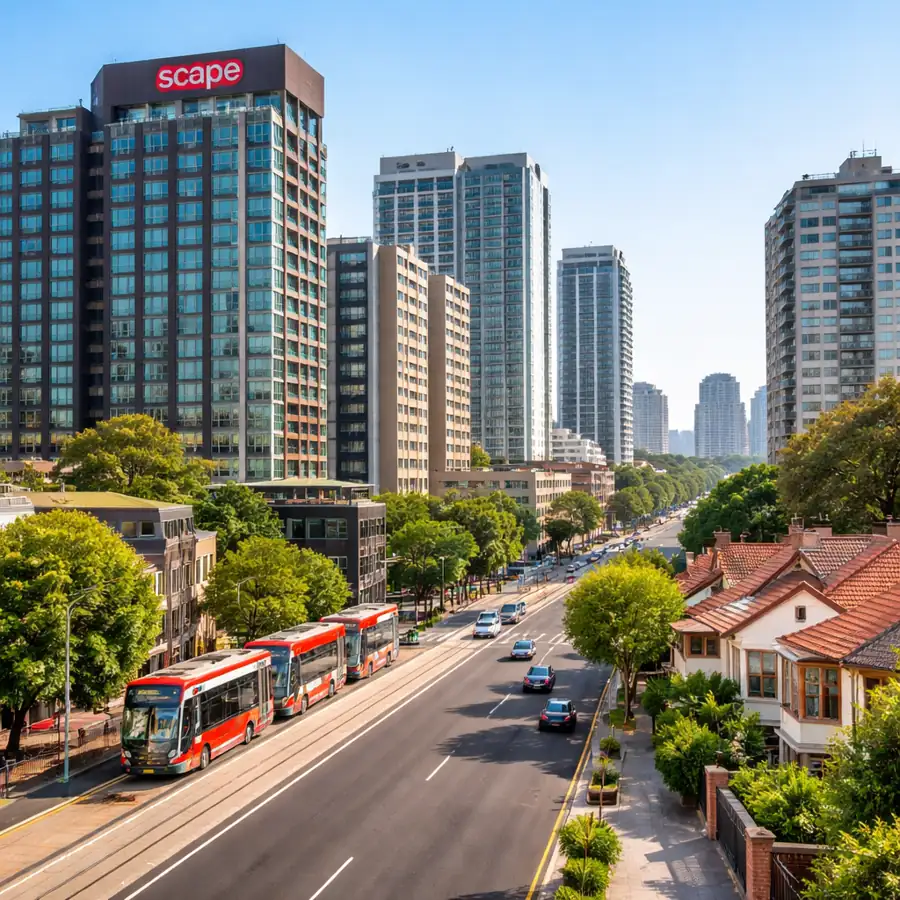
The area surrounding Anzac Parade has become one of Australia’s largest student accommodation hubs because it sits next to the University of New South Wales (UNSW), one of the country’s biggest universities with around 70,000 students. Direct light rail services, frequent buses and easy access to Sydney’s CBD have made the precinct especially attractive for student housing providers.
Major operators including Scape have opened multiple buildings in recent years, with additional projects either under construction or recently completed. The concentration of these developments has transformed sections of Kensington and Kingsford into neighbourhoods dominated by university accommodation.
The trend has occurred while Sydney continues to experience historically low rental vacancy rates and ongoing pressure to increase housing supply. Recent Australian Bureau of Statistics data also shows residential building approvals remain below levels many housing experts believe are needed to meet future demand.
Industry says purpose-built accommodation eases rental pressure
Student accommodation providers disagree with the council’s proposal, arguing that purpose-built housing helps reduce competition in Sydney’s already strained private rental market.
Scape Chief Executive Officer Anouk Darling has said dedicated student accommodation gives university students an alternative to renting standard apartments and houses that would otherwise be shared with families, workers and other residents.
Housing advocacy organisation Sydney YIMBY has also criticised the proposed restrictions, saying international education is one of Australia’s most valuable export industries and requires appropriate housing infrastructure to support future student demand.
Supporters of continued development argue that limiting student accommodation may simply shift thousands of students into the traditional rental market, increasing competition for existing homes rather than creating additional housing supply. The debate comes as other local government decisions affecting Australian communities continue to draw public attention.
Students describe an increasingly competitive market
Many students studying at UNSW say securing accommodation close to campus has already become one of the biggest challenges of university life in Sydney.
Student Lars Nolles said rental inspections often attract large numbers of applicants, making it difficult to secure housing within the Randwick area. After an extended search, he ultimately found accommodation further from the university.
Another student, Sylvia Wang, said purpose-built student accommodation provides advantages that traditional rentals often cannot. International students, in particular, can frequently reserve accommodation before arriving in Australia, reducing uncertainty during relocation. Many developments also include communal facilities designed to help students settle into a new city.
The issue extends beyond students. Hospital employees, university staff, essential workers and long-term residents all compete for housing across Sydney’s eastern suburbs, adding further pressure to an already limited rental market.
A wider debate over Sydney’s housing priorities
The disagreement reflects a larger planning challenge facing Sydney as governments attempt to increase housing supply while balancing different community needs.
Supporters of the council’s proposal argue that planning incentives should encourage more permanent housing for local communities. Opponents believe removing incentives for student accommodation could unintentionally worsen rental affordability by forcing more students into the general housing market.
What happens in Randwick could influence planning discussions in other university precincts across Australia where population growth, housing shortages and higher education expansion are placing increasing pressure on available land. Similar debates are emerging around wider policy decisions shaping Australian communities as governments weigh long-term public interests.
As governments continue reviewing planning policies and housing targets, the debate is likely to remain focused on one central question: should scarce development opportunities prioritise permanent residential housing, or should dedicated student accommodation continue to play a major role in supporting Australia’s university sector?
Read More:
- Baw Baw parking fine refunds: What affected drivers need to know
- Some restaurants remove fresh produce from menus amid Cyclospora outbreak
- Visit the Swikblog homepage for more latest news
Additional information on housing approvals and construction trends is available from the Australian Bureau of Statistics, while ongoing reporting on the planning debate can be found through ABC News.

Make Swikblog your go-to source on Google for reliable updates, smart insights, and daily trends.