
NASA’s Artemis II mission has entered its final hours before liftoff, with officials confirming an 80% chance of favorable weather. The mission, set to send astronauts around the Moon for the first time since the Apollo era, is now deep into countdown operations at Kennedy Space Center.
But even as excitement builds, engineers and mission teams remain cautious. From fueling complexities to weather rules and technical risks, Artemis II is a high-stakes test of NASA’s next-generation Moon program.
Final countdown: Fueling and system checks underway
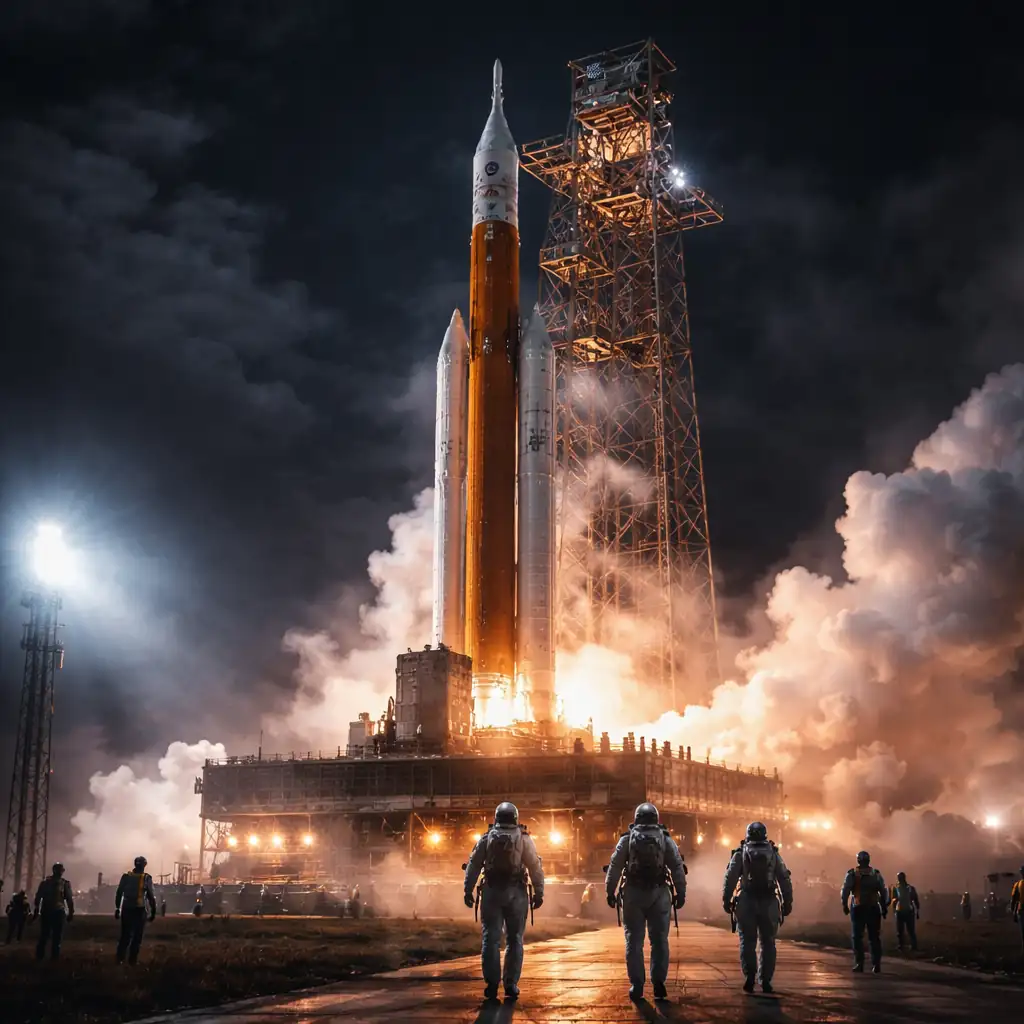
The Artemis II launch countdown has moved into its most critical phase — fueling the Space Launch System (SLS) rocket with super-cold propellants. Teams began with chilldown procedures early in the morning, cooling transfer lines to handle liquid hydrogen (LH2) and liquid oxygen (LOX) safely.
Slow fill operations were followed by fast fill, where massive quantities of cryogenic fuel were loaded into both the core stage and the upper stage. Engineers then transitioned to topping and replenish modes — a delicate process that ensures fuel levels remain stable as natural boil-off occurs.
These steps are not routine. Handling LH2 and LOX requires extreme precision, as even small temperature variations or leaks can halt the launch.
NASA teams have also completed vent and relief tests to confirm proper pressure regulation inside the rocket’s tanks. With all stages now in replenish mode, the vehicle is being kept at flight-ready conditions ahead of the final minutes of the countdown.
Weather 80% “go” — but not risk-free
Weather conditions currently stand at 80% favorable, but officials are closely watching several key constraints. The primary concerns include the cumulus cloud rule, flight through precipitation, and ground wind limits.
Even minor violations of these rules can delay launch. Lightning risk and sea conditions for potential splashdown recovery are also being monitored.
Before fueling began, astronauts received a final weather briefing covering all possible abort scenarios and recovery zones. These briefings ensure that both crew and ground teams are aligned on safety protocols.
Despite the positive outlook, weather remains one of the most unpredictable factors in any launch attempt.
Mission details: 10-day journey around the Moon
Artemis II will carry four astronauts — Reid Wiseman, Victor Glover, Christina Koch, and Canadian astronaut Jeremy Hansen — on a roughly 10-day mission around the Moon and back to Earth.
The flight will test the Orion spacecraft’s systems in deep space, including navigation, communication, and life-support capabilities. Unlike future missions, Artemis II will not land on the Moon but will perform a lunar flyby before returning for splashdown.
The mission is a crucial step in NASA’s broader Artemis program, which aims to establish a long-term human presence on the Moon.
For more official mission updates, visit NASA’s Artemis program page.
Safety concerns remain despite progress
While NASA has cleared the mission for launch, several safety concerns continue to draw attention.
The Orion spacecraft’s heat shield remains one of the most closely watched components. During the Artemis I test flight, engineers observed unexpected wear during re-entry. NASA has since conducted detailed analysis and adjustments, but Artemis II will be the first real test with astronauts onboard.
Fueling systems are another area of concern. Previous launch attempts were delayed due to hydrogen leaks — a known challenge when dealing with super-cold fuel. Although improvements have been made, engineers are maintaining strict monitoring throughout the countdown.
Beyond technical systems, the mission itself introduces risks associated with deep space travel. Once Orion leaves Earth’s protective magnetic field, astronauts will be exposed to higher levels of cosmic radiation. While the mission duration is relatively short, solar activity remains an unpredictable factor.
Life-support systems, too, are being tested in real conditions for the first time with a crew onboard. Oxygen supply, temperature control, and cabin pressure must perform flawlessly throughout the journey.
A historic moment with calculated risk
NASA officials emphasize that every stage of the mission has been carefully reviewed, with built-in holds during the countdown allowing teams to verify system health and resolve any issues.
Earlier in the countdown, engineers performed critical steps such as cavity inerting — replacing air inside the rocket with gaseous nitrogen to reduce fire risk — and multiple system checks to ensure vehicle integrity.
These precautions highlight the level of control and planning behind the mission, even as inherent risks remain.
Artemis II is not just another launch. It represents a return to human deep space exploration, laying the groundwork for future missions that aim to land astronauts on the Moon and eventually reach Mars.
As the countdown continues, the balance between excitement and caution defines this moment. With an 80% chance of favorable conditions and all systems nearing readiness, NASA stands at the edge of a mission that could shape the future of space exploration.

Make Swikblog your go-to source on Google for reliable updates, smart insights, and daily trends.