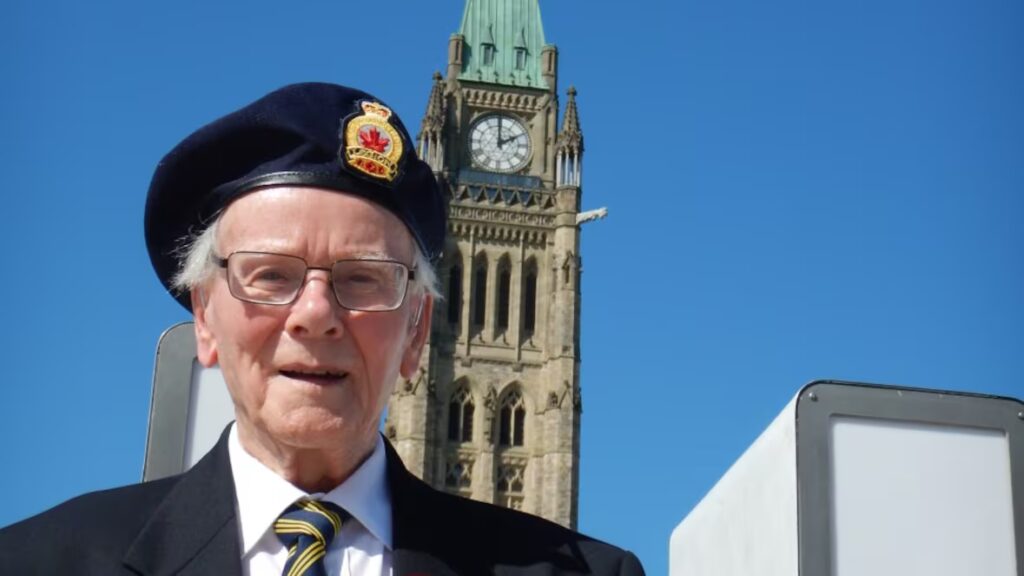

Canada’s oldest known living citizen and one of the world’s oldest surviving Second World War veterans, Burdett “Burd” Sisler, has died at the age of 110, his family confirmed on Saturday, drawing national attention to the passing of a man whose life spanned more than a century of history.
Sisler died of natural causes on Thursday in Fort Erie, Ontario, less than two weeks before his 111th birthday on April 13. His death marks the loss of one of Canada’s last living links to the Second World War era, at a time when that generation is rapidly fading from public life.
“It’s certainly bittersweet. We were blessed to have him for so long,” his son, Norm Sisler, said, describing the deep impact his father had on family, community and fellow veterans. Known locally through the Royal Canadian Legion and beyond, Sisler was widely regarded as a steady, thoughtful presence who remained engaged well into his later years.
Born in Akron, Ohio, in 1915, Sisler moved with his family to Ontario in 1918. His life unfolded across an extraordinary timeline — from the aftermath of the First World War to the digital age — giving him a rare perspective on how dramatically society had evolved.
He married just days after Britain declared war on Germany in 1939 and soon enlisted in the Canadian military. Sisler trained in Nova Scotia during the Second World War, though he never served overseas. His family has often reflected that this circumstance likely shaped the generations that followed.
A life shaped by war, work and community
After the war, Sisler continued working with the military before beginning a long career as a customs agent and appraiser at the Peace Bridge port of entry in Fort Erie, one of Canada’s busiest border crossings with the United States. He served in that role for decades before retiring more than 45 years ago.
Even in retirement, Sisler remained closely connected to his community. His longevity was not defined by isolation but by continued activity and involvement. He drove until he was 100 years old and lived independently in his own home until around age 107, with family support helping him navigate the COVID-19 pandemic.
He stayed mentally and socially active, following current events closely, calling bingo, and maintaining strong ties with family and local organizations. In 2025, the Canada Border Services Agency publicly recognized his service, sending birthday greetings to their former colleague.
By the time he turned 110, Sisler’s family had grown to include five children, 11 grandchildren, 22 great-grandchildren and 14 great-great-grandchildren — a living legacy that reflected not only longevity but continuity across generations. His wife, Mae, died in 1985.
Sisler often spoke candidly about the changes he witnessed over more than a century. In one of his later reflections, he remarked that the world had “changed beyond recognition,” expressing concern about shifting values and a growing sense that people were becoming less considerate of one another.
His observations carried weight precisely because they came from lived experience rather than abstraction. Having witnessed both world wars, economic upheaval and technological transformation, Sisler’s perspective offered a rare long view of societal change.
Simple habits, lasting impact
Despite reaching 110, Sisler did not attribute his longevity to any extraordinary formula. Instead, he emphasized consistency and moderation. His advice was straightforward: don’t smoke, don’t drink, and stay active. He famously continued bowling well into his later years, remaining physically engaged even past the age of 100.
But his most enduring message was less about physical health and more about how people treat one another. “Everything everyone does matters,” he said, often encouraging others to follow a simple principle — treat people the way you would want to be treated.
That outlook, shaped by decades of personal and historical experience, resonated widely in recent years as his story gained national attention. In an era marked by rapid change and growing social divisions, Sisler’s emphasis on respect and responsibility struck a chord beyond his immediate community.
His death also highlights a broader shift taking place in Canada and across the world. The generation that experienced the Second World War firsthand is nearing its end, transforming how history is remembered and understood. As fewer veterans remain to share their stories directly, their experiences are increasingly preserved through archives, institutions and family histories.
Sisler’s life bridged that transition. He was not only a witness to history but also a participant in it, contributing through military service, public work and everyday community life. His story reflects a form of quiet service that often defines a generation more than headline-making events.
A funeral service for Sisler is scheduled for April 9 at Benner Funeral Home in Fort Erie, where family, friends and community members are expected to gather to remember a man whose life extended across three centuries of lived experience.
In the end, Sisler’s legacy may lie not only in the number of years he lived, but in how he lived them — steadily, actively and with a consistent belief that individual actions, however small, shape the world around us.

Make Swikblog your go-to source on Google for reliable updates, smart insights, and daily trends.